Psychology = the study of mental activity & behavior (mind ,
brain
,
behavior)
Critical thinking is a hallmark of a
good scientist ( openness & wariness )
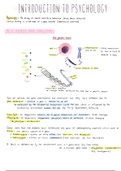
HC1:GENESANDEV0LUT
thegeneticbasis
( ell -
Chromosome
✓
=
Carry instructions
( one of 4G )
on how to build &
nucleus
/ operate a
body
bases ( coiled strands of DNA
BA
-
double
helix
gene .
-
=
meaningful sequence
of nitrogen bases provide the
-
⑧ code for a specific protein
Each cell contains the same chromosomes and information but they look different due to :
gene expression = whether a
gene is turned on or off
La controlled by the biochemical environment inside the cell which is influenced by the
biochemical environment outside the cell leg timing development
.
,
behavior)
Genotype = an organisms specific set of
genes determined at conception ,
never changes
phenotype = an organisms observable (physical ) traits & behavior
,
always changing
LB
genotype t environment
Genes come from OUR parents, each contributes one
gene of
corresponding positions which pair up .
Allele one specific variant of a
gene
=
•
Heterozygote = alleles on locus differ (one dominant
,
one Recessive )
•
Homozygote = alleles on locus correspont ( two dominant or two recessive )
A trait is determined by the environment and -07
gene pair leg .
hair color )
OR → multiple gene pairs
=
poly genetic characteristic
(e.g .
intelligence )
,Heredity =
parents pass on
genes to
offspring
Heritability = a statistical estimate of the extent to which variation in a trait within a
population can be explained by genetics →
genetic variance :
phenotype variance
euowtionbynatuRan
Darwin
zconditionsfornatur-aseectiono.IT says there
, origins of species ( 1859 ) are
Variation among individuals within a
population
2) Individuals with an advantageous trait should be more likely
to survive / procreate
3) This trait should be passed on to the offspring
Survival of the
genes > survival of the individual ( e.g .
broken wing bird ,
nest & predator)
The
genome is shaped by evolution
EUidencefortheeuolutionfytheory.ae
fossil
the Record
the resemblance of between (similar
genomes
•
organisms ancestors)
that don't ( e.g
pseudogenes inactive produce uit production gene)
•
=
genes proteins .
a
•
distribution of species around the world (e.g .
Hawaii )
→ evolution doesn't necessarily improve beings
-0 evolution doesn't lead to
rigid behavioral patterns ( adaptation Alex ibility despite genes)
geriesebehauior
Behavioral genetics = the
study of the interaction between
genes & environment
it 's
and influence On
psychological activity .
→ uses twin and adoption studies
Epigenetics = the
study of how environment affects
genetic expression (e.g living
.
under stress )
, HC20.tt/EBRa1NANDTHE#RV0USSYSTEM
these two WOR
→ to cont
together
movement
I
"m
:L:c.ua?inttE..abeaesica+una:tssm.:tint:e.m::::oussssi-
La communicate selectively with other neurons to
em
form
and
neural
are exit ane
networks
. IHB
•
neural networks develop through : maturation
,
experience & Repeated firing
S A 1
/
A neuron has a semi -
permeable Types of neuron : -
sensory receptors
E
membrane sensitive to stimulation afferent
sensory neurons
III.III.9mF
-
.
=
'
• can
selectively allow
I or
m
.
neurons
ions in and out
SALEM
¥iaainformation from other
'
neurons
EeEtnex.o.a Serves the rapid conduction
: ÷÷÷÷÷÷÷÷i ÷÷÷:÷:÷÷
"" ""
:÷÷i÷÷÷÷
in
On the membrane are
-
m÷aisa::n:÷¥:::÷:::
ion channels which help - Ayon : outgrowth of a neuron
control the electrical impulse , by which information is
n
that insulates the axon
allowing a faster transmission
brain
,
behavior)
Critical thinking is a hallmark of a
good scientist ( openness & wariness )
HC1:GENESANDEV0LUT
thegeneticbasis
( ell -
Chromosome
✓
=
Carry instructions
( one of 4G )
on how to build &
nucleus
/ operate a
body
bases ( coiled strands of DNA
BA
-
double
helix
gene .
-
=
meaningful sequence
of nitrogen bases provide the
-
⑧ code for a specific protein
Each cell contains the same chromosomes and information but they look different due to :
gene expression = whether a
gene is turned on or off
La controlled by the biochemical environment inside the cell which is influenced by the
biochemical environment outside the cell leg timing development
.
,
behavior)
Genotype = an organisms specific set of
genes determined at conception ,
never changes
phenotype = an organisms observable (physical ) traits & behavior
,
always changing
LB
genotype t environment
Genes come from OUR parents, each contributes one
gene of
corresponding positions which pair up .
Allele one specific variant of a
gene
=
•
Heterozygote = alleles on locus differ (one dominant
,
one Recessive )
•
Homozygote = alleles on locus correspont ( two dominant or two recessive )
A trait is determined by the environment and -07
gene pair leg .
hair color )
OR → multiple gene pairs
=
poly genetic characteristic
(e.g .
intelligence )
,Heredity =
parents pass on
genes to
offspring
Heritability = a statistical estimate of the extent to which variation in a trait within a
population can be explained by genetics →
genetic variance :
phenotype variance
euowtionbynatuRan
Darwin
zconditionsfornatur-aseectiono.IT says there
, origins of species ( 1859 ) are
Variation among individuals within a
population
2) Individuals with an advantageous trait should be more likely
to survive / procreate
3) This trait should be passed on to the offspring
Survival of the
genes > survival of the individual ( e.g .
broken wing bird ,
nest & predator)
The
genome is shaped by evolution
EUidencefortheeuolutionfytheory.ae
fossil
the Record
the resemblance of between (similar
genomes
•
organisms ancestors)
that don't ( e.g
pseudogenes inactive produce uit production gene)
•
=
genes proteins .
a
•
distribution of species around the world (e.g .
Hawaii )
→ evolution doesn't necessarily improve beings
-0 evolution doesn't lead to
rigid behavioral patterns ( adaptation Alex ibility despite genes)
geriesebehauior
Behavioral genetics = the
study of the interaction between
genes & environment
it 's
and influence On
psychological activity .
→ uses twin and adoption studies
Epigenetics = the
study of how environment affects
genetic expression (e.g living
.
under stress )
, HC20.tt/EBRa1NANDTHE#RV0USSYSTEM
these two WOR
→ to cont
together
movement
I
"m
:L:c.ua?inttE..abeaesica+una:tssm.:tint:e.m::::oussssi-
La communicate selectively with other neurons to
em
form
and
neural
are exit ane
networks
. IHB
•
neural networks develop through : maturation
,
experience & Repeated firing
S A 1
/
A neuron has a semi -
permeable Types of neuron : -
sensory receptors
E
membrane sensitive to stimulation afferent
sensory neurons
III.III.9mF
-
.
=
'
• can
selectively allow
I or
m
.
neurons
ions in and out
SALEM
¥iaainformation from other
'
neurons
EeEtnex.o.a Serves the rapid conduction
: ÷÷÷÷÷÷÷÷i ÷÷÷:÷:÷÷
"" ""
:÷÷i÷÷÷÷
in
On the membrane are
-
m÷aisa::n:÷¥:::÷:::
ion channels which help - Ayon : outgrowth of a neuron
control the electrical impulse , by which information is
n
that insulates the axon
allowing a faster transmission