NURS 4600 Pharm - Exam 4
Anesthesia With Solution
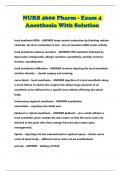
local anethesia MOA - ANSWER stops axonal conduction by blocking sodium
channels. all nerve conduction is lost - loss of sensation AND motor activity
local anesthesia adverse reactions - ANSWER CNS excitation followed by
depression, bradycardia, allergic reactions, paresthesia, anxiety, tremors,
tinnitus, vasodilatation.
local anesthesia infiltration - ANSWER involves injecting the local anesthetic
solution directly ---dental surgery and suturing.
nerve block - local anesthesia - ANSWER injection of a local anesthetic along
a nerve before it reaches the surgical site-allows large amounts of an
anesthesia to be delivered to a specific area without effecting the whole
body.
Intravenous regional anesthesia - ANSWER anesthetize
extremities---injection into distal vein.
Epidural vs. Spinal anesthesia - ANSWER Epidural---via a small catheter a
local anesthetic given outside the dura mater so that the nerve roots are
blocked at the point after they emerge from the dura mater (pain
management).
Spinal---injecting into the subarachnoid or epidural space---blocks nerve
roots of lower body---different nerve roots can be anesthetized.
wet tap - ANSWER - leaking csf fluid
, - *postural headache* that is worse wtith sitting up and improved with lying
down after delivery
What are the two main types of local anesthetics? - ANSWER amides and
esters
Amide anesthetics MOA - ANSWER Stabilizes the neuronal membrane by
binding to and
inhibiting voltage-gated sodium channels, thereby inhibiting
the ionic fluxes required for the initiation and conduction of
impulses and effecting local anesthesia.
prototype - lidocaine
esters MOA and prototype - ANSWER Decreases the influx of sodium into the
nerve cell and depresses depolarization to prevent conduction of the nerve
impulse.
Chloroprocaine
Which local anesthetic has increased risk of allergic reactions? - ANSWER
esters have more allergic rxns
inhaled anesthetics endings - ANSWER -flurane or -thane
Anesthesia With Solution
local anethesia MOA - ANSWER stops axonal conduction by blocking sodium
channels. all nerve conduction is lost - loss of sensation AND motor activity
local anesthesia adverse reactions - ANSWER CNS excitation followed by
depression, bradycardia, allergic reactions, paresthesia, anxiety, tremors,
tinnitus, vasodilatation.
local anesthesia infiltration - ANSWER involves injecting the local anesthetic
solution directly ---dental surgery and suturing.
nerve block - local anesthesia - ANSWER injection of a local anesthetic along
a nerve before it reaches the surgical site-allows large amounts of an
anesthesia to be delivered to a specific area without effecting the whole
body.
Intravenous regional anesthesia - ANSWER anesthetize
extremities---injection into distal vein.
Epidural vs. Spinal anesthesia - ANSWER Epidural---via a small catheter a
local anesthetic given outside the dura mater so that the nerve roots are
blocked at the point after they emerge from the dura mater (pain
management).
Spinal---injecting into the subarachnoid or epidural space---blocks nerve
roots of lower body---different nerve roots can be anesthetized.
wet tap - ANSWER - leaking csf fluid
, - *postural headache* that is worse wtith sitting up and improved with lying
down after delivery
What are the two main types of local anesthetics? - ANSWER amides and
esters
Amide anesthetics MOA - ANSWER Stabilizes the neuronal membrane by
binding to and
inhibiting voltage-gated sodium channels, thereby inhibiting
the ionic fluxes required for the initiation and conduction of
impulses and effecting local anesthesia.
prototype - lidocaine
esters MOA and prototype - ANSWER Decreases the influx of sodium into the
nerve cell and depresses depolarization to prevent conduction of the nerve
impulse.
Chloroprocaine
Which local anesthetic has increased risk of allergic reactions? - ANSWER
esters have more allergic rxns
inhaled anesthetics endings - ANSWER -flurane or -thane