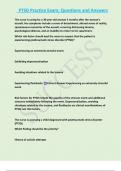
PTSD Practice Exam; Questions and Answers
The nurse is caring for a 30-year-old woman 3 months after the woman's
assault. Her symptoms include a sense of detachment, altered sense of reality,
spontaneous memories of the assault, recurring distressing dreams,
psychological distress, and an inability to return to her apartment.
Which risk factor should lead the nurse to suspect that the patient is
experiencing posttraumatic stress disorder (PTSD)?
Experiencing an extremely stressful event
Exhibiting depersonalization
Avoiding situations related to the trauma
Experiencing flashbacks Correct Answer-Experiencing an extremely stressful
event
Risk factors for PTSD include the severity of the stressor event and additional
stressors immediately following the event. Depersonalization, avoiding
situations related to the trauma, and flashbacks are clinical manifestations of
PTSD, not risk factors.
The nurse is assessing a child diagnosed with posttraumatic stress disorder
(PTSD).
Which finding should be the priority?
History of suicide attempts
, PTSD Practice Exam; Questions and Answers
Changes in sleeping patterns
History of traumatic brain injury
Lack of social support Correct Answer-Changes in sleeping patterns
Identification of PTSD in children is improved when they are questioned directly
about their experiences. Assessment of younger children involves questioning
the child and/or the parents about significant changes in behavior and sleeping
patterns. Lack of social support, history of traumatic brain injury, and history of
suicide attempts are vital information for other patient populations but are not
critical for the pediatric population.
A patient wishes to incorporate complementary integrative health (CIH)
approaches in the treatment regimen for posttraumatic stress disorder (PTSD).
Which type of CIH approach enables the patient to have an effective plan to
address the negative obstacles that may be encountered?
Breathing retraining
Real-world training
Stress inoculation
Prolonged exposure training Correct Answer-Stress inoculation
, PTSD Practice Exam; Questions and Answers
Stress inoculation is a form of psychotherapy in which the therapist teaches the
patient on the stress that may be endured, including the negative outcomes.
This enables the patient to have an effective plan to address the negative
obstacles that may be encountered. Prolonged exposure training, breathing
retraining, or real-world training will not enable the patient to have an effective
plan to address the potential negative obstacles.
A patient with posttraumatic stress disorder (PTSD) wishes to include
nonpharmacologic therapy as part of the treatment regimen.
Which form of nonpharmacologic therapy allows the patient to develop
effective coping skills in a safe, controlled environment?
Cognitive-behavioral therapy
Body-centered therapy
Dual-attention stimulus
Exposure therapy Correct Answer-Exposure therapy
Exposure therapy allows the patient to develop effective coping skills in a safe,
controlled environment. Cognitive-behavioral therapy, body-centered therapy,
and dual-attention stimulus do not provide this for the patient.
A patient wishes to incorporate exposure therapy into the treatment regimen.
The nurse is caring for a 30-year-old woman 3 months after the woman's
assault. Her symptoms include a sense of detachment, altered sense of reality,
spontaneous memories of the assault, recurring distressing dreams,
psychological distress, and an inability to return to her apartment.
Which risk factor should lead the nurse to suspect that the patient is
experiencing posttraumatic stress disorder (PTSD)?
Experiencing an extremely stressful event
Exhibiting depersonalization
Avoiding situations related to the trauma
Experiencing flashbacks Correct Answer-Experiencing an extremely stressful
event
Risk factors for PTSD include the severity of the stressor event and additional
stressors immediately following the event. Depersonalization, avoiding
situations related to the trauma, and flashbacks are clinical manifestations of
PTSD, not risk factors.
The nurse is assessing a child diagnosed with posttraumatic stress disorder
(PTSD).
Which finding should be the priority?
History of suicide attempts
, PTSD Practice Exam; Questions and Answers
Changes in sleeping patterns
History of traumatic brain injury
Lack of social support Correct Answer-Changes in sleeping patterns
Identification of PTSD in children is improved when they are questioned directly
about their experiences. Assessment of younger children involves questioning
the child and/or the parents about significant changes in behavior and sleeping
patterns. Lack of social support, history of traumatic brain injury, and history of
suicide attempts are vital information for other patient populations but are not
critical for the pediatric population.
A patient wishes to incorporate complementary integrative health (CIH)
approaches in the treatment regimen for posttraumatic stress disorder (PTSD).
Which type of CIH approach enables the patient to have an effective plan to
address the negative obstacles that may be encountered?
Breathing retraining
Real-world training
Stress inoculation
Prolonged exposure training Correct Answer-Stress inoculation
, PTSD Practice Exam; Questions and Answers
Stress inoculation is a form of psychotherapy in which the therapist teaches the
patient on the stress that may be endured, including the negative outcomes.
This enables the patient to have an effective plan to address the negative
obstacles that may be encountered. Prolonged exposure training, breathing
retraining, or real-world training will not enable the patient to have an effective
plan to address the potential negative obstacles.
A patient with posttraumatic stress disorder (PTSD) wishes to include
nonpharmacologic therapy as part of the treatment regimen.
Which form of nonpharmacologic therapy allows the patient to develop
effective coping skills in a safe, controlled environment?
Cognitive-behavioral therapy
Body-centered therapy
Dual-attention stimulus
Exposure therapy Correct Answer-Exposure therapy
Exposure therapy allows the patient to develop effective coping skills in a safe,
controlled environment. Cognitive-behavioral therapy, body-centered therapy,
and dual-attention stimulus do not provide this for the patient.
A patient wishes to incorporate exposure therapy into the treatment regimen.