100% satisfaction guarantee Immediately available after payment Both online and in PDF No strings attached 4.6 TrustPilot
logo-home
Exam (elaborations)

WGU Psych D094 Objective Assessment Study Guide (Qs and As) Download To Score An A (Latest Update)

Rating
-
Sold
-
Pages
3
Grade
A+
Uploaded on
29-08-2024
Written in
2024/2025

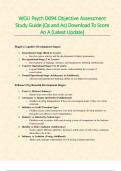
WGU Psych D094 Objective Assessment Study Guide (Qs and As) Download To Score An A (Latest Update) Piaget's Cognitive Development Stages: 1. Sensorimotor Stage (Birth to 2 years): o Involves motor activity and the development of object permanence. 2. Pre-operational Stage (2 to 7 years): o Development of language, memory, and imagination; thinking symbolically. 3. Concrete Operational Stage (7 to 11 years): o Logical thinking about concrete events; understanding the concept of conservation. 4. Formal Operational Stage (Adolescence to Adulthood): o Abstract and hypothetical thinking; ability to use deductive reasoning. Erikson's Psychosocial Development Stages: 1. Trust vs. Mistrust (Infancy): o Infants learn trust when basic needs are met. 2. Autonomy vs. Shame and Doubt (Toddlerhood): o Toddlers develop independence if they are encouraged; doubt if they are overly criticized. 3. Initiative vs. Guilt (Preschool Age): o Children assert control and power over their environment; develop initiative or feel guilt over efforts to exert independence. 4. Industry vs. Inferiority (School Age): o Children work to master skills and develop a sense of competence or feel inferior if unsuccessful. 5. Identity vs. Role Confusion (Adolescence): o Teens explore different identities; develop a stable sense of self or face confusion about their role in life. 6. Intimacy vs. Isolation (Young Adulthood): o Adults seek intimate relationships or risk feeling isolated and alone. Vygotsky's Sociocultural Theory: • Emphasizes the role of social interaction and culture in cognitive development. Key concept: Zone of Proximal Development (ZPD) — the difference between what a child can do independently and with guidance. Bandura's Social Cognitive Theory: • Behavior is influenced by the interaction of personal factors, environmental factors, and behavior itself. Kohlberg's Stages of Moral Development: 1. Preconventional: Morality is shaped by consequences and rewards. 2. Conventional: Morality is based on social rules and laws. 3. Postconventional: Morality is guided by abstract ethical principles. Gilligan's Theory of Moral Development: • Proposes a different path for moral development in women, emphasizing care and relationships over abstract principles of justice. Chomsky's Language Theory: • Proposes an inborn ability to learn language, suggesting that language acquisition is a natural biological process. Skinner's Language Theory: • Language learning is shaped by reinforcement, imitation, and association. Behaviorist Theory: • Learning is a result of associations formed between stimuli and responses through conditioning. Cognitivist Theory: • Focuses on how the human mind processes, stores, and retrieves information. Humanistic Theory: • Emphasizes human dignity, personal choice, and self-worth, focusing on the whole person. Constructivist Theory: • Suggests that learning is an active, constructive process where learners build new ideas or concepts based on their current/past knowledge. Learning Strategies: • Cooperative Learning: Small groups working together toward common goals. • Collaborative Learning: Students working in groups to discuss and solve problems.

Show more Read less


Whoops! We can’t load your doc right now. Try again or contact support.

Document information

Uploaded on
August 29, 2024
Number of pages
3
Written in
2024/2025
Type
Exam (elaborations)
Contains
Questions & answers

Subjects

Content preview

WGU Psych D094 Objective Assessment
Study Guide (Qs and As) Download To Score
An A (Latest Update)

Piaget's Cognitive Development Stages:

1. Sensorimotor Stage (Birth to 2 years):
o Involves motor activity and the development of object permanence.
2. Pre-operational Stage (2 to 7 years):
o Development of language, memory, and imagination; thinking symbolically.
3. Concrete Operational Stage (7 to 11 years):
o Logical thinking about concrete events; understanding the concept of
conservation.
4. Formal Operational Stage (Adolescence to Adulthood):
o Abstract and hypothetical thinking; ability to use deductive reasoning.


Erikson's Psychosocial Development Stages:

1. Trust vs. Mistrust (Infancy):
o Infants learn trust when basic needs are met.
2. Autonomy vs. Shame and Doubt (Toddlerhood):
o Toddlers develop independence if they are encouraged; doubt if they are overly
criticized.
3. Initiative vs. Guilt (Preschool Age):
o Children assert control and power over their environment; develop initiative or
feel guilt over efforts to exert independence.
4. Industry vs. Inferiority (School Age):
o Children work to master skills and develop a sense of competence or feel inferior
if unsuccessful.
5. Identity vs. Role Confusion (Adolescence):
o Teens explore different identities; develop a stable sense of self or face confusion
about their role in life.
6. Intimacy vs. Isolation (Young Adulthood):
o Adults seek intimate relationships or risk feeling isolated and alone.

Get to know the seller

Seller avatar
Reputation scores are based on the amount of documents a seller has sold for a fee and the reviews they have received for those documents. There are three levels: Bronze, Silver and Gold. The better the reputation, the more your can rely on the quality of the sellers work.
ProfGoodlucK Rasmussen College
View profile
Follow You need to be logged in order to follow users or courses
Sold
3474
Member since
5 year
Number of followers
2867
Documents
8663
Last sold
1 week ago
High Quality Exams, Study guides, Reviews, Notes, Case Studies

All study solutions.

4.0

704 reviews

5
379
4
131
3
83
2
39
1
72

Recently viewed by you

Why students choose Stuvia

Created by fellow students, verified by reviews

Quality you can trust: written by students who passed their tests and reviewed by others who've used these notes.

Didn't get what you expected? Choose another document

No worries! You can instantly pick a different document that better fits what you're looking for.

Pay as you like, start learning right away

No subscription, no commitments. Pay the way you're used to via credit card and download your PDF document instantly.

Student with book image

“Bought, downloaded, and aced it. It really can be that simple.”

Alisha Student

Frequently asked questions