©SOPHIABENNET@2024/2025 Monday, August 19, 2024 10:32 PM
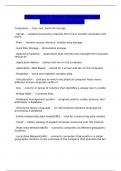
BCBA Exam Study Guide with Complete Solutions
3 Principles of Behavior - Answer✔️✔️-reinforcement, punishment,
extinction
4 Functions of Behavior - Answer✔️✔️-SEAT
Sensory, escape/avoidance, attention, tangible
Anecdotal Data - Answer✔️✔️-A method of descriptively recording the
behavior emitted by the learner, the response of others, and information
about the environment.
Antecedent - Answer✔️✔️-What occurs before a behavior that then
influences behavior; an environment or a stimulus change existing or
occurring prior to a behavior of interest
Applied Behavior Analysis - Answer✔️✔️-The science in which tactics
derived from the principles of behavior are applied to improve socially
significant behavior and experimentation is used to identify the variables
responsible for behavior change; The scientific study of principles of
learning and behavior
How could you assist in training stakeholders? - Answer✔️✔️-Train
stakeholders by giving them instruction, modeling, rehearsal, and feedback
with regard to behavior skills training
Attention Function - Answer✔️✔️-A function of behavior in which the
individual is reinforced by receiving attention from others.
1
,©SOPHIABENNET@2024/2025 Monday, August 19, 2024 10:32 PM
Automatic Reinforcement - Answer✔️✔️-(AKA self-stimming) The behavior
itself is reinforcing and is not dependent on social interaction or receiving a
tangible item.
Backward Chaining - Answer✔️✔️-Training begins the link with the last
behavior in the sequence.
Trainer performs all but the last step until the learner masters the last step.
Then trainer performs all but the lasts two steps until learner masters the
last two steps and so on.
Baseline Data - Answer✔️✔️-Data taken before an intervention takes place.
Describes the existing level of performance.
Chaining - Answer✔️✔️-A specific sequence of discrete responses, each
associated with a particular stimulus condition.
When components are linked together, they form a chain that produces a
terminal outcome.
Components of a Written Behavior Plan - Answer✔️✔️-1. Identify, describe,
create a goal for a behavior in observable terms.
2. Assess antecedent/consequence that may maintain behavior.
3. Identify hypothesis of function of behavior.
4. Identify possible replacement behaviors.
5. Select and implement antecedent/consequence based interventions.
2
,©SOPHIABENNET@2024/2025 Monday, August 19, 2024 10:32 PM
6. Create crisis intervention plan.
7. Implementation, modification, generalization and maintenance
procedures.
Conditioned Response - Answer✔️✔️-A behavior that does not come
naturally, but must be learning by the individual by pairing a neutral
stimulus with an unconditioned stimulus.
Conditioned Stimulus - Answer✔️✔️-A previous neutral stimulus that, after
repeated association with an unconditioned stimulus, elicits the response
produced by the unconditioned stimulus itself.
Consequence - Answer✔️✔️-Events that follow behavior and may influence
it including increasing or decreasing it in the future; may be reinforcers or
punishers.
Contingency - Answer✔️✔️-Refers to an if _______, then ________
relationship between a behavior and a consequence.
Continuous Reinforcement Schedule - Answer✔️✔️-Reinforcing one
response class and withholding reinforcement from another response class;
behavior receiving reinforcement should increase while the behavior for
which reinforcement is being withheld should decrease.
Differential Reinforcement of Alternative Behaviors (DRA) - Answer✔️✔️-
Focus on increasing a desirable alternative behavior that directly or
indirectly interfere with the performance of the undesired target behavior
(i.e., reinforce knitting or giving self manicure instead of biting nails;
3
, ©SOPHIABENNET@2024/2025 Monday, August 19, 2024 10:32 PM
reinforce appropriate language use instead of punishing swearing at
others)
Differential Reinforcement of Incompatible Behaviors (DRI) - Answer✔️✔️-
Similar to DRA but you choose an alternative behavior to reinforce that, if
performed, would be incompatible with undesired target behavior (i.e.,
playing nicely vs. fighting; on-task behavior vs. off-task behavior; in seat
vs. out of seat; deep breathing vs. yelling)
Differential Reinforcement of Low Rates (DRL) - Answer✔️✔️-Entails
reinforcing for reductions in the frequency of the undesired behavior.
Often used when an individual is engaging in a behavior too frequently
(bathroom, calling out)
Differential Reinforcement of Other Behaviors (DRO) - Answer✔️✔️-
Providing a reinforcer after a particular time frame without the target
behavior (i.e., engaging in any other behavior except the target behavior)
E.g., every 5 minutes without hitting, individual receives a sticker.
Direct Observation Preference Assessment - Answer✔️✔️-Identify what is
motivating the individual.
The more time spent with an item, the stronger the presumed preference.
Discrete Trial Training - Answer✔️✔️-Structured instructional methodology
used to teach new behaviors; Designed to maximize a learner's potential by
presenting information in a three-part teaching unit; Based on Antecedent-
Behavior-Consequence (A.k.a ABC; Stimulus-Response-Consequence);
4
BCBA Exam Study Guide with Complete Solutions
3 Principles of Behavior - Answer✔️✔️-reinforcement, punishment,
extinction
4 Functions of Behavior - Answer✔️✔️-SEAT
Sensory, escape/avoidance, attention, tangible
Anecdotal Data - Answer✔️✔️-A method of descriptively recording the
behavior emitted by the learner, the response of others, and information
about the environment.
Antecedent - Answer✔️✔️-What occurs before a behavior that then
influences behavior; an environment or a stimulus change existing or
occurring prior to a behavior of interest
Applied Behavior Analysis - Answer✔️✔️-The science in which tactics
derived from the principles of behavior are applied to improve socially
significant behavior and experimentation is used to identify the variables
responsible for behavior change; The scientific study of principles of
learning and behavior
How could you assist in training stakeholders? - Answer✔️✔️-Train
stakeholders by giving them instruction, modeling, rehearsal, and feedback
with regard to behavior skills training
Attention Function - Answer✔️✔️-A function of behavior in which the
individual is reinforced by receiving attention from others.
1
,©SOPHIABENNET@2024/2025 Monday, August 19, 2024 10:32 PM
Automatic Reinforcement - Answer✔️✔️-(AKA self-stimming) The behavior
itself is reinforcing and is not dependent on social interaction or receiving a
tangible item.
Backward Chaining - Answer✔️✔️-Training begins the link with the last
behavior in the sequence.
Trainer performs all but the last step until the learner masters the last step.
Then trainer performs all but the lasts two steps until learner masters the
last two steps and so on.
Baseline Data - Answer✔️✔️-Data taken before an intervention takes place.
Describes the existing level of performance.
Chaining - Answer✔️✔️-A specific sequence of discrete responses, each
associated with a particular stimulus condition.
When components are linked together, they form a chain that produces a
terminal outcome.
Components of a Written Behavior Plan - Answer✔️✔️-1. Identify, describe,
create a goal for a behavior in observable terms.
2. Assess antecedent/consequence that may maintain behavior.
3. Identify hypothesis of function of behavior.
4. Identify possible replacement behaviors.
5. Select and implement antecedent/consequence based interventions.
2
,©SOPHIABENNET@2024/2025 Monday, August 19, 2024 10:32 PM
6. Create crisis intervention plan.
7. Implementation, modification, generalization and maintenance
procedures.
Conditioned Response - Answer✔️✔️-A behavior that does not come
naturally, but must be learning by the individual by pairing a neutral
stimulus with an unconditioned stimulus.
Conditioned Stimulus - Answer✔️✔️-A previous neutral stimulus that, after
repeated association with an unconditioned stimulus, elicits the response
produced by the unconditioned stimulus itself.
Consequence - Answer✔️✔️-Events that follow behavior and may influence
it including increasing or decreasing it in the future; may be reinforcers or
punishers.
Contingency - Answer✔️✔️-Refers to an if _______, then ________
relationship between a behavior and a consequence.
Continuous Reinforcement Schedule - Answer✔️✔️-Reinforcing one
response class and withholding reinforcement from another response class;
behavior receiving reinforcement should increase while the behavior for
which reinforcement is being withheld should decrease.
Differential Reinforcement of Alternative Behaviors (DRA) - Answer✔️✔️-
Focus on increasing a desirable alternative behavior that directly or
indirectly interfere with the performance of the undesired target behavior
(i.e., reinforce knitting or giving self manicure instead of biting nails;
3
, ©SOPHIABENNET@2024/2025 Monday, August 19, 2024 10:32 PM
reinforce appropriate language use instead of punishing swearing at
others)
Differential Reinforcement of Incompatible Behaviors (DRI) - Answer✔️✔️-
Similar to DRA but you choose an alternative behavior to reinforce that, if
performed, would be incompatible with undesired target behavior (i.e.,
playing nicely vs. fighting; on-task behavior vs. off-task behavior; in seat
vs. out of seat; deep breathing vs. yelling)
Differential Reinforcement of Low Rates (DRL) - Answer✔️✔️-Entails
reinforcing for reductions in the frequency of the undesired behavior.
Often used when an individual is engaging in a behavior too frequently
(bathroom, calling out)
Differential Reinforcement of Other Behaviors (DRO) - Answer✔️✔️-
Providing a reinforcer after a particular time frame without the target
behavior (i.e., engaging in any other behavior except the target behavior)
E.g., every 5 minutes without hitting, individual receives a sticker.
Direct Observation Preference Assessment - Answer✔️✔️-Identify what is
motivating the individual.
The more time spent with an item, the stronger the presumed preference.
Discrete Trial Training - Answer✔️✔️-Structured instructional methodology
used to teach new behaviors; Designed to maximize a learner's potential by
presenting information in a three-part teaching unit; Based on Antecedent-
Behavior-Consequence (A.k.a ABC; Stimulus-Response-Consequence);
4