SEPSIS.
LEARNING OUTCOMES.
• Define sepsis
• Understand the symptoms
• Understand incidence, mortality and demographic of sepsis
• Understand diagnostic methods
• Be able to give examples of the different microorganisms that can cause sepsis
• Describe approaches to treat sepsis
SYMPTOMS.
WHAT IS SEPSIS.
• A consequence of septicaemia or blood poisoning caused by bacteraemia (when
bacteria get into the blood). bacteraemia is not sepsis but it can LEAD to sepsis.
• Not simply a blood stream infection, it’s the overreaction of the immune system in
response to septicaemia or bacteraemia and it can lead to septicaemic shock. This
shock is the over-reaction of the immune system that we refer to as sepsis.
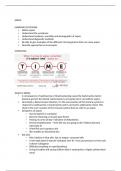
• Symptoms of sepsis:
– Slurred speech or confusion
– Extreme shivering or muscle pain (fever)
– Passing no urine all day- indicative of dehydration.
– Severe breathlessness – feels like you are going to die. Patients become
extremely ill.
– It feel like you're going to die
– Skin mottles or discolored skin
• But also:
– Pale, blotchy or blue skin, lips or tongue- cyanosed skin
– A rash that doesn’t blanche (roll glass over it)- if you put pressure on the rash,
it doesn't disappear
– Difficulty breathing or rapid breathing
– Crying in babies and young children that is weak/quiet or higher pitched than
usual.
, – Feeling confused or lethargic
– Fever, loss of appetite, vomiting, having a septic abrasion- having a wound
that is highly infected on the exterior.
SEPSIS INCIDENCE AND MORTALITY.
• 11 Million deaths globally every year among 49 million cases
• Up to 48,000 deaths in the UK every year
• Sepsis kills more than breast, bowel and prostate cancer combined
MORTALITY AND DEMOGRAPHIC.
25,000 child cases every year in the UK
Incidence of sepsis based on age- very young children and very elderly are at increased risk
of sepsis.
Female to male mortality, as you increase in age group the mortality rate significantly
increases, in the early years you have a greater risk of sepsis in females than you do in
males.
This equalizes until the extremes of age, where females have an increased risk.
Females have a greater risk, because the frequency of infection is higher, particularly urinary
tract infections in older women.
The general increase of infection risk in both genders is because you get a lot more medical
intervention at a later age. Such as catheter fitting. Therefore, you get an increase in urinary
tract infections and therefore you at an increased risk of developing bacteremia.
Women are at an increased risk because they have more urinary tract infections.
But at a later age both males and females are at risk due to catheterization interventions.
Sepsis can result from many common infections.
Measure and record vital signs.
Alert parents of clinical features that cause deterioration.
WHERE DOES SEPSIS COME FROM?
• Bacterial Infection (undiagnosed could it be viral?) -> bacteraemia (gets into blood
stream- disseminated infection) -> sepsis (septicaemic shock- immune response).
• Reduce number of people dying by sepsis by making people more aware of it.
• Microbiology important as blood cultures are an important part of diagnosing sepsis.
• Starts of with a bacterial infection- could be a viral infection. Maybe the bacterial
infection goes undiagnosed.
• This could lead to bacteremia where it gets into the blood stream, and causes a
disseminated infection of the bacteria. The bacteria travels around the body and
starts to impact the organs.
• Septic shock- this is an aggressive immune response that can lead to the clinical
presentation of sepsis.
• If left untreated this can lead to killing the patient.
BLOOD CULTURE IS KEY TO DIAGNOSIS.
• Majority of positive blood cultures yield one of the following:
– S. aureus
– E. coli (or other enterobacteria)
LEARNING OUTCOMES.
• Define sepsis
• Understand the symptoms
• Understand incidence, mortality and demographic of sepsis
• Understand diagnostic methods
• Be able to give examples of the different microorganisms that can cause sepsis
• Describe approaches to treat sepsis
SYMPTOMS.
WHAT IS SEPSIS.
• A consequence of septicaemia or blood poisoning caused by bacteraemia (when
bacteria get into the blood). bacteraemia is not sepsis but it can LEAD to sepsis.
• Not simply a blood stream infection, it’s the overreaction of the immune system in
response to septicaemia or bacteraemia and it can lead to septicaemic shock. This
shock is the over-reaction of the immune system that we refer to as sepsis.
• Symptoms of sepsis:
– Slurred speech or confusion
– Extreme shivering or muscle pain (fever)
– Passing no urine all day- indicative of dehydration.
– Severe breathlessness – feels like you are going to die. Patients become
extremely ill.
– It feel like you're going to die
– Skin mottles or discolored skin
• But also:
– Pale, blotchy or blue skin, lips or tongue- cyanosed skin
– A rash that doesn’t blanche (roll glass over it)- if you put pressure on the rash,
it doesn't disappear
– Difficulty breathing or rapid breathing
– Crying in babies and young children that is weak/quiet or higher pitched than
usual.
, – Feeling confused or lethargic
– Fever, loss of appetite, vomiting, having a septic abrasion- having a wound
that is highly infected on the exterior.
SEPSIS INCIDENCE AND MORTALITY.
• 11 Million deaths globally every year among 49 million cases
• Up to 48,000 deaths in the UK every year
• Sepsis kills more than breast, bowel and prostate cancer combined
MORTALITY AND DEMOGRAPHIC.
25,000 child cases every year in the UK
Incidence of sepsis based on age- very young children and very elderly are at increased risk
of sepsis.
Female to male mortality, as you increase in age group the mortality rate significantly
increases, in the early years you have a greater risk of sepsis in females than you do in
males.
This equalizes until the extremes of age, where females have an increased risk.
Females have a greater risk, because the frequency of infection is higher, particularly urinary
tract infections in older women.
The general increase of infection risk in both genders is because you get a lot more medical
intervention at a later age. Such as catheter fitting. Therefore, you get an increase in urinary
tract infections and therefore you at an increased risk of developing bacteremia.
Women are at an increased risk because they have more urinary tract infections.
But at a later age both males and females are at risk due to catheterization interventions.
Sepsis can result from many common infections.
Measure and record vital signs.
Alert parents of clinical features that cause deterioration.
WHERE DOES SEPSIS COME FROM?
• Bacterial Infection (undiagnosed could it be viral?) -> bacteraemia (gets into blood
stream- disseminated infection) -> sepsis (septicaemic shock- immune response).
• Reduce number of people dying by sepsis by making people more aware of it.
• Microbiology important as blood cultures are an important part of diagnosing sepsis.
• Starts of with a bacterial infection- could be a viral infection. Maybe the bacterial
infection goes undiagnosed.
• This could lead to bacteremia where it gets into the blood stream, and causes a
disseminated infection of the bacteria. The bacteria travels around the body and
starts to impact the organs.
• Septic shock- this is an aggressive immune response that can lead to the clinical
presentation of sepsis.
• If left untreated this can lead to killing the patient.
BLOOD CULTURE IS KEY TO DIAGNOSIS.
• Majority of positive blood cultures yield one of the following:
– S. aureus
– E. coli (or other enterobacteria)