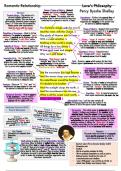
Romantic Relationship Love’s Philosophy
Structure
Nouns & Theme of Nature - Natural
imagery portrayed in simplistic nouns, Percy Bysshe Shelley
“fountains”, “rivers”, “ocean”. Suggests
Trochaic Metre - The pattern of a speaker is honest. The speaker also only
stressed syllable followed by an describes what he can see with his own eyes, Enjambment - Reflects the natural flow of
unstressed syllable. This can have an rendering his arguments a matter of fact. fountain into river and river into ocean
otherworldly, hypnotic sensory impact. suggesting the mingling of the speaker and
Lines 1 & 3 also uses this irregularity, his beloved a natural response.
helping poem seem spontaneous.
“And the rivers with the ocean” The fountains mingle with the river,a Theme of Nature - Suggests that everything
And the rivers with the Ocean, b in nature becomes part of or is paired with
Repetition of Assonance - Used to further another aspect of nature. “mingle” & “mix”
emphasise the speaker’s argument. “sweet The winds of Heaven mix for ever a used to enhance this image.
emotion” is natural and in keeping with his
way of thinking. “I with thine” unites With a sweet emotion; b Rhyme - “ocean” & “emotion”, “single” &
speaker and lover in shared vowel sound. “mingle” are light in tone and rhythmical,
Nothing in the world is single; a reinforcing the optimism of speaker’s romantic
Adjective & Rhyme - “divine” suggests that All things by a law divine b love. Rhyme also presents ideas that this love
natural law is holy and sacred while also will be inevitable as it becomes predictable.
rhyming with “thine”, meaning the speaker In one spirit meet and mingle - a
sanctifies their potential union. Repetition & Rhyme - Repeated word
Why not I with thine? b “mingle” rhyming with “single” suggesting
the natural course towards unity.
Imperative Verb - “See” intensifies the
speaker’s address to his beloved. Metonym - “High Heaven” used to
describe ‘sky’. One of the few Dash - Creates a pause which makes the line that
Makes the reader, like the subject, to embellishments of poem perhaps follows appear spontaneous and entirely reasonable.
look around and seemingly challenge
her to prove what nature reveals. connoting God, religion and higher power.
Reinforced by earlier “divine law”.
Enjambment - Used throughout to pair
Repetition of Conjunction - “And” lines together. The lines only make sense
emphasises how union is natural. By See the mountains kiss high heaven a when read together further highlighting
piling up the examples in nature, the the importance of each person being
And the waves clasp one another; b incomplete without its pair.
speaker makes it increasingly difficult
for his beloved to refuse his idea. No sister-flower would be forgiven a
Themes - The idea of union is intensified by
Emphasis - Stress on “If”, “kiss” and “me”, If it disdain’d its brother: b the image of a flower, requiring pollination
emphasising his inner desire for him and And the sunlight clasps the earth, a to bear fruit. “Forgiven” also shows that a
his beloved to embrace each other. rejection of duality is unforgivable.
And the moonbeams kiss the sea - b
Repetition - “kiss” is repeated numerous
Rhetorical Question - Used in support What is all this sweet work worth, a times again emphasising his desire for her.
of his argument - none of nature’s
unions are worth anything if his If thou kiss not me? B
beloved will not unite with him. Monosyllabic Tone - Last line only contains 5
syllables. Perhaps to illustrate that the action of the
kiss is meant to fill in the spaces rather than words.
Analysing Structure (A02)
S
Focus & Movement The speaker tanza 2 Perspective - The whole poem is dominated by the
. to look aroinun
structs his bel thought, feelings and opinion of the speaker with
example of n d and see thove
ed minimal input from the subject. Some perspectives
a tu re
rejection of n , arguing that a include that the speakers desires to devote his life to
Stanza 1 a
Describes aspects of thase a would be untufore’s reciprocity this woman, his desires to enjoy the woman for sexual
satisfaction she can provide (objectification?) or the
rgiveable.
natural world “mixieng”
speaker speakers wishes to follow the “divine law” of nature
good example for th loved. and like everything in the world couple up in union
and his silent be
Lyric Poem Perspective with his beloved to be in harmony with nature.
first person- It is written in the
ex
Key Themes emotions apressing personal Summary
nd feelings.
• The nature of romantic love The poem takes the form of a romantic
• Seduction love’s playful argument in which he
• Unity puts forward his case for union.
Structure & Form
Each octave is made up of two alternating rhyming
quatrains. May be linked to ballad form - quatrains Context about Percy Bysshe Shelley (A03)
writing in either abcb or abab rhyme schemes. Then the
1st and 3rd lines are in iambic tetrameter (four metric • Romantic poet
feet/eight syllables) and 2nd and 4th lines in trimester • Radical
(three metric feet/six syllables). This structure (ballad • Died in a boating accident in Italy.
form)may be used to give poem light-hearted tone in • Wrote political pamphlets as well as poetry.
order to make his argument seem less aggressive and • Believed poetry should be the voice of
thus more successful.
transformation and rebellion.
• ‘Love’s Philosophy’ was written in 1820, at
which time Shelley was living in Italy.
Structure
Nouns & Theme of Nature - Natural
imagery portrayed in simplistic nouns, Percy Bysshe Shelley
“fountains”, “rivers”, “ocean”. Suggests
Trochaic Metre - The pattern of a speaker is honest. The speaker also only
stressed syllable followed by an describes what he can see with his own eyes, Enjambment - Reflects the natural flow of
unstressed syllable. This can have an rendering his arguments a matter of fact. fountain into river and river into ocean
otherworldly, hypnotic sensory impact. suggesting the mingling of the speaker and
Lines 1 & 3 also uses this irregularity, his beloved a natural response.
helping poem seem spontaneous.
“And the rivers with the ocean” The fountains mingle with the river,a Theme of Nature - Suggests that everything
And the rivers with the Ocean, b in nature becomes part of or is paired with
Repetition of Assonance - Used to further another aspect of nature. “mingle” & “mix”
emphasise the speaker’s argument. “sweet The winds of Heaven mix for ever a used to enhance this image.
emotion” is natural and in keeping with his
way of thinking. “I with thine” unites With a sweet emotion; b Rhyme - “ocean” & “emotion”, “single” &
speaker and lover in shared vowel sound. “mingle” are light in tone and rhythmical,
Nothing in the world is single; a reinforcing the optimism of speaker’s romantic
Adjective & Rhyme - “divine” suggests that All things by a law divine b love. Rhyme also presents ideas that this love
natural law is holy and sacred while also will be inevitable as it becomes predictable.
rhyming with “thine”, meaning the speaker In one spirit meet and mingle - a
sanctifies their potential union. Repetition & Rhyme - Repeated word
Why not I with thine? b “mingle” rhyming with “single” suggesting
the natural course towards unity.
Imperative Verb - “See” intensifies the
speaker’s address to his beloved. Metonym - “High Heaven” used to
describe ‘sky’. One of the few Dash - Creates a pause which makes the line that
Makes the reader, like the subject, to embellishments of poem perhaps follows appear spontaneous and entirely reasonable.
look around and seemingly challenge
her to prove what nature reveals. connoting God, religion and higher power.
Reinforced by earlier “divine law”.
Enjambment - Used throughout to pair
Repetition of Conjunction - “And” lines together. The lines only make sense
emphasises how union is natural. By See the mountains kiss high heaven a when read together further highlighting
piling up the examples in nature, the the importance of each person being
And the waves clasp one another; b incomplete without its pair.
speaker makes it increasingly difficult
for his beloved to refuse his idea. No sister-flower would be forgiven a
Themes - The idea of union is intensified by
Emphasis - Stress on “If”, “kiss” and “me”, If it disdain’d its brother: b the image of a flower, requiring pollination
emphasising his inner desire for him and And the sunlight clasps the earth, a to bear fruit. “Forgiven” also shows that a
his beloved to embrace each other. rejection of duality is unforgivable.
And the moonbeams kiss the sea - b
Repetition - “kiss” is repeated numerous
Rhetorical Question - Used in support What is all this sweet work worth, a times again emphasising his desire for her.
of his argument - none of nature’s
unions are worth anything if his If thou kiss not me? B
beloved will not unite with him. Monosyllabic Tone - Last line only contains 5
syllables. Perhaps to illustrate that the action of the
kiss is meant to fill in the spaces rather than words.
Analysing Structure (A02)
S
Focus & Movement The speaker tanza 2 Perspective - The whole poem is dominated by the
. to look aroinun
structs his bel thought, feelings and opinion of the speaker with
example of n d and see thove
ed minimal input from the subject. Some perspectives
a tu re
rejection of n , arguing that a include that the speakers desires to devote his life to
Stanza 1 a
Describes aspects of thase a would be untufore’s reciprocity this woman, his desires to enjoy the woman for sexual
satisfaction she can provide (objectification?) or the
rgiveable.
natural world “mixieng”
speaker speakers wishes to follow the “divine law” of nature
good example for th loved. and like everything in the world couple up in union
and his silent be
Lyric Poem Perspective with his beloved to be in harmony with nature.
first person- It is written in the
ex
Key Themes emotions apressing personal Summary
nd feelings.
• The nature of romantic love The poem takes the form of a romantic
• Seduction love’s playful argument in which he
• Unity puts forward his case for union.
Structure & Form
Each octave is made up of two alternating rhyming
quatrains. May be linked to ballad form - quatrains Context about Percy Bysshe Shelley (A03)
writing in either abcb or abab rhyme schemes. Then the
1st and 3rd lines are in iambic tetrameter (four metric • Romantic poet
feet/eight syllables) and 2nd and 4th lines in trimester • Radical
(three metric feet/six syllables). This structure (ballad • Died in a boating accident in Italy.
form)may be used to give poem light-hearted tone in • Wrote political pamphlets as well as poetry.
order to make his argument seem less aggressive and • Believed poetry should be the voice of
thus more successful.
transformation and rebellion.
• ‘Love’s Philosophy’ was written in 1820, at
which time Shelley was living in Italy.