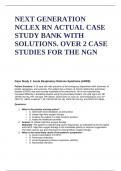
NEXT GENERATION
NCLEX RN ACTUAL CASE
STUDY BANK WITH
SOLUTIONS. OVER 2 CASE
STUDIES FOR THE NGN
Case Study 1: Acute Respiratory Distress Syndrome (ARDS)
Patient Scenario: A 55-year-old male presents to the emergency department with shortness of
breath, tachypnea, and cyanosis. The patient has a history of chronic obstructive pulmonary
disease (COPD) and was recently hospitalized for pneumonia. He is now experiencing
increased difficulty in breathing despite using his prescribed inhalers. His vital signs are: BP
145/90 mm Hg, HR 110 bpm, RR 30/min, SpO2 82% on room air, and temperature 101.3°F
(38.5°C). ABGs reveal pH 7.28, PaCO2 58 mm Hg, PaO2 50 mm Hg, and HCO3 24 mEq/L.
Questions:
1. What is the priority nursing action?
○ A. Administer bronchodilators as prescribed.
○ B. Initiate high-flow oxygen therapy.
○ C. Position the patient in a high-Fowler's position.
○ D. Notify the healthcare provider.
2. Answer: B. Initiate high-flow oxygen therapy.
Rationale: The patient is experiencing severe hypoxemia, as indicated by the low SpO2
and PaO2. High-flow oxygen therapy is the immediate priority to improve oxygenation.
The other actions are also important but should follow oxygen therapy.
3. What is the most likely cause of the patient's symptoms?
○ A. Acute exacerbation of COPD.
○ B. Pulmonary embolism.
○ C. Acute Respiratory Distress Syndrome (ARDS).
○ D. Myocardial infarction.
NCLEX RN ACTUAL CASE
STUDY BANK WITH
SOLUTIONS. OVER 2 CASE
STUDIES FOR THE NGN
Case Study 1: Acute Respiratory Distress Syndrome (ARDS)
Patient Scenario: A 55-year-old male presents to the emergency department with shortness of
breath, tachypnea, and cyanosis. The patient has a history of chronic obstructive pulmonary
disease (COPD) and was recently hospitalized for pneumonia. He is now experiencing
increased difficulty in breathing despite using his prescribed inhalers. His vital signs are: BP
145/90 mm Hg, HR 110 bpm, RR 30/min, SpO2 82% on room air, and temperature 101.3°F
(38.5°C). ABGs reveal pH 7.28, PaCO2 58 mm Hg, PaO2 50 mm Hg, and HCO3 24 mEq/L.
Questions:
1. What is the priority nursing action?
○ A. Administer bronchodilators as prescribed.
○ B. Initiate high-flow oxygen therapy.
○ C. Position the patient in a high-Fowler's position.
○ D. Notify the healthcare provider.
2. Answer: B. Initiate high-flow oxygen therapy.
Rationale: The patient is experiencing severe hypoxemia, as indicated by the low SpO2
and PaO2. High-flow oxygen therapy is the immediate priority to improve oxygenation.
The other actions are also important but should follow oxygen therapy.
3. What is the most likely cause of the patient's symptoms?
○ A. Acute exacerbation of COPD.
○ B. Pulmonary embolism.
○ C. Acute Respiratory Distress Syndrome (ARDS).
○ D. Myocardial infarction.