trident PSC 201
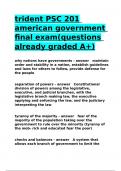
american government
final exam(questions
already graded A+)
why nations have governments - answer maintain
order and stability in a nation, establish guidelines
and laws for others to follow, provide defense for
the people
separation of powers - answer Constitutional
division of powers among the legislative,
executive, and judicial branches, with the
legislative branch making law, the executive
applying and enforcing the law, and the judiciary
interpreting the law
tyranny of the majority - answer fear of the
majority of the population taking over the
government to rule over the minority (tyranny of
the mob- rich and educated fear the poor)
checks and balances - answer A system that
allows each branch of government to limit the
, powers of the other branches in order to prevent
abuse of power
federalism - answer the division of power across
the federal, state, and local governments. strong
central government
failure of the articles of confederation - answer
weak national government, too much power in the
states, only one legislative branch, no standard
currency
Annapolis Conference - answer meeting was
called by Alexander Hamilton and others to talk
about the lowering of taxes and tariffs to increase
trade between the states -- against the AOC
republic - answer A form of government in which
the people select representatives to govern them
and make laws
democracy - answer government by the people; a
form of government in which the supreme power is
vested in the people and exercised directly by
them or by their elected agents under a free
electoral system
american government
final exam(questions
already graded A+)
why nations have governments - answer maintain
order and stability in a nation, establish guidelines
and laws for others to follow, provide defense for
the people
separation of powers - answer Constitutional
division of powers among the legislative,
executive, and judicial branches, with the
legislative branch making law, the executive
applying and enforcing the law, and the judiciary
interpreting the law
tyranny of the majority - answer fear of the
majority of the population taking over the
government to rule over the minority (tyranny of
the mob- rich and educated fear the poor)
checks and balances - answer A system that
allows each branch of government to limit the
, powers of the other branches in order to prevent
abuse of power
federalism - answer the division of power across
the federal, state, and local governments. strong
central government
failure of the articles of confederation - answer
weak national government, too much power in the
states, only one legislative branch, no standard
currency
Annapolis Conference - answer meeting was
called by Alexander Hamilton and others to talk
about the lowering of taxes and tariffs to increase
trade between the states -- against the AOC
republic - answer A form of government in which
the people select representatives to govern them
and make laws
democracy - answer government by the people; a
form of government in which the supreme power is
vested in the people and exercised directly by
them or by their elected agents under a free
electoral system