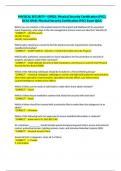
PHTLS Quiz
Questions and
Complete Solutions
Graded A+
Denning [Date] [Course title]
, In general, what is the leading cause of death in the United States? - Answer: Unintentional injury
Actions taken during the event phase of trauma care are designed to: - Answer: Minimize the injury
Which of the following does PHTLS not provide? - Answer: Specific care protocols for different classes of
trauma patients
Which of the following is a key change in the PHTLS recommendation for the assessment and treatment
of trauma patients? - Answer: XABCDE
You are called to the scene of a possible domestic violence situation and are the first to arrive on scene.
As you arrive, you hear a man and woman arguing loudly and a child crying in the background. You hear
a loud crash, and the women cries out. What is your first priority? - Answer: Call for law enforcement
Upon entering the house, you note that the female has obvious multiple bruises on her face and a
laceration over one cheek. She is holding her right arm, and you note a significant amount of blood
flowing from a long gash. This is an example of what type of hemorrhage? - Answer: Venous bleeding
What is the best way to control the bleeding? - Answer: direct pressure
As your partner begins to control the bleeding, what should you do? - Answer: Observe the scene for
potential danger
The patient is wearing long sleeves, and you have trouble visualizing the wound. What should you do? -
Answer: Cut the cloth away from the site, avoiding cutting through the slashed area.
You are called to the scene of an explosion and fire at a chemical plant where you find multiple
casualties. Triage has begun. Your first patient is a 40-year-old man who was near the source of the
explosion. He is unconscious and has extensive injuries. You note gurgling respiration's. Why should you
use the trauma jaw thrust maneuver first when dealing with a trauma patient? - Answer: It allows you to
open the airway with little or no movement of the head and cervical spine.
Questions and
Complete Solutions
Graded A+
Denning [Date] [Course title]
, In general, what is the leading cause of death in the United States? - Answer: Unintentional injury
Actions taken during the event phase of trauma care are designed to: - Answer: Minimize the injury
Which of the following does PHTLS not provide? - Answer: Specific care protocols for different classes of
trauma patients
Which of the following is a key change in the PHTLS recommendation for the assessment and treatment
of trauma patients? - Answer: XABCDE
You are called to the scene of a possible domestic violence situation and are the first to arrive on scene.
As you arrive, you hear a man and woman arguing loudly and a child crying in the background. You hear
a loud crash, and the women cries out. What is your first priority? - Answer: Call for law enforcement
Upon entering the house, you note that the female has obvious multiple bruises on her face and a
laceration over one cheek. She is holding her right arm, and you note a significant amount of blood
flowing from a long gash. This is an example of what type of hemorrhage? - Answer: Venous bleeding
What is the best way to control the bleeding? - Answer: direct pressure
As your partner begins to control the bleeding, what should you do? - Answer: Observe the scene for
potential danger
The patient is wearing long sleeves, and you have trouble visualizing the wound. What should you do? -
Answer: Cut the cloth away from the site, avoiding cutting through the slashed area.
You are called to the scene of an explosion and fire at a chemical plant where you find multiple
casualties. Triage has begun. Your first patient is a 40-year-old man who was near the source of the
explosion. He is unconscious and has extensive injuries. You note gurgling respiration's. Why should you
use the trauma jaw thrust maneuver first when dealing with a trauma patient? - Answer: It allows you to
open the airway with little or no movement of the head and cervical spine.