DANIELLA SPOTO
jeudi 3 mars 2022
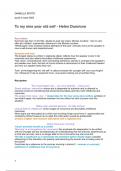
To my nine year old self - Helen Dunmore
Key context
Dunmore was born in the 50s- alludes to post war years, Moores murders- ‘men in cars
after girl-children’ euphemistic reference to the Moores murders.
‘White paper’ links to failed creative attempts of the poet- dramatic irony as the speaker is
now a well-known and respected poet.
Structure and tone
The longest stanza is written in elaborate detail- re ects how the speaker is lost in her
memories and also re ects boundless childhood experiences.
Free verse- conversational, short concluding sentences, stands in contrast ti the speaker’s
and readers own lives, the lack of rhyme scheme is reminiscent of their childhood freedom
and how our speaker lacks that now.
Tone- at the beginning the ‘old self’ is callous towards her younger self ‘you must forgive
me’. Moreover it has an exophoric tone- one person looking out at another thing.
Key quotes
‘You must forgive me/… we once shared/… I leave you’
Direct address- imperative shows she is desperate for authority and to attempt to
exercise control on something that should be boundless and free, both childhood and
memories.
The jumps from ‘you/.. me/.. I’ desperation for the two voices tone uni ed, symbolic of
her wistful regret, the transitions between the two re ect her lack of power over the
situation.
‘Baby vole/..sherbet lemons/.. ice lolly factory’
Lexical eld of childhood- evoke images of innocence and boundless childhood
memories.
When plans are interrupted as a child more exciting things come from it- opportunities are
constantly birthed however as an adult this interruption would be problematic
Creates a lighter tone however still paired with a regretful tone.
‘shant cloud your morning’
‘Cloud’ presents herself as a burden
‘Morning’ is a homophone for ‘mourning’ this emphasis the desperation to be uni ed
with her younger self but simultaneously an understanding that her previous experiences as
a child are now lost- she is no longer able to live in the same way she once did.
The title is signi cant as it represents the transition before double digits- possibly
referencing to the transition into puberty and becoming the woman she is today (voice of
the poem)
Could also be a reference to the summer morning in stanza 2 - summer vs overcast,
adulthood vs childhood, loss of innocence.
1
fi fi fl fl fl fi fi
jeudi 3 mars 2022
To my nine year old self - Helen Dunmore
Key context
Dunmore was born in the 50s- alludes to post war years, Moores murders- ‘men in cars
after girl-children’ euphemistic reference to the Moores murders.
‘White paper’ links to failed creative attempts of the poet- dramatic irony as the speaker is
now a well-known and respected poet.
Structure and tone
The longest stanza is written in elaborate detail- re ects how the speaker is lost in her
memories and also re ects boundless childhood experiences.
Free verse- conversational, short concluding sentences, stands in contrast ti the speaker’s
and readers own lives, the lack of rhyme scheme is reminiscent of their childhood freedom
and how our speaker lacks that now.
Tone- at the beginning the ‘old self’ is callous towards her younger self ‘you must forgive
me’. Moreover it has an exophoric tone- one person looking out at another thing.
Key quotes
‘You must forgive me/… we once shared/… I leave you’
Direct address- imperative shows she is desperate for authority and to attempt to
exercise control on something that should be boundless and free, both childhood and
memories.
The jumps from ‘you/.. me/.. I’ desperation for the two voices tone uni ed, symbolic of
her wistful regret, the transitions between the two re ect her lack of power over the
situation.
‘Baby vole/..sherbet lemons/.. ice lolly factory’
Lexical eld of childhood- evoke images of innocence and boundless childhood
memories.
When plans are interrupted as a child more exciting things come from it- opportunities are
constantly birthed however as an adult this interruption would be problematic
Creates a lighter tone however still paired with a regretful tone.
‘shant cloud your morning’
‘Cloud’ presents herself as a burden
‘Morning’ is a homophone for ‘mourning’ this emphasis the desperation to be uni ed
with her younger self but simultaneously an understanding that her previous experiences as
a child are now lost- she is no longer able to live in the same way she once did.
The title is signi cant as it represents the transition before double digits- possibly
referencing to the transition into puberty and becoming the woman she is today (voice of
the poem)
Could also be a reference to the summer morning in stanza 2 - summer vs overcast,
adulthood vs childhood, loss of innocence.
1
fi fi fl fl fl fi fi