Thermochemistry
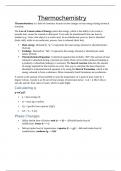
Thermochemistry is a field of chemistry focused on the changes in heat energy during chemical
reactions.
The Law of Conservation of Energy states that energy, which is the ability to do work or
provide heat, cannot be created or destroyed. It can only be transformed from one form to
another (e.g., from a hot object to a cooler one). In an endothermic process, heat is absorbed
(feels cold), while in an exothermic process, heat is released (feels hot).
Heat energy: Denoted by “q,” it represents the total energy released or absorbed (units:
J/kJ/cal).
Enthalpy: Denoted by “ΔH,” it represents the energy released or absorbed per mole
(units: kJ/mol).
Thermochemical Equation: A chemical equation that includes “ΔH” (the amount of heat
released or absorbed during a reaction per mole). Heat can be either produced (making it
a product) or absorbed (making it a reactant). The heat of reaction indicates the amount
of energy required for the reaction to occur. One way to calculate the heat released or
absorbed in a thermochemical equation is by using the Heat of Formation, which is the
energy released to form a substance. Most commonly listed formations are exothermic.
A calorie is the amount of heat needed to raise the temperature of 1 gram of pure water by 1
degree Celsius. A joule is an SI unit of heat energy. (Conversion factor: 1 cal = 4.184 J; this is
also the specific heat value of water, which is quite high).
Calculating q
q=mCpΔT
q = heat energy (J)
m = mass (g or moles)
Cp = specific heat capacity (J/gC)
ΔT = Tf - Ti (C)
Phase Changes
ΔHfus (molar heat of fusion: melt (s --> l)) = -ΔHsolid (molar heat of
solidifiction: freeze (l --> s)
ΔHvap (molar heat of vaporization: vaporize (l --> g)) = -ΔHcond (molar heat of
condensation: condense (g --> l)W
Thermochemistry is a field of chemistry focused on the changes in heat energy during chemical
reactions.
The Law of Conservation of Energy states that energy, which is the ability to do work or
provide heat, cannot be created or destroyed. It can only be transformed from one form to
another (e.g., from a hot object to a cooler one). In an endothermic process, heat is absorbed
(feels cold), while in an exothermic process, heat is released (feels hot).
Heat energy: Denoted by “q,” it represents the total energy released or absorbed (units:
J/kJ/cal).
Enthalpy: Denoted by “ΔH,” it represents the energy released or absorbed per mole
(units: kJ/mol).
Thermochemical Equation: A chemical equation that includes “ΔH” (the amount of heat
released or absorbed during a reaction per mole). Heat can be either produced (making it
a product) or absorbed (making it a reactant). The heat of reaction indicates the amount
of energy required for the reaction to occur. One way to calculate the heat released or
absorbed in a thermochemical equation is by using the Heat of Formation, which is the
energy released to form a substance. Most commonly listed formations are exothermic.
A calorie is the amount of heat needed to raise the temperature of 1 gram of pure water by 1
degree Celsius. A joule is an SI unit of heat energy. (Conversion factor: 1 cal = 4.184 J; this is
also the specific heat value of water, which is quite high).
Calculating q
q=mCpΔT
q = heat energy (J)
m = mass (g or moles)
Cp = specific heat capacity (J/gC)
ΔT = Tf - Ti (C)
Phase Changes
ΔHfus (molar heat of fusion: melt (s --> l)) = -ΔHsolid (molar heat of
solidifiction: freeze (l --> s)
ΔHvap (molar heat of vaporization: vaporize (l --> g)) = -ΔHcond (molar heat of
condensation: condense (g --> l)W