5.1 Communica-on and homeostasis
5.1.1 The Need for Homeostasis
Need for Communica-on Systems in Organisms
- Organisms need to respond to changes in internal/external environment, and coordinate different organs
- Control + communica;on systems ensure internal condi;ons are rela;vely constant for the organism to
func;on effec;vely
- Homeostasis = physiologically controlling systems to maintain internal environment within restricted
limits, cri;cally important to ensure maintenance of op;mal condi;ons for enzyme ac;on and cell func;on
- Physiological factors controlled by homeostasis: core body temperature, metabolic waste, blood pH, conc.
of blood glucose, water poten;al of blood, conc. of respiratory gases in blood
- Homeostasis requires informa;on to be transferred between parts of the body using 2 communica;on
systems: 1. The nervous system, 2. The endocrine system
The nervous system
- Human nervous system consists of: 1. CNS (central nervous system) – brain and spinal cord, 2. PNS
(peripheral nervous system) – all of the nerves in the body
- Allows humans to make sense of and respond to surroundings, coordinate and regulate body func;ons
- Informa;on is sent as nerve impulses – electrical signals that pass along nerve cells called neurones that
form bundles called nerves
- Neurones coordinate the ac;vity of sensory receptors, decision making centres in the CNS and effectors
e.g. muscles/glands
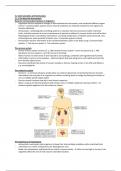
The endocrine system
- Hormone = a chemical substance produced by an endocrine gland and carried by the blood to transmit
informa;on from one part of an organism to another and bring about a change by altering the ac;vity of
one or mul;ple specific target organs
- Used to control func;ons that don’t need instant responses
- Gland = a group of cells that produces and releases one or mul;ple substances during secre;on – all
endocrine glands together form the endocrine system
The importance of homeostasis
- Homeosta;c mechanisms help organisms to keep their internal body condi;ons within restricted limits
- 3 key factors to control: temperature, pH, blood glucose conc.
- Stable core temperature and blood pH are vital for enzyme ac;vity – if either are too high or too low it can
nega;vely affect the rate of vital enzyme-controlled reac;ons
, pH
- All enzymes have an op;mum pH and are denatured at pH extremes
- Hydrogen and ionic bonds in the ter;ary structure are broken by excess of H+ or OH- ions in acidic/alkaline
solu;ons -> alters the shape of the ac;ve site -> enzyme-substate complexes form less easily un;l they
cannot form at all -> complete denatura;on of the enzyme
- Op;mal pH of each enzyme is influenced by where it operates in the body
Blood glucose concentra-on
- Conc. of blood glucose is vital as it affects the water poten;al of the blood and the availability of
respiratory substrate for cells
- Normal blood glucose conc. is 90mg per 100cm3 of blood
- Sufficient amount of circula;ng glucose is essen;al for cellular respira;on, brain cells can become rapidly
damaged or die without this, but too much drama;cally affects water poten;al
Stomata
- Plants carry out homeostasis to maintain a constant internal environment e.g. supply of carbon dioxide
- Stomata (especially guard cells) control the diffusion of gases in and out of leaves
- Stomata opening during the day is: 1. Good as carbon dioxide can be gained for photosynthesis, 2. Bad as
leaves lose lots of water through transpira;on
- Stomata closing at night is: 1. Good as water is retained (good during water stress), 2. Bad as supply of
carbon dioxide is reduced so rate of photosynthesis decreases
5.1.2 Principles of Homeostasis
Nega-ve Feedback
- Majority of homeosta;c control mechanisms use nega;ve feedback to maintain homeosta;c balance –
keeping certain physiological factors within specific limits
- Nega;ve feedback control loops involve: 1. A receptor to detect a s;mulus, 2. Coordina;on system
(nervous or endocrine) to transfer informa;on between parts of body, 3. Effector to carry out a response
- The factor/s;mulus is con;nuously monitored, so if it increases the body responds to make it decrease
and vice versa
5.1.1 The Need for Homeostasis
Need for Communica-on Systems in Organisms
- Organisms need to respond to changes in internal/external environment, and coordinate different organs
- Control + communica;on systems ensure internal condi;ons are rela;vely constant for the organism to
func;on effec;vely
- Homeostasis = physiologically controlling systems to maintain internal environment within restricted
limits, cri;cally important to ensure maintenance of op;mal condi;ons for enzyme ac;on and cell func;on
- Physiological factors controlled by homeostasis: core body temperature, metabolic waste, blood pH, conc.
of blood glucose, water poten;al of blood, conc. of respiratory gases in blood
- Homeostasis requires informa;on to be transferred between parts of the body using 2 communica;on
systems: 1. The nervous system, 2. The endocrine system
The nervous system
- Human nervous system consists of: 1. CNS (central nervous system) – brain and spinal cord, 2. PNS
(peripheral nervous system) – all of the nerves in the body
- Allows humans to make sense of and respond to surroundings, coordinate and regulate body func;ons
- Informa;on is sent as nerve impulses – electrical signals that pass along nerve cells called neurones that
form bundles called nerves
- Neurones coordinate the ac;vity of sensory receptors, decision making centres in the CNS and effectors
e.g. muscles/glands
The endocrine system
- Hormone = a chemical substance produced by an endocrine gland and carried by the blood to transmit
informa;on from one part of an organism to another and bring about a change by altering the ac;vity of
one or mul;ple specific target organs
- Used to control func;ons that don’t need instant responses
- Gland = a group of cells that produces and releases one or mul;ple substances during secre;on – all
endocrine glands together form the endocrine system
The importance of homeostasis
- Homeosta;c mechanisms help organisms to keep their internal body condi;ons within restricted limits
- 3 key factors to control: temperature, pH, blood glucose conc.
- Stable core temperature and blood pH are vital for enzyme ac;vity – if either are too high or too low it can
nega;vely affect the rate of vital enzyme-controlled reac;ons
, pH
- All enzymes have an op;mum pH and are denatured at pH extremes
- Hydrogen and ionic bonds in the ter;ary structure are broken by excess of H+ or OH- ions in acidic/alkaline
solu;ons -> alters the shape of the ac;ve site -> enzyme-substate complexes form less easily un;l they
cannot form at all -> complete denatura;on of the enzyme
- Op;mal pH of each enzyme is influenced by where it operates in the body
Blood glucose concentra-on
- Conc. of blood glucose is vital as it affects the water poten;al of the blood and the availability of
respiratory substrate for cells
- Normal blood glucose conc. is 90mg per 100cm3 of blood
- Sufficient amount of circula;ng glucose is essen;al for cellular respira;on, brain cells can become rapidly
damaged or die without this, but too much drama;cally affects water poten;al
Stomata
- Plants carry out homeostasis to maintain a constant internal environment e.g. supply of carbon dioxide
- Stomata (especially guard cells) control the diffusion of gases in and out of leaves
- Stomata opening during the day is: 1. Good as carbon dioxide can be gained for photosynthesis, 2. Bad as
leaves lose lots of water through transpira;on
- Stomata closing at night is: 1. Good as water is retained (good during water stress), 2. Bad as supply of
carbon dioxide is reduced so rate of photosynthesis decreases
5.1.2 Principles of Homeostasis
Nega-ve Feedback
- Majority of homeosta;c control mechanisms use nega;ve feedback to maintain homeosta;c balance –
keeping certain physiological factors within specific limits
- Nega;ve feedback control loops involve: 1. A receptor to detect a s;mulus, 2. Coordina;on system
(nervous or endocrine) to transfer informa;on between parts of body, 3. Effector to carry out a response
- The factor/s;mulus is con;nuously monitored, so if it increases the body responds to make it decrease
and vice versa