
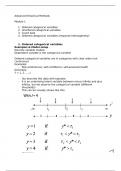
Advanced Empirical Methods
Module 1
1. Ordered categorical variables
2. Unordered categorical variables
3. Count data
4. Ordered categorical variables (response heterogeneity)
1. Ordered categorical variables
Examples & Model setup
Discrete variable models
Dependent variable is the categorical variable
Ordered categorical variables are in categories with clear order (not
continuous)
Examples:
- Risk preferences, self-confidence, self-assessed health
Generally:
Y = 1, 2, …, J
- You describe this data with tabulate.
- It is an underlying latent variable between minus infinity and plus
infinity, but we observe the categorical variable (different
thresholds)
- This can be visually shown like this:
,We can use the ordered logit and the ordered probit model for an ordered
categorical dependent variable. If we make a linear model for latent
continuous variable y*:
The categorical variable with the underlying latent variable:
We can choose for ordered probit or ordered logit model; the choice
depends on the error term:
- Ordered probit: u follows a std. normal distribution.
- Ordered logit: u follows a logistic distribution.
They are almost identical, not much difference.
The probability that y=j with an ordered logit model:
Pay attention to the minuses in the formula (they are correct because of
the thresholds)
The probability that y=j with an ordered probit model:
,Ordered logit model
Exponential of minus infinity is zero, so
Exponential of infinity is infinity. Infinity / infinity = 1, so
, Ordered probit model is done in the same matter as logit
Maximum Likelihood Estimation
We take the log likelihood because this simplifies the likelihood function.
Capital L over all the observations
Small 1 over 1 observation
Module 1
1. Ordered categorical variables
2. Unordered categorical variables
3. Count data
4. Ordered categorical variables (response heterogeneity)
1. Ordered categorical variables
Examples & Model setup
Discrete variable models
Dependent variable is the categorical variable
Ordered categorical variables are in categories with clear order (not
continuous)
Examples:
- Risk preferences, self-confidence, self-assessed health
Generally:
Y = 1, 2, …, J
- You describe this data with tabulate.
- It is an underlying latent variable between minus infinity and plus
infinity, but we observe the categorical variable (different
thresholds)
- This can be visually shown like this:
,We can use the ordered logit and the ordered probit model for an ordered
categorical dependent variable. If we make a linear model for latent
continuous variable y*:
The categorical variable with the underlying latent variable:
We can choose for ordered probit or ordered logit model; the choice
depends on the error term:
- Ordered probit: u follows a std. normal distribution.
- Ordered logit: u follows a logistic distribution.
They are almost identical, not much difference.
The probability that y=j with an ordered logit model:
Pay attention to the minuses in the formula (they are correct because of
the thresholds)
The probability that y=j with an ordered probit model:
,Ordered logit model
Exponential of minus infinity is zero, so
Exponential of infinity is infinity. Infinity / infinity = 1, so
, Ordered probit model is done in the same matter as logit
Maximum Likelihood Estimation
We take the log likelihood because this simplifies the likelihood function.
Capital L over all the observations
Small 1 over 1 observation


