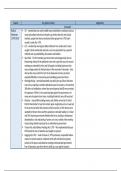
Aspects Key points/content Judgements
In Breadth
Radical SCI – membership was mostly middle-class industrialists, meetings to discuss
Reformers social and political reform but refused to go further than this into radical
(1790-1819) methods, people lost interest and joined other groups from 1783 and it
ceased to exist after 1795
LCS – membership was largely skilled craftsmen from London but it never
sought to limit membership and had a very low subscription fee; peaceful
methods such as pamphletting, discussions and debates
Spa Fields – The first meeting saw Henry Hunt come dangerously close to
threatening violence if the petitioners were not to get their way; the second
meeting was attended by Hunt and 10k people, including Spenceans who
were unhappy about the limited nature of the movement’s demands – they
riled up the crowd, which forced it to be dispersed and many arrested;
exposed difficulties of overcoming and outwitting government forces
Pentridge Rising – Jeremiah Brandreth was told by the spy Oliver that there
was to be an uprising in London replicated across the country so he marched
300 others to Nottingham, where they were dispersed and 80 were arrested;
the exposure of Oliver’s role caused outrage against the government, yet
many were transported and some, including Brandreth, were still executed
Peterloo – around 80k including women and children arrived to St. Peter’s
Field in Manchester to hear Henry Hunt speak, magistrates put out a warrant
for his arrest and when the yeomanry tried to exercise it, their horses were
spooked by thrown stones and they panicked, eventually leading to 11 dead
and 500+ injured; government defended the forces, leading to widespread
dissatisfaction, riots and joining of unions as it was a symbol of the working-
classes being violently repressed by an authoritarian government
Treason Act and Seditious Meetings Acts 1795 – Was implemented because
MPs feared the rise of radicalism and sought to repress it
Gagging Acts 1817 – made Treason act 1795 permanent, suspended habeus
corpus on treason suspects, outlawed secret oath and Spencean groups,
justices of the peace could disperse meetings; demonstrated government
fear of Spenceans, gave them time to build up a case against suspects,
, quelled unrest in the short-term but only until 1818 when the terms lapsed
Six Acts 1819 – unlawful drillings act, misdemeanours act, seditious meetings
act, criminal libel act, stamps act, seizure of arms act; seen as curtailing
freedom and so opposed by Whig opposition and contemporaries, although
others saw it as only tools at government’s disposal, restored calm, Seditious
Meetings Act repealed in 1924
Tom Paine – Wrote ‘Rights of Man’ which was a response to the conservative
Edmund Burke’s anti-revolutionary ideas and gained widespread support in
Britain and France; it proposed equal political and human rights and
proposed that there should be the implementation of a democratic assembly,
national education system, removal of aristocracy and their titles and also the
reorganisation of the tax system; the government ignored the first part even
though it reached an audience of 200k but, after the second publication,
introduced the seditious writings act which was seen as a direct response
John Cartwright – founded SCI and Hampden clubs; London Hampden clubs
had high fees and therefore middle-class membership, whilst regional
Hampden clubs were less exclusive; they discussed national news and
political matters and their aims were to achieve universal suffrage and annual
parliaments through petitioning; although they operated legally, the
government infiltrated them and many were arrested for attending seditious
meetings, preventing them from being able to continue beyond 1817
William Cobbett – wrote the Political Register, which had a circulation of 4k in
1805 and had sold 200k copies by 1817; ‘two-penny trash’ was a 2p single-
sheet version that could be sold to the WC and escape the stamp duties
Henry Hunt – radical orator who spoke at Peterloo; his political beliefs
changed drastically at the turn of the century when he was jailed
Chartism Aims of the Charter – Universal male suffrage, annual parliaments, abolition
(1838-50) of property qualification for MPs, payment of MPs, constituencies of equal
size, secret ballot
National Convention 1839 – attended by many men, women and children,
mostly MC, southerners had political concerns whilst midlanders economic;
mostly accepted that Parliament wouldn’t accept terms but torn between
peaceful and forceful methods to promote its passage; many MC delegates
In Breadth
Radical SCI – membership was mostly middle-class industrialists, meetings to discuss
Reformers social and political reform but refused to go further than this into radical
(1790-1819) methods, people lost interest and joined other groups from 1783 and it
ceased to exist after 1795
LCS – membership was largely skilled craftsmen from London but it never
sought to limit membership and had a very low subscription fee; peaceful
methods such as pamphletting, discussions and debates
Spa Fields – The first meeting saw Henry Hunt come dangerously close to
threatening violence if the petitioners were not to get their way; the second
meeting was attended by Hunt and 10k people, including Spenceans who
were unhappy about the limited nature of the movement’s demands – they
riled up the crowd, which forced it to be dispersed and many arrested;
exposed difficulties of overcoming and outwitting government forces
Pentridge Rising – Jeremiah Brandreth was told by the spy Oliver that there
was to be an uprising in London replicated across the country so he marched
300 others to Nottingham, where they were dispersed and 80 were arrested;
the exposure of Oliver’s role caused outrage against the government, yet
many were transported and some, including Brandreth, were still executed
Peterloo – around 80k including women and children arrived to St. Peter’s
Field in Manchester to hear Henry Hunt speak, magistrates put out a warrant
for his arrest and when the yeomanry tried to exercise it, their horses were
spooked by thrown stones and they panicked, eventually leading to 11 dead
and 500+ injured; government defended the forces, leading to widespread
dissatisfaction, riots and joining of unions as it was a symbol of the working-
classes being violently repressed by an authoritarian government
Treason Act and Seditious Meetings Acts 1795 – Was implemented because
MPs feared the rise of radicalism and sought to repress it
Gagging Acts 1817 – made Treason act 1795 permanent, suspended habeus
corpus on treason suspects, outlawed secret oath and Spencean groups,
justices of the peace could disperse meetings; demonstrated government
fear of Spenceans, gave them time to build up a case against suspects,
, quelled unrest in the short-term but only until 1818 when the terms lapsed
Six Acts 1819 – unlawful drillings act, misdemeanours act, seditious meetings
act, criminal libel act, stamps act, seizure of arms act; seen as curtailing
freedom and so opposed by Whig opposition and contemporaries, although
others saw it as only tools at government’s disposal, restored calm, Seditious
Meetings Act repealed in 1924
Tom Paine – Wrote ‘Rights of Man’ which was a response to the conservative
Edmund Burke’s anti-revolutionary ideas and gained widespread support in
Britain and France; it proposed equal political and human rights and
proposed that there should be the implementation of a democratic assembly,
national education system, removal of aristocracy and their titles and also the
reorganisation of the tax system; the government ignored the first part even
though it reached an audience of 200k but, after the second publication,
introduced the seditious writings act which was seen as a direct response
John Cartwright – founded SCI and Hampden clubs; London Hampden clubs
had high fees and therefore middle-class membership, whilst regional
Hampden clubs were less exclusive; they discussed national news and
political matters and their aims were to achieve universal suffrage and annual
parliaments through petitioning; although they operated legally, the
government infiltrated them and many were arrested for attending seditious
meetings, preventing them from being able to continue beyond 1817
William Cobbett – wrote the Political Register, which had a circulation of 4k in
1805 and had sold 200k copies by 1817; ‘two-penny trash’ was a 2p single-
sheet version that could be sold to the WC and escape the stamp duties
Henry Hunt – radical orator who spoke at Peterloo; his political beliefs
changed drastically at the turn of the century when he was jailed
Chartism Aims of the Charter – Universal male suffrage, annual parliaments, abolition
(1838-50) of property qualification for MPs, payment of MPs, constituencies of equal
size, secret ballot
National Convention 1839 – attended by many men, women and children,
mostly MC, southerners had political concerns whilst midlanders economic;
mostly accepted that Parliament wouldn’t accept terms but torn between
peaceful and forceful methods to promote its passage; many MC delegates