Chapter 53: Psychosocial Problems in Children and Families
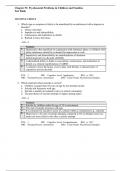
Test Bank
MULTIPLE CHOICE
1. Which sign or symptom is likely to be manifested by an adolescent with a depressive
disorder?
a. Abuse of alcohol
b. Impulsivity and distractibility
c. Carelessness and inattention to details
d. Refusal to leave the house
ANS: A
Feedback
A Depression often manifests in conjunction with substance abuse, so children who
abuse substances should be evaluated for depression as well.
B Impulsivity and distractibility are manifestations of attention-
deficit/hyperactivity disorder (ADHD).
C A diminished ability to think or concentrate, carelessness, and inattention to
details is a clinical manifestation of ADHD.
D A refusal to leave the house, even to play with friends, is characteristic of
separation anxiety disorder.
PTS: 1 DIF: Cognitive Level: Application REF: p. 1453
OBJ: Nursing Process: Assessment MSC: Client Needs: Psychosocial Integrity
2. Which statement about suicide is correct?
a. Children younger than 10 years of age do not attempt suicide.
b. Suicide risk decreases with age.
c. Suicide is usually an isolated event in a school community.
d. The prevalence of suicide attempts is higher among males.
ANS: A
Feedback
A Suicide by children under the age of 10 is uncommon.
B The risk of suicide increases with age.
C It is common for suicide to occur in a cluster within a community (e.g., schools).
D Males have a 4% rate of suicide attempts compared to 8% in females; however,
males are more likely to die after a suicide attempt.
PTS: 1 DIF: Cognitive Level: Comprehension REF: p. 1457
OBJ: Nursing Process: Assessment MSC: Client Needs: Psychosocial Integrity
, 3. The best response for the nurse to make to an adolescent who states, “I am very sad. I wish I
was not alive.” is
a. “Everyone feels sad once in a while.”
b. “You are just trying to escape your problems.”
c. “Have you told your parents how you feel?”
d. “Have you thought about hurting yourself?”
ANS: D
Feedback
A This is a judgmental response that ignores the adolescent’s obvious statement
indicating a need for professional help.
B This is a judgmental response that could increase the adolescent’s sense of
isolation and rejection.
C The parents should be made aware of an adolescent’s precarious mental state;
however, this response does not address the adolescent’s statement.
D This response acknowledges the adolescent’s suicide gesture and further
assesses the adolescent’s condition.
PTS: 1 DIF: Cognitive Level: Application REF: p. 1458 | Box 53-1
OBJ: Nursing Process: Implementation MSC: Client Needs: Psychosocial Integrity
4. The long-term treatment plan for an adolescent with an eating disorder focuses on
a. Managing the effects of malnutrition
b. Establishing sufficient caloric intake
c. Improving family dynamics
d. Restructuring perception of body image
ANS: D
Feedback
A The treatment of eating disorders is initially focused on reestablishing
physiologic homeostasis.
B Once body systems are stabilized, the next goal of treatment for eating disorders
is maintaining adequate caloric intake.
C Although family therapy is indicated when dysfunctional family relationships
exist, the primary focus of therapy for eating disorders is to help the adolescent
cope with complex issues.
D The focus of treatment in individual therapy for an eating disorder involves
restructuring cognitive perceptions about the individual’s body image.
PTS: 1 DIF: Cognitive Level: Application REF: p. 1465
OBJ: Nursing Process: Implementation MSC: Client Needs: Psychosocial Integrity
5. A parent of a child with an anxiety disorder states, “I don’t know how my child developed this
problem.” On what information should the nurse base a response?
a. Genetic factors, hormonal imbalances, and societal influences all contribute to the
development of anxiety disorders in children.
b. Like many conditions affecting children, the etiology of anxiety disorders is
unknown.
c. The majority of anxiety disorders have a clear pattern of genetic inheritance.
Test Bank
MULTIPLE CHOICE
1. Which sign or symptom is likely to be manifested by an adolescent with a depressive
disorder?
a. Abuse of alcohol
b. Impulsivity and distractibility
c. Carelessness and inattention to details
d. Refusal to leave the house
ANS: A
Feedback
A Depression often manifests in conjunction with substance abuse, so children who
abuse substances should be evaluated for depression as well.
B Impulsivity and distractibility are manifestations of attention-
deficit/hyperactivity disorder (ADHD).
C A diminished ability to think or concentrate, carelessness, and inattention to
details is a clinical manifestation of ADHD.
D A refusal to leave the house, even to play with friends, is characteristic of
separation anxiety disorder.
PTS: 1 DIF: Cognitive Level: Application REF: p. 1453
OBJ: Nursing Process: Assessment MSC: Client Needs: Psychosocial Integrity
2. Which statement about suicide is correct?
a. Children younger than 10 years of age do not attempt suicide.
b. Suicide risk decreases with age.
c. Suicide is usually an isolated event in a school community.
d. The prevalence of suicide attempts is higher among males.
ANS: A
Feedback
A Suicide by children under the age of 10 is uncommon.
B The risk of suicide increases with age.
C It is common for suicide to occur in a cluster within a community (e.g., schools).
D Males have a 4% rate of suicide attempts compared to 8% in females; however,
males are more likely to die after a suicide attempt.
PTS: 1 DIF: Cognitive Level: Comprehension REF: p. 1457
OBJ: Nursing Process: Assessment MSC: Client Needs: Psychosocial Integrity
, 3. The best response for the nurse to make to an adolescent who states, “I am very sad. I wish I
was not alive.” is
a. “Everyone feels sad once in a while.”
b. “You are just trying to escape your problems.”
c. “Have you told your parents how you feel?”
d. “Have you thought about hurting yourself?”
ANS: D
Feedback
A This is a judgmental response that ignores the adolescent’s obvious statement
indicating a need for professional help.
B This is a judgmental response that could increase the adolescent’s sense of
isolation and rejection.
C The parents should be made aware of an adolescent’s precarious mental state;
however, this response does not address the adolescent’s statement.
D This response acknowledges the adolescent’s suicide gesture and further
assesses the adolescent’s condition.
PTS: 1 DIF: Cognitive Level: Application REF: p. 1458 | Box 53-1
OBJ: Nursing Process: Implementation MSC: Client Needs: Psychosocial Integrity
4. The long-term treatment plan for an adolescent with an eating disorder focuses on
a. Managing the effects of malnutrition
b. Establishing sufficient caloric intake
c. Improving family dynamics
d. Restructuring perception of body image
ANS: D
Feedback
A The treatment of eating disorders is initially focused on reestablishing
physiologic homeostasis.
B Once body systems are stabilized, the next goal of treatment for eating disorders
is maintaining adequate caloric intake.
C Although family therapy is indicated when dysfunctional family relationships
exist, the primary focus of therapy for eating disorders is to help the adolescent
cope with complex issues.
D The focus of treatment in individual therapy for an eating disorder involves
restructuring cognitive perceptions about the individual’s body image.
PTS: 1 DIF: Cognitive Level: Application REF: p. 1465
OBJ: Nursing Process: Implementation MSC: Client Needs: Psychosocial Integrity
5. A parent of a child with an anxiety disorder states, “I don’t know how my child developed this
problem.” On what information should the nurse base a response?
a. Genetic factors, hormonal imbalances, and societal influences all contribute to the
development of anxiety disorders in children.
b. Like many conditions affecting children, the etiology of anxiety disorders is
unknown.
c. The majority of anxiety disorders have a clear pattern of genetic inheritance.