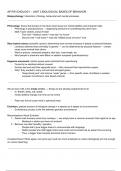
AP PSYCHOLOGY – UNIT 3 BIOLOGICAL BASES OF BEHAVIOR
Biopsychology: Interaction of biology, behavioral and mental processes
Phrenology: theory that bumps on the skull could reveal our mental abilities and character traits
- Phenology is pseudoscience → diagnosing someone w/ something they don’t have
- Mark Twain visited Lorenzo Fowler
- First visit = fictitious name = was told “no humor”
- Second visit = real name = was told “loftiest bump of humor” ever
Race based science (scientific racism): determining how criminal someone is based on physical features
- Lombroso believed that criminality is genetic → can be determined by physical features → certain
races more criminal than others
- Went to prisons, measured people’s skull size, nose length, etc.
- Most people in prisoners were Black or eastern european (pseudoscience)
Eugenics movement: certain groups were restricted from reproducing
- Forced to be sterilized without consent
- Doctors lied and said their appendix burst → then removed their reproductive organs
- Why? they wanted to carry out best and strongest genes
- “Keep blood pure” and remove “weak” genes → from specific races, like Black or eastern
european (Lombroso’s race based science)
We are born with a few innate abilities → things we are already programmed to do
- Ie. Breath, sleep, eat, speak
- Innate abilities change over time as we evolve
- Plato was first to locate mind in spherical head
Evolution: gradual process of biological change in a species as it adapts to its environment
- Evolutionary process is the link between genetics and behavior
Misconceptions About Evolution
1. Darwin said humans come from monkeys → we simply have a common ancestor that might be an ape
- Monkeys in status quo have not evolved
2. Behavior can alter heredity / genetics
- People didn’t grow bigger brains to communicate with language
- Rather people who had bigger brains and could communicate had an easier time surviving
- Thus, a bigger brain became dominant trait in humans
Accepted theory? Most agree, but some say it puts too much emphasis on nature (biological) and not enough
on nurture (learning)
,Natural Selection
- Those best adapted to environment are more likely to flourish and reproduce
- Those poorly adapted will have less offspring and their line will slowly die out as they have to compete
with stronger individuals
- New species would form when ancestors accumulated new traits that allowed them to survive
Owl butterfly
- White moths stood out in the dark, polluted city of Industrial era → easy to be found by predators
- Darker, black moths could survive → white moths became less common
- Owl butterfly’s wing looks like half an owl’s eye → scares away predators who are preyed by owls
How did this pattern develop?
- At first, they were just normal butterflies with random patterns
- But some butterflies with patterns that happened to look like an eye had a slightly less chance of being
eaten
- Over generations and over thousands of butterflies, the eye pattern dominates
- Then variations in this population form → as not all offspring will look identical
- Then within offspring, some will have slight differences that allow them to survive even better
- Whatever trait is best for survival will dominate
Heredity and Environment
- Heredity always works with environment → ie. nutrition, disease, stress
Genie the Wild Child
- Nature VS nurture
- Genie was rescued from immense abuse → her parents neglected her
- Put her in a dark cage where no one spoke to her → neural signals never fired, she never learned how
to understand language → when these signals don’t fire, they die off
- She was tiny → poor nutrition, no vitamin D from the sun
- Father is very abusive → orders wife and son to not talk to Genie
- Mother abused by husband
- Father goes out for groceries and mother escapes to neighbor and neighbor calls police → then finds
out abt Genie
- **When police arrives, Genie’s mother STILL sides with father → psychologically she’s still attached to
abuser (domestic abuse)
- Clark refused to answer questions abt Genie from the press
- He shot and killed himself before going to court for child abuse
- Could they teach Genie how to speak?
- Hypothesis: young children could only learn certain things at certain times → critical periods
- Genie was very curious and excited abt learning the words for things around her → she was not stupid,
not cognitively worse
- She learned so many WORDS but could not form sentences
, - **The neural system in left cortex of brain for speech and language was never stimulated → become
dysfunctional, disconnected, physically changes
- Without normal stimulation, brains are smaller and malformed → more this happens, worse the
symptoms
- One of scientists wanted her to get adopted → she needs love and belonging to feel secure
- When Genie turned 18, she moved back to abusive household with her mother
- Her mother refused to cope → Genie was moved to state care
- Genie moved from household to household → often staying with her therapists or scientists
- Irene claimed these people became too close to Genie and filed a lawsuit to prevent them from
seeing her → creating more isolation for Genie
Genetics and Inheritance
- Genetics plays a role in our basic makeup → temperament, tendency for fears, certain behavioral
patterns
- Genes: a segment of chromosome that encodes the directions for the inherited physical and mental
characteristics of an organism
- Portion of DNA that codes for a trait
- Occurs in pairs
- Dominant Gene: a gene that actively controls the expression of a trait
- Recessive Gene: a gene that influences the expression of a trait only when paired with an identical
gene
- Two categories of genetic inheritance: genotype and phenotype
- Genotype: An organism’s genetic makeup
- genetic code of your cells → responsible for your traits
- Three types of genotypes:
- Homozygous Dominant = BB
- Homozygous Recessive = bb
- Heterozygous = Bb
- Phenotype: What the genotype PHYSICALLY LOOKS like
- An organism’s physical characteristics → person’s unique sequence of DNA
- Physical expression of traits or genotype
- Ie. eye color, hair color
- Alleles: one gene out of BB
- different forms of the same trait
- Ie. both people have hair but in different textures or colors
- Dominant allele will cover a recessive allele
- You will only get a recessive allele if both alleles are recessive
- Ie. Eye color
- Dominant gene (B) others are recessive gene (b)
- Brown eyes are dominant gene, blue eyes are not (same with blonde hair)
- All people with brown eyes would be a little bit related as in they come from the same
ancestor
- Dominant genes are very STRONG and are likely to affect phenotype
Biopsychology: Interaction of biology, behavioral and mental processes
Phrenology: theory that bumps on the skull could reveal our mental abilities and character traits
- Phenology is pseudoscience → diagnosing someone w/ something they don’t have
- Mark Twain visited Lorenzo Fowler
- First visit = fictitious name = was told “no humor”
- Second visit = real name = was told “loftiest bump of humor” ever
Race based science (scientific racism): determining how criminal someone is based on physical features
- Lombroso believed that criminality is genetic → can be determined by physical features → certain
races more criminal than others
- Went to prisons, measured people’s skull size, nose length, etc.
- Most people in prisoners were Black or eastern european (pseudoscience)
Eugenics movement: certain groups were restricted from reproducing
- Forced to be sterilized without consent
- Doctors lied and said their appendix burst → then removed their reproductive organs
- Why? they wanted to carry out best and strongest genes
- “Keep blood pure” and remove “weak” genes → from specific races, like Black or eastern
european (Lombroso’s race based science)
We are born with a few innate abilities → things we are already programmed to do
- Ie. Breath, sleep, eat, speak
- Innate abilities change over time as we evolve
- Plato was first to locate mind in spherical head
Evolution: gradual process of biological change in a species as it adapts to its environment
- Evolutionary process is the link between genetics and behavior
Misconceptions About Evolution
1. Darwin said humans come from monkeys → we simply have a common ancestor that might be an ape
- Monkeys in status quo have not evolved
2. Behavior can alter heredity / genetics
- People didn’t grow bigger brains to communicate with language
- Rather people who had bigger brains and could communicate had an easier time surviving
- Thus, a bigger brain became dominant trait in humans
Accepted theory? Most agree, but some say it puts too much emphasis on nature (biological) and not enough
on nurture (learning)
,Natural Selection
- Those best adapted to environment are more likely to flourish and reproduce
- Those poorly adapted will have less offspring and their line will slowly die out as they have to compete
with stronger individuals
- New species would form when ancestors accumulated new traits that allowed them to survive
Owl butterfly
- White moths stood out in the dark, polluted city of Industrial era → easy to be found by predators
- Darker, black moths could survive → white moths became less common
- Owl butterfly’s wing looks like half an owl’s eye → scares away predators who are preyed by owls
How did this pattern develop?
- At first, they were just normal butterflies with random patterns
- But some butterflies with patterns that happened to look like an eye had a slightly less chance of being
eaten
- Over generations and over thousands of butterflies, the eye pattern dominates
- Then variations in this population form → as not all offspring will look identical
- Then within offspring, some will have slight differences that allow them to survive even better
- Whatever trait is best for survival will dominate
Heredity and Environment
- Heredity always works with environment → ie. nutrition, disease, stress
Genie the Wild Child
- Nature VS nurture
- Genie was rescued from immense abuse → her parents neglected her
- Put her in a dark cage where no one spoke to her → neural signals never fired, she never learned how
to understand language → when these signals don’t fire, they die off
- She was tiny → poor nutrition, no vitamin D from the sun
- Father is very abusive → orders wife and son to not talk to Genie
- Mother abused by husband
- Father goes out for groceries and mother escapes to neighbor and neighbor calls police → then finds
out abt Genie
- **When police arrives, Genie’s mother STILL sides with father → psychologically she’s still attached to
abuser (domestic abuse)
- Clark refused to answer questions abt Genie from the press
- He shot and killed himself before going to court for child abuse
- Could they teach Genie how to speak?
- Hypothesis: young children could only learn certain things at certain times → critical periods
- Genie was very curious and excited abt learning the words for things around her → she was not stupid,
not cognitively worse
- She learned so many WORDS but could not form sentences
, - **The neural system in left cortex of brain for speech and language was never stimulated → become
dysfunctional, disconnected, physically changes
- Without normal stimulation, brains are smaller and malformed → more this happens, worse the
symptoms
- One of scientists wanted her to get adopted → she needs love and belonging to feel secure
- When Genie turned 18, she moved back to abusive household with her mother
- Her mother refused to cope → Genie was moved to state care
- Genie moved from household to household → often staying with her therapists or scientists
- Irene claimed these people became too close to Genie and filed a lawsuit to prevent them from
seeing her → creating more isolation for Genie
Genetics and Inheritance
- Genetics plays a role in our basic makeup → temperament, tendency for fears, certain behavioral
patterns
- Genes: a segment of chromosome that encodes the directions for the inherited physical and mental
characteristics of an organism
- Portion of DNA that codes for a trait
- Occurs in pairs
- Dominant Gene: a gene that actively controls the expression of a trait
- Recessive Gene: a gene that influences the expression of a trait only when paired with an identical
gene
- Two categories of genetic inheritance: genotype and phenotype
- Genotype: An organism’s genetic makeup
- genetic code of your cells → responsible for your traits
- Three types of genotypes:
- Homozygous Dominant = BB
- Homozygous Recessive = bb
- Heterozygous = Bb
- Phenotype: What the genotype PHYSICALLY LOOKS like
- An organism’s physical characteristics → person’s unique sequence of DNA
- Physical expression of traits or genotype
- Ie. eye color, hair color
- Alleles: one gene out of BB
- different forms of the same trait
- Ie. both people have hair but in different textures or colors
- Dominant allele will cover a recessive allele
- You will only get a recessive allele if both alleles are recessive
- Ie. Eye color
- Dominant gene (B) others are recessive gene (b)
- Brown eyes are dominant gene, blue eyes are not (same with blonde hair)
- All people with brown eyes would be a little bit related as in they come from the same
ancestor
- Dominant genes are very STRONG and are likely to affect phenotype