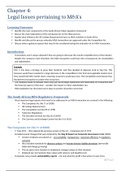
Chapter 4:
Legal Issues pertaining to M&A’s
Learning Outcomes
Identify the main components of the South African M&A regulatory framework
Discuss the main implications of the Companies Act on the M&A process
Explain what influence the JSE Listings Requirements have on M&A activities in South Africa
Identify and discuss the process whereby M&A transactions are approved under the Competition Act
Discuss other regulatory aspects that need to be considered during the evaluation of an M&A transaction.
Introduction
- Transactions aren’t always allowed if they are going to decrease the overall competitiveness of the industry
- Despite the company’s best intentions the M&A transaction could have dire consequences for shareholders
and stakeholders.
Example
Pick ‘n Pay have a strategy to grow their footprint, and thus decided to takeover Fruit & Veg City. This
however would have resulted in a large decrease in the competition in the fruit and vegetable market since
they would hold 60% market share, meaning consumers would pay more. The Competition Commission thus
blocked this transaction to protect the consumers.
- The company needs to consider more than just the strategic importance and motivation for transaction and
the financial aspects of the deal – consider the impact on other stakeholders too.
- M&A legislation has thus been put in place to protect all parties concerned.
The South African M&A Regulatory Framework
- Most important legal aspects that need to be addressed in an M&A transaction are covered in the following:
The Companies Act (No.71 of 2008)
JSE Listings Requirements
The Competition Act (No.89 of 1998)
Takeovers Regulations
The Securities Services Act (No.36 of 2004)
The Currency and Exchange Control Act (No.9 of 1933)
The Companies Act (No.71 of 2008)
- 1st May 2011 – this replaced the previous version of the act – Companies Act of 1973
- Included several changes that were inspired by the King III Report on Corporate Governance in SA (2009):
Greater emphasis was placed on – accountability, transparency, corporate efficiency & regulatory
certainty
Also included standards for director conduct and stricter director liability provisions (personally
liable with things go wrong)
This act gives more freedom to implement changes unique to their situation
Replaced par and nominal share values with solvency and liquidity tests
- Companies now provide sustainability reports – not only what the profit is but where it came from.
1|Page
, - There were changes to the mergers and amalgamations , this had implications for M&A transactions
- Merger/Amalgamation is now defined as:
“…any transaction that will either result in the formation of a new company ( or companies) that holds all
the assets and liabilities of the participating companies, or that entails the survival of at least one of the
participating companies that will hold all the assets and liabilities after the transaction took place.”
- Very important that that the resulting company should satisfy the Act’s solvency and liquidity requirements
- View table 4.1 on page 91 of textbook to see requirements
Elements of a business combination
- 3 stages that should be followed when combining businesses:
1.) Parties should enter into a merger agreement
2.) Shareholders of the participating companies should vote on the approval of the transaction
3.) Parties should implement the transaction
Stage 1: Entering into a merger agreement
Provides shareholders of prospective companies with most important info for proposed transaction
Written agreement should included information about:
o the proposed structure of the combined entity (A+B=C, A+B=A , A+B=B)
o the way in which the shares in the combine entity will be distributed or exchanged
o the manner in which the deal will be financed (more detail in chapter 6)
o the way in which the participating companies’ assets and liabilities will be distributed
o the strategy that will be followed to ensure that the combined entity will be managed
successfully
if the participating companies agree that the amalgamated company will meet the solvency and
liquidity requirements they can submit the agreement to be discussed at the shareholders meeting
each shareholder should receive a copy of the merger agreement
the shareholders should receive independent advice and have all the info to make a good decision
Stage 2: Shareholders of the participating companies should vote on the approval of the transaction
the shareholders must vote on the approval of the transaction
a special resolution should be passed:
o there should be a quorum of at least 25% of ordinary shareholders at the meeting
(Preference shares don’t have a vote)
o of these votes, approval by 75% of the participating vote is required
o if the acquirer is also a subsidiary – the parent must also approve the transaction
If shareholders who own 15% or more in any of the participating companies vote against the
proposal, any opposing shareholder could require the company first obtain court approval before the
deal can go through.
The board of directors of the relevant party then decide what to do (usually agree with court)
If 90% or more of the shareholders are in favour then the minorities can be “squeezed out” – this is
where they are forced to accept the deal
The minority will receive the same offer and terms as the other 90%
2|Page
Legal Issues pertaining to M&A’s
Learning Outcomes
Identify the main components of the South African M&A regulatory framework
Discuss the main implications of the Companies Act on the M&A process
Explain what influence the JSE Listings Requirements have on M&A activities in South Africa
Identify and discuss the process whereby M&A transactions are approved under the Competition Act
Discuss other regulatory aspects that need to be considered during the evaluation of an M&A transaction.
Introduction
- Transactions aren’t always allowed if they are going to decrease the overall competitiveness of the industry
- Despite the company’s best intentions the M&A transaction could have dire consequences for shareholders
and stakeholders.
Example
Pick ‘n Pay have a strategy to grow their footprint, and thus decided to takeover Fruit & Veg City. This
however would have resulted in a large decrease in the competition in the fruit and vegetable market since
they would hold 60% market share, meaning consumers would pay more. The Competition Commission thus
blocked this transaction to protect the consumers.
- The company needs to consider more than just the strategic importance and motivation for transaction and
the financial aspects of the deal – consider the impact on other stakeholders too.
- M&A legislation has thus been put in place to protect all parties concerned.
The South African M&A Regulatory Framework
- Most important legal aspects that need to be addressed in an M&A transaction are covered in the following:
The Companies Act (No.71 of 2008)
JSE Listings Requirements
The Competition Act (No.89 of 1998)
Takeovers Regulations
The Securities Services Act (No.36 of 2004)
The Currency and Exchange Control Act (No.9 of 1933)
The Companies Act (No.71 of 2008)
- 1st May 2011 – this replaced the previous version of the act – Companies Act of 1973
- Included several changes that were inspired by the King III Report on Corporate Governance in SA (2009):
Greater emphasis was placed on – accountability, transparency, corporate efficiency & regulatory
certainty
Also included standards for director conduct and stricter director liability provisions (personally
liable with things go wrong)
This act gives more freedom to implement changes unique to their situation
Replaced par and nominal share values with solvency and liquidity tests
- Companies now provide sustainability reports – not only what the profit is but where it came from.
1|Page
, - There were changes to the mergers and amalgamations , this had implications for M&A transactions
- Merger/Amalgamation is now defined as:
“…any transaction that will either result in the formation of a new company ( or companies) that holds all
the assets and liabilities of the participating companies, or that entails the survival of at least one of the
participating companies that will hold all the assets and liabilities after the transaction took place.”
- Very important that that the resulting company should satisfy the Act’s solvency and liquidity requirements
- View table 4.1 on page 91 of textbook to see requirements
Elements of a business combination
- 3 stages that should be followed when combining businesses:
1.) Parties should enter into a merger agreement
2.) Shareholders of the participating companies should vote on the approval of the transaction
3.) Parties should implement the transaction
Stage 1: Entering into a merger agreement
Provides shareholders of prospective companies with most important info for proposed transaction
Written agreement should included information about:
o the proposed structure of the combined entity (A+B=C, A+B=A , A+B=B)
o the way in which the shares in the combine entity will be distributed or exchanged
o the manner in which the deal will be financed (more detail in chapter 6)
o the way in which the participating companies’ assets and liabilities will be distributed
o the strategy that will be followed to ensure that the combined entity will be managed
successfully
if the participating companies agree that the amalgamated company will meet the solvency and
liquidity requirements they can submit the agreement to be discussed at the shareholders meeting
each shareholder should receive a copy of the merger agreement
the shareholders should receive independent advice and have all the info to make a good decision
Stage 2: Shareholders of the participating companies should vote on the approval of the transaction
the shareholders must vote on the approval of the transaction
a special resolution should be passed:
o there should be a quorum of at least 25% of ordinary shareholders at the meeting
(Preference shares don’t have a vote)
o of these votes, approval by 75% of the participating vote is required
o if the acquirer is also a subsidiary – the parent must also approve the transaction
If shareholders who own 15% or more in any of the participating companies vote against the
proposal, any opposing shareholder could require the company first obtain court approval before the
deal can go through.
The board of directors of the relevant party then decide what to do (usually agree with court)
If 90% or more of the shareholders are in favour then the minorities can be “squeezed out” – this is
where they are forced to accept the deal
The minority will receive the same offer and terms as the other 90%
2|Page