Week 2: The Oscilloscope
Thursday, January 9, 2020 4:14 PM
Key
• Oscilloscope trace: graph of Time(x) vs. Voltage(y)
• Voltage signal: voltage input occurring at a specific time.
2.1.1: Introduction to the Oscilloscope
• Used to measure voltage signals.
• Acts as a fast plotter of voltage over time.
○ Various knobs control the scales of the graph and when to begin plotting.
○ A dual-trace oscilloscope can plot 2 signals simultaneously.
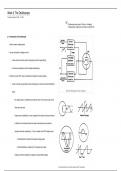
• Cathode-ray Tube (CRT): used by oscilloscope to display time varying voltages.
○ Inside, an electron gun generates a beam that passes b/w vertical and horizontal deflection
plates.
• No voltage: beam is un-deflected and strikes the center of the screen (screen on the
other side of the tube).
• Voltage: beam is deflected b/c a force is applied to the electrons that cause the beam
to deflect from its initial path. Beam then strikes a fluorescent screen (coated w/
phosphors that emit a visible light). -> Trace is created on the CRT's display screen.
• Vertical deflection: created by the measured voltage signal.
• Horizontal deflection: created by the "time base(x axis)" signal.
• Voltage must first be amplified, then applied to vertical deflection plates.
Function generator: gives the voltage signal Theoretical
Thursday, January 9, 2020 4:14 PM
Key
• Oscilloscope trace: graph of Time(x) vs. Voltage(y)
• Voltage signal: voltage input occurring at a specific time.
2.1.1: Introduction to the Oscilloscope
• Used to measure voltage signals.
• Acts as a fast plotter of voltage over time.
○ Various knobs control the scales of the graph and when to begin plotting.
○ A dual-trace oscilloscope can plot 2 signals simultaneously.
• Cathode-ray Tube (CRT): used by oscilloscope to display time varying voltages.
○ Inside, an electron gun generates a beam that passes b/w vertical and horizontal deflection
plates.
• No voltage: beam is un-deflected and strikes the center of the screen (screen on the
other side of the tube).
• Voltage: beam is deflected b/c a force is applied to the electrons that cause the beam
to deflect from its initial path. Beam then strikes a fluorescent screen (coated w/
phosphors that emit a visible light). -> Trace is created on the CRT's display screen.
• Vertical deflection: created by the measured voltage signal.
• Horizontal deflection: created by the "time base(x axis)" signal.
• Voltage must first be amplified, then applied to vertical deflection plates.
Function generator: gives the voltage signal Theoretical