BLS PRACTICE TEST QUESTIONS AND
ANSWERS
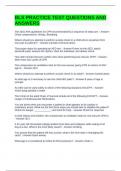
The 2010 AHA guidelines for CPR recommended BLS sequence of steps are: - Answer-
Chest compressions, Airway, Breathing
Where should you attempt to perform a pulse check in a child who is anywhere from
one year to puberty?* - Answer-Carotid or femoral artery
The proper steps for operating an AED are: - Answer-Power on the AED, attach
electrode pads, analyze the rhythm, clear the individual, and deliver shock
How often should rescuers switch roles when performing two-rescuer CPR? - Answer-
After every two cycles of CPR
The compression to ventilation ratio for the one-rescuer giving CPR to victims of ANY
age is: - Answer-30:2
Where should you attempt to perform a pulse check in an adult? - Answer-Carotid artery
At what age is it necessary to use the child AED pads? - Answer-8 years of age or
younger
An AED can be used safely in which of the following situations EXCEPT: - Answer-
Victim lying partially in water
The 5 links in the adult Chain of Survival include all of the following EXCEPT: - Answer-
Usage of Cardiovascular Medications
You are alone when you encounter a patient in what appears to be cardiac or
respiratory arrest. What are the first three steps you should take to stabilize the patient?
Check for danger, ____________, and send for help. - Answer-Check for response
In both infants and children, the compression to ventilation ratio for one-rescuer CPR is:
- Answer-30:2
A 21 year old intoxicated college student turns blue and collapses while eating a hot
dog at a bar. What is the most likely cause? - Answer-Choking
You assess that the patient still has a pulse, what is the next step in managing this
case? - Answer-Open airway
What age is a considered an infant for BLS purposes? - Answer-Under 1
ANSWERS
The 2010 AHA guidelines for CPR recommended BLS sequence of steps are: - Answer-
Chest compressions, Airway, Breathing
Where should you attempt to perform a pulse check in a child who is anywhere from
one year to puberty?* - Answer-Carotid or femoral artery
The proper steps for operating an AED are: - Answer-Power on the AED, attach
electrode pads, analyze the rhythm, clear the individual, and deliver shock
How often should rescuers switch roles when performing two-rescuer CPR? - Answer-
After every two cycles of CPR
The compression to ventilation ratio for the one-rescuer giving CPR to victims of ANY
age is: - Answer-30:2
Where should you attempt to perform a pulse check in an adult? - Answer-Carotid artery
At what age is it necessary to use the child AED pads? - Answer-8 years of age or
younger
An AED can be used safely in which of the following situations EXCEPT: - Answer-
Victim lying partially in water
The 5 links in the adult Chain of Survival include all of the following EXCEPT: - Answer-
Usage of Cardiovascular Medications
You are alone when you encounter a patient in what appears to be cardiac or
respiratory arrest. What are the first three steps you should take to stabilize the patient?
Check for danger, ____________, and send for help. - Answer-Check for response
In both infants and children, the compression to ventilation ratio for one-rescuer CPR is:
- Answer-30:2
A 21 year old intoxicated college student turns blue and collapses while eating a hot
dog at a bar. What is the most likely cause? - Answer-Choking
You assess that the patient still has a pulse, what is the next step in managing this
case? - Answer-Open airway
What age is a considered an infant for BLS purposes? - Answer-Under 1