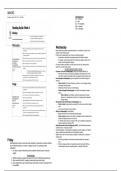
Wk4RG
Sunday, January 27, 2019 9:25 AM Abbreviation key:
b/w = between
w/ = with
Ex. = For example,
INC = increase
DEC = decrease
Wk4RG
Wednesday
• Before determining protein's properties/activities, it is essential for a protein to be
purified in their functional state.
• Proteins can be separated by size, charge, and binding properties
○ Fractionation: treatments that separate proteins into different fractions.
○ Ex. Dialysis: Large proteins kept within membranous bag/tube while conc of
solute in protein preparation changes.
• First step of protein purification is to break open (lyse) the cells, releasing their
protein into a crude extract solution.
• COLUMN CHROMATOGRAPHY NOTES:
• Overview of Column chromatography: charge, size, binding affinities, etc.
○ Will most likely have more resolution (separation) with smaller pores? in the
solid matrix; would allow smaller proteins to separate from larger ones (size).
• Ion-exchange chromatography: sign and magnitude of net electric charge @ a
given pH.
○ Order of elution: for cation exchangers, proteins w/ a more negative charge
move faster and elute earlier.
○ Affected by pH and/or salt conc of mobile phase.
○ Cation-exchange Chromatography: solid matrix has negatively charged
groups.
• Order of elution: just like Ion-, positively charged proteins migrate
slower, as (-) charged resin can bind to (+) charged proteins (opposite
charges attract).
• Size-exclusion (aka Gel Filtration) chromatography: size.
○ Order of elution: Large proteins emerge from the column sooner than smaller
ones.
○ Can be used to approx the size of protein.
• Affinity chromatography: binding affinity.
○ Beads within column have covalently-attached ligands.
○ Order of elution: proteins w/ an affinity to said ligand will bind to beads; those
proteins will migrate slower thru the column.
○ Ex. Protein whose function is to bind to ATP. Can be purified by migrating thru
beads w/ ligands that resemble ATP.
• High-performance liquid chromatography (HPLC): Limits diffusional spreading
of protein bands -> improves resolution.
• Immunoprecipitation: the technique of precipitating a protein antigen out of solution
using an antibody that specifically binds to that particular protein.
• Specific activity: the # of enzyme units per milligram of total protein; a measure of
enzyme purity.
Friday ○ INCs during purification and becomes maximal/constant when enzyme is
pure.
• Electrophoresis provides a visual for protein separation: researchers are able to estimate ○ Should be measured after each purification step b/c total protein DECs as
the # of different proteins in a mixture or degree of purity* of a particular protein chromatography removes unwanted proteins.-> Specific activity INCs.
preparation.
○ Can also be used to determine protein's properties (isoelectric point, molecular
weight).
Electrophoresis:
1. Different samples are loaded into wells @ the top of the SDS polyacrylamide gel.
2. When an electric field (E) is applied, proteins will move down the gel.
3. Gel is treated with a dye (Coomassie blue) which binds to proteins, allowing them to
be visualized.
Sunday, January 27, 2019 9:25 AM Abbreviation key:
b/w = between
w/ = with
Ex. = For example,
INC = increase
DEC = decrease
Wk4RG
Wednesday
• Before determining protein's properties/activities, it is essential for a protein to be
purified in their functional state.
• Proteins can be separated by size, charge, and binding properties
○ Fractionation: treatments that separate proteins into different fractions.
○ Ex. Dialysis: Large proteins kept within membranous bag/tube while conc of
solute in protein preparation changes.
• First step of protein purification is to break open (lyse) the cells, releasing their
protein into a crude extract solution.
• COLUMN CHROMATOGRAPHY NOTES:
• Overview of Column chromatography: charge, size, binding affinities, etc.
○ Will most likely have more resolution (separation) with smaller pores? in the
solid matrix; would allow smaller proteins to separate from larger ones (size).
• Ion-exchange chromatography: sign and magnitude of net electric charge @ a
given pH.
○ Order of elution: for cation exchangers, proteins w/ a more negative charge
move faster and elute earlier.
○ Affected by pH and/or salt conc of mobile phase.
○ Cation-exchange Chromatography: solid matrix has negatively charged
groups.
• Order of elution: just like Ion-, positively charged proteins migrate
slower, as (-) charged resin can bind to (+) charged proteins (opposite
charges attract).
• Size-exclusion (aka Gel Filtration) chromatography: size.
○ Order of elution: Large proteins emerge from the column sooner than smaller
ones.
○ Can be used to approx the size of protein.
• Affinity chromatography: binding affinity.
○ Beads within column have covalently-attached ligands.
○ Order of elution: proteins w/ an affinity to said ligand will bind to beads; those
proteins will migrate slower thru the column.
○ Ex. Protein whose function is to bind to ATP. Can be purified by migrating thru
beads w/ ligands that resemble ATP.
• High-performance liquid chromatography (HPLC): Limits diffusional spreading
of protein bands -> improves resolution.
• Immunoprecipitation: the technique of precipitating a protein antigen out of solution
using an antibody that specifically binds to that particular protein.
• Specific activity: the # of enzyme units per milligram of total protein; a measure of
enzyme purity.
Friday ○ INCs during purification and becomes maximal/constant when enzyme is
pure.
• Electrophoresis provides a visual for protein separation: researchers are able to estimate ○ Should be measured after each purification step b/c total protein DECs as
the # of different proteins in a mixture or degree of purity* of a particular protein chromatography removes unwanted proteins.-> Specific activity INCs.
preparation.
○ Can also be used to determine protein's properties (isoelectric point, molecular
weight).
Electrophoresis:
1. Different samples are loaded into wells @ the top of the SDS polyacrylamide gel.
2. When an electric field (E) is applied, proteins will move down the gel.
3. Gel is treated with a dye (Coomassie blue) which binds to proteins, allowing them to
be visualized.