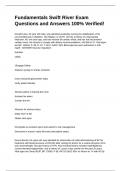
Fundamentals Swift River Exam
Questions and Answers 100% Verified!
Donald Lyles, 52-year old male, was admitted yesterday evening for stabilization of his
uncontrolled type II diabetes. His HbgA1c is 10.6%. He has a history of a Myocardial
Infarction, MI, one year ago, and has refused all cardiac rehab, and has not had another
cardiac event. He refuses to comply with dietary recommendations. His BMI is 37. Vital signs
are BP: 146/94, P: 88, R: 22, T: 99.2, PaO2: 94% Blood glucose upon admission is 340
mg/dl - ANSWER-Glucose regulation
Nutrition
safety
1Engage Safety
Dispose syringe in sharps container
2Use unexpired glucometer strips
Verify patient identity
3Assist patient in leaving the room
Activate fire alarm
Contain the fire
4Assess for obvious injury
Notify HCP of fall
Obtain vital signs
5Complete an incident report and submit to risk management
Document in nurses' notes fall event and patient status
Kenny Barrett, 64 years old, was admitted for observation of initial administering of BP his
treatment with blood pressure of 220/124 after visiting his doctor for a routine physical. ECG
was unremarkable. No past history of HTN. Past medical history includes hyperlipidemia,
current elevated triglycerides, and a history of 1 pack a day smoker for the past 20 years.
Vital signs are Temp 98.9F, BP 178/90, P 88, RR 18 SaO2 95% on Room air. IV with NS @
, 125 mL/ hr. Patient has been complaining of a headache and dizziness. He is a patient of Dr.
Adams. - ANSWER-Addiction
perfusion
2Inform patient that you will turn on the light
Ensure bed is in the lowest position and the bedside commode is next to the bed
Have patient sit on edge of the bed and place gait belt around waist
Call for 2nd assistance, if needed
3Enter patient's room quietly
Obtain vital signs and turn patient during lab draw
Check IV pump and hang antibiotics while patient is sleeping
4Ask patient how well she sleeps at night when at home
Review time/dose of patient's pain medication
Ask Ms. Yu if what sleep aids she takes at home
Assess patient's anxiety/depression related to sleep deprivation
5Place PureWick catheter
Give patient a bed bath and offer a back rub
Administer pain medication throughout the night
Preston Wright Scenario 1
Mr. Wright is experiencing aphasia. Select the appropriate ways to facilitate communication
with him. - ANSWER-1-Listen attentively and be patient
-Ask simple questions that require yes or no answers
-Use visual cues
-Let the patient know if you did not understand him
2-Reduce environmental noise
-Ensure you have the patient's full attention before speaking
-Face patient with mouth visible while speaking
Questions and Answers 100% Verified!
Donald Lyles, 52-year old male, was admitted yesterday evening for stabilization of his
uncontrolled type II diabetes. His HbgA1c is 10.6%. He has a history of a Myocardial
Infarction, MI, one year ago, and has refused all cardiac rehab, and has not had another
cardiac event. He refuses to comply with dietary recommendations. His BMI is 37. Vital signs
are BP: 146/94, P: 88, R: 22, T: 99.2, PaO2: 94% Blood glucose upon admission is 340
mg/dl - ANSWER-Glucose regulation
Nutrition
safety
1Engage Safety
Dispose syringe in sharps container
2Use unexpired glucometer strips
Verify patient identity
3Assist patient in leaving the room
Activate fire alarm
Contain the fire
4Assess for obvious injury
Notify HCP of fall
Obtain vital signs
5Complete an incident report and submit to risk management
Document in nurses' notes fall event and patient status
Kenny Barrett, 64 years old, was admitted for observation of initial administering of BP his
treatment with blood pressure of 220/124 after visiting his doctor for a routine physical. ECG
was unremarkable. No past history of HTN. Past medical history includes hyperlipidemia,
current elevated triglycerides, and a history of 1 pack a day smoker for the past 20 years.
Vital signs are Temp 98.9F, BP 178/90, P 88, RR 18 SaO2 95% on Room air. IV with NS @
, 125 mL/ hr. Patient has been complaining of a headache and dizziness. He is a patient of Dr.
Adams. - ANSWER-Addiction
perfusion
2Inform patient that you will turn on the light
Ensure bed is in the lowest position and the bedside commode is next to the bed
Have patient sit on edge of the bed and place gait belt around waist
Call for 2nd assistance, if needed
3Enter patient's room quietly
Obtain vital signs and turn patient during lab draw
Check IV pump and hang antibiotics while patient is sleeping
4Ask patient how well she sleeps at night when at home
Review time/dose of patient's pain medication
Ask Ms. Yu if what sleep aids she takes at home
Assess patient's anxiety/depression related to sleep deprivation
5Place PureWick catheter
Give patient a bed bath and offer a back rub
Administer pain medication throughout the night
Preston Wright Scenario 1
Mr. Wright is experiencing aphasia. Select the appropriate ways to facilitate communication
with him. - ANSWER-1-Listen attentively and be patient
-Ask simple questions that require yes or no answers
-Use visual cues
-Let the patient know if you did not understand him
2-Reduce environmental noise
-Ensure you have the patient's full attention before speaking
-Face patient with mouth visible while speaking