

HISTORY
GERMANY- OPTION 1C 1918-1945
- PART 4
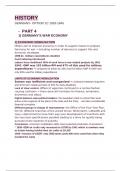
1) GERMANY'S WAR ECONOMY
1) ECONOMIC MOBILISATION
Hitlers aim to improve economy in order to support means to prepare
Germany for war → including number of decrees to support this and
economic strategies
1939-41- military expenditures doubled
Food rationing introduced
Labour force mobilised- 55% of work force in war related projects by 1941
1941- GNP was 152 billion RM and 47% of this used for military
expenditures → compared to britain by 1941 had 6.8 billion GBP in GNP and
only 60% used for military expenditures
LIMITS OF ECONOMIC MOBILISATION
System was inefficient and unorganised → confusion between long term
and short term needs and lack of time for early deadlines
Lack of clear control- differe;nt agencies continued in a normal fashion
causing confusion → there were still ministers for finance, armament,
economics and labour
Fights between nazi political leaders- the Gauleiters tried to control their local
areas at the expense of the plans of the state and the Party - and also considerable
financial corruption.
Different groups in charge of rearmaments- the Office of the Four-Year Plan,
the SS, different branches of the armed forces: Wehrmacht, Luftwaffe and
navy→ determined to have their way over development of munitions with
the very best specifications possible leading to a drive for quality being
pursued at the expense of quantity.
Conclusion- economic mobilisation didnt meet expected production of armament
^ 1939- 8290 air crafts only increased to 10780 by 1941 which is nowhere near
to britain having trebled their air crafts to 20,100
1942- invasion of USSR- only 3500 tanks (only 800 more used than when they
invaded the west)
, PLUNDERING FOREIGN RESOURCES
ADVANTAGES OF FOREIGN RESOURCES:
- gained access to new food supplies and to some key raw materials. France
provided coal and iron ore, Romania oil and the southern part of Russia
wheat.
- was able to exploit industrial facilities located within the conquered territories
– steelworks and munitions factories in France and Belgium, for example.
- captured large quantities of military equipment which it was able to put to use.
Former French tanks and artillery were in service with the German army right
up until 1945.
EFFECTS OF LOSS OF FOREIGN RESOURCES
- Oil was also in short supply.
- Synthetic fuel and Romanian oilfields could not keep up with demand.
- Hitler hoped to overcome the oil problem by seizing control of the Baku oilfield
in southern Russia. Defeat at Stalingrad in 1943 put an end to his hopes.
They could only plunder if they were winning.
IMPROVING ORGANISATION
- Responsibility over planning shared by competing agencies- ministry of war
general thomas led economic section of armaments programme →
had rivals in economic supremacy (Hermann goering head of 4 year
plan & walther flunk leader of minister of economics)|
- 1940- ministry of munitions created by fritz todt- helping the confusion of
that part of economy
- June 1940- france surrneder plans to use nazi regimes resources
- 1941- invasion of SU- failure led to rethinking of economic policy
- 3rd dec 1941- Fuhrer Order on the Simplication and Increased Efficiency
in Armaments Production which ordered Todt to rationalize the
armaments industry → raising production levels
- Feb 1942- Albert speer appointed as minister if armaments and war
production → followed with todts plans to rationalize industry and
more control over industry plants
TOTAL WAR- introduced by joseph goebbles → called for labour service
and closure of all non-essential businesses → down to the work of speer
GERMANY- OPTION 1C 1918-1945
- PART 4
1) GERMANY'S WAR ECONOMY
1) ECONOMIC MOBILISATION
Hitlers aim to improve economy in order to support means to prepare
Germany for war → including number of decrees to support this and
economic strategies
1939-41- military expenditures doubled
Food rationing introduced
Labour force mobilised- 55% of work force in war related projects by 1941
1941- GNP was 152 billion RM and 47% of this used for military
expenditures → compared to britain by 1941 had 6.8 billion GBP in GNP and
only 60% used for military expenditures
LIMITS OF ECONOMIC MOBILISATION
System was inefficient and unorganised → confusion between long term
and short term needs and lack of time for early deadlines
Lack of clear control- differe;nt agencies continued in a normal fashion
causing confusion → there were still ministers for finance, armament,
economics and labour
Fights between nazi political leaders- the Gauleiters tried to control their local
areas at the expense of the plans of the state and the Party - and also considerable
financial corruption.
Different groups in charge of rearmaments- the Office of the Four-Year Plan,
the SS, different branches of the armed forces: Wehrmacht, Luftwaffe and
navy→ determined to have their way over development of munitions with
the very best specifications possible leading to a drive for quality being
pursued at the expense of quantity.
Conclusion- economic mobilisation didnt meet expected production of armament
^ 1939- 8290 air crafts only increased to 10780 by 1941 which is nowhere near
to britain having trebled their air crafts to 20,100
1942- invasion of USSR- only 3500 tanks (only 800 more used than when they
invaded the west)
, PLUNDERING FOREIGN RESOURCES
ADVANTAGES OF FOREIGN RESOURCES:
- gained access to new food supplies and to some key raw materials. France
provided coal and iron ore, Romania oil and the southern part of Russia
wheat.
- was able to exploit industrial facilities located within the conquered territories
– steelworks and munitions factories in France and Belgium, for example.
- captured large quantities of military equipment which it was able to put to use.
Former French tanks and artillery were in service with the German army right
up until 1945.
EFFECTS OF LOSS OF FOREIGN RESOURCES
- Oil was also in short supply.
- Synthetic fuel and Romanian oilfields could not keep up with demand.
- Hitler hoped to overcome the oil problem by seizing control of the Baku oilfield
in southern Russia. Defeat at Stalingrad in 1943 put an end to his hopes.
They could only plunder if they were winning.
IMPROVING ORGANISATION
- Responsibility over planning shared by competing agencies- ministry of war
general thomas led economic section of armaments programme →
had rivals in economic supremacy (Hermann goering head of 4 year
plan & walther flunk leader of minister of economics)|
- 1940- ministry of munitions created by fritz todt- helping the confusion of
that part of economy
- June 1940- france surrneder plans to use nazi regimes resources
- 1941- invasion of SU- failure led to rethinking of economic policy
- 3rd dec 1941- Fuhrer Order on the Simplication and Increased Efficiency
in Armaments Production which ordered Todt to rationalize the
armaments industry → raising production levels
- Feb 1942- Albert speer appointed as minister if armaments and war
production → followed with todts plans to rationalize industry and
more control over industry plants
TOTAL WAR- introduced by joseph goebbles → called for labour service
and closure of all non-essential businesses → down to the work of speer



