

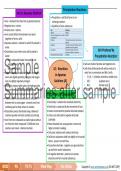
Precipitation Reactions:
Ions in Aqueous Solution:
• Precipitate = solid that forms in ion-
• Ions = elements that have lost or gained electrons. exchange reaction.
• Negative ions = anions. • Solubility of ionic substances:
• Positive ions = cations.
• Ionic crystal lattice formed when ions bond
together to form a solid.
• Aqueous solution = solution in which the solvent is
water.
• Dissolution occurs when ionic solid is placed in Salt Produced by
water: Precipitation Reaction:
- Ionic compound breaks into positive and
•Sample negative ions.
- Ions are hydrated.
Water molecules are polar molecules - hydrogen
atoms are slightly positively charged, and oxygen
ions are slightly negatively charged.
U1: Reactions
in Aqueous
Solutions (A)
• Salts are made of positive and negative ions.
• Salts that will be dealt with will be made of a
metal ion or ammonium ion (NH4+) with:
- Cl-, Br-, I- (chloride, bromide or iodide ions).
- SO42- (sulphate ions).
• -
Summaries after sample
When ions interact with water, the hydrogen side - NO3 (nitrate ions).
of water molecules surrounds negative ions - causes - CO32- (carbonate ions).
attraction between hydrogen atoms and ions. Electrolytes & Conductivity:
• Positive ions are surrounded due to attraction
between the ion and oxygen - prevents ions from • Electrolyte = solution that conducts electricity.
combining and so they remain in solution. • Electricity is conducted by the movement of ions.
• Dissolution process illustrated using a balanced • Anions are attracted to positive electrode (anode).
reaction equation and state symbols (s) and (aq). • Cations are attracted to negative electrode
• Ions from one compound can switch places with an (cathode).
ion from the other compound if 2 different ionic • More dissolved ions cause greater current and
solutions are mixed - chemical reaction. higher ammeter readings.
• Only ionic solutions will conduct electricity.
• Solid ionic substances hold ions tightly in the crystal
lattice - prevent current flow.
• At positive electrode - negative ions give electrons
up and form neutral substances.
• At negative electrode - positive ions accept
electrons and form neutral substances.
GR10 PS T3-T1 Mind Map Via Afrika Copyright © www.summariessa.co.za (DO NOT COPY)
,Sample
Summaries after sample
, Sample
Summaries after sample
Ions in Aqueous Solution:
• Precipitate = solid that forms in ion-
• Ions = elements that have lost or gained electrons. exchange reaction.
• Negative ions = anions. • Solubility of ionic substances:
• Positive ions = cations.
• Ionic crystal lattice formed when ions bond
together to form a solid.
• Aqueous solution = solution in which the solvent is
water.
• Dissolution occurs when ionic solid is placed in Salt Produced by
water: Precipitation Reaction:
- Ionic compound breaks into positive and
•Sample negative ions.
- Ions are hydrated.
Water molecules are polar molecules - hydrogen
atoms are slightly positively charged, and oxygen
ions are slightly negatively charged.
U1: Reactions
in Aqueous
Solutions (A)
• Salts are made of positive and negative ions.
• Salts that will be dealt with will be made of a
metal ion or ammonium ion (NH4+) with:
- Cl-, Br-, I- (chloride, bromide or iodide ions).
- SO42- (sulphate ions).
• -
Summaries after sample
When ions interact with water, the hydrogen side - NO3 (nitrate ions).
of water molecules surrounds negative ions - causes - CO32- (carbonate ions).
attraction between hydrogen atoms and ions. Electrolytes & Conductivity:
• Positive ions are surrounded due to attraction
between the ion and oxygen - prevents ions from • Electrolyte = solution that conducts electricity.
combining and so they remain in solution. • Electricity is conducted by the movement of ions.
• Dissolution process illustrated using a balanced • Anions are attracted to positive electrode (anode).
reaction equation and state symbols (s) and (aq). • Cations are attracted to negative electrode
• Ions from one compound can switch places with an (cathode).
ion from the other compound if 2 different ionic • More dissolved ions cause greater current and
solutions are mixed - chemical reaction. higher ammeter readings.
• Only ionic solutions will conduct electricity.
• Solid ionic substances hold ions tightly in the crystal
lattice - prevent current flow.
• At positive electrode - negative ions give electrons
up and form neutral substances.
• At negative electrode - positive ions accept
electrons and form neutral substances.
GR10 PS T3-T1 Mind Map Via Afrika Copyright © www.summariessa.co.za (DO NOT COPY)
,Sample
Summaries after sample
, Sample
Summaries after sample


