biomg 3300 unit 13 Questions with Correct Answers
What is the function of glycogen in mammals? In what tissues does it
occur (pp. 556 - 557)? Correct Answer-glycogen: storage of glucose in
animals. occurs in liver and muscle
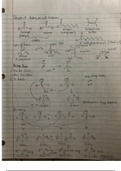
Using structures, write a balanced chemical equation for the reaction
catalyzed by glycogen phosphorylase (Fig. 15-3, p. 558). Correct
Answer-use glycogen phosphorylase to catalyze cleavage of glycogen
w/ n residues
forms glucose 1-phosphate + glycogen with n-1 residues
Explain why glycogen phosphorolysis is energetically more efficient
than hydrolysis (that occurs during digestion in the intestine; pp. 558 -
559. Think about this in terms of the product of glycogen phosphorolysis
and what would be required to produce a similar molecule using
glycolysis). Correct Answer-phosphorylysis: energy stored in formation
of phosphate ester
hydrolysis: energy released as heat
List several reasons why sugar nucleotides are suitable substrates for
biosynthetic reactions (pp. 560 - 561). Correct Answer-1. formation of
sugars is metabolically irreversible
2. nucleotides can undergo non-covalent interactions w enzymes
3. nucleotidyl group (UDP/ADP) is a good leaving group
, 4. cells can tag hexose with nucleotidyl groups + designate for another
purpose
Using structures, write a balanced chemical equation for the reaction that
generates a sugar nucleotide (Fig. 15-7, p. 563). Name the other product
of the reaction and discuss why it is important Correct Answer-
(Although this Figure is general for polysaccharide synthesis, the sugar
nucleotide that is specifically used in the formation of glycogen is UDP-
glucose.)
net reaction: Sugar phosphate + NTP -> NDP-Sugar + 2Pi
products: NDP-sugar + Pyrophosphate
Using structures, write a balanced chemical equation for the reaction
catalyzed by glycogen synthase (Fig. 15-8, p. 563). Correct Answer-net
reaction: UDP-Glucose + (non-reducing end of) glycogen chain w/ n
residues -> elongated glycogen chain w/ n+1 residues
All polysaccharide synthesis follows the same general pattern:
conversion of a monosaccharide 1-P to a nucleoside diphosphate sugar
(NDP - sugar) followed by transfer of the sugar to the growing end of a
polysaccharide chain.
Discuss the biological significance of the branched structure in glycogen
(p. 563). Correct Answer-branching increases the number of non-
What is the function of glycogen in mammals? In what tissues does it
occur (pp. 556 - 557)? Correct Answer-glycogen: storage of glucose in
animals. occurs in liver and muscle
Using structures, write a balanced chemical equation for the reaction
catalyzed by glycogen phosphorylase (Fig. 15-3, p. 558). Correct
Answer-use glycogen phosphorylase to catalyze cleavage of glycogen
w/ n residues
forms glucose 1-phosphate + glycogen with n-1 residues
Explain why glycogen phosphorolysis is energetically more efficient
than hydrolysis (that occurs during digestion in the intestine; pp. 558 -
559. Think about this in terms of the product of glycogen phosphorolysis
and what would be required to produce a similar molecule using
glycolysis). Correct Answer-phosphorylysis: energy stored in formation
of phosphate ester
hydrolysis: energy released as heat
List several reasons why sugar nucleotides are suitable substrates for
biosynthetic reactions (pp. 560 - 561). Correct Answer-1. formation of
sugars is metabolically irreversible
2. nucleotides can undergo non-covalent interactions w enzymes
3. nucleotidyl group (UDP/ADP) is a good leaving group
, 4. cells can tag hexose with nucleotidyl groups + designate for another
purpose
Using structures, write a balanced chemical equation for the reaction that
generates a sugar nucleotide (Fig. 15-7, p. 563). Name the other product
of the reaction and discuss why it is important Correct Answer-
(Although this Figure is general for polysaccharide synthesis, the sugar
nucleotide that is specifically used in the formation of glycogen is UDP-
glucose.)
net reaction: Sugar phosphate + NTP -> NDP-Sugar + 2Pi
products: NDP-sugar + Pyrophosphate
Using structures, write a balanced chemical equation for the reaction
catalyzed by glycogen synthase (Fig. 15-8, p. 563). Correct Answer-net
reaction: UDP-Glucose + (non-reducing end of) glycogen chain w/ n
residues -> elongated glycogen chain w/ n+1 residues
All polysaccharide synthesis follows the same general pattern:
conversion of a monosaccharide 1-P to a nucleoside diphosphate sugar
(NDP - sugar) followed by transfer of the sugar to the growing end of a
polysaccharide chain.
Discuss the biological significance of the branched structure in glycogen
(p. 563). Correct Answer-branching increases the number of non-