LEARNING UNIT 1: HEATING & EQUIPMENT
- {CHAPTER 4: FOOD SAFETY & 5: FOOD PREP BASICS}
1.1. Heating: the process of speeding up the movement of molecules, while low temperatures
slow it down.
Heating food also involves:
o Conduction
o Convection
o Induction
o Radiation
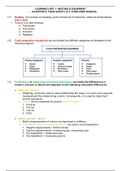
1.2. Food preparation equipment can be divided into different categories as illustrated in the
following diagram:
1.3. Consistency in measuring and mixing techniques can make the difference to a
recipe’s success or failure and depends on the following noticeable differences:
Mass and volume
o Weighing, commonly used to mean determining the mass, is a much more accurate
measurement than determining volume. Consequently, it is used by many food
service operations.
o Weight can be measured by several different scales.
1. Nominal
2. Ordinal
3. Interval
4. Ratio.
Metric and Non - Metric
o Metric measurements of volume are expressed in millilitres.
o Five different types of measuring utensils are used in food preparation.
1. Weight measurements = Kitchen Scale
2. Volume measurements = measuring jug / measuring cups
3. Dry ingredients = measuring cups
4. Dry ingredients = measuring spoons
, LEARNING UNIT 2: FOOD PREPARATION BASICS
- {CHAPTER 5: FOOD PREP BASICS}
2.1. Methods of heating food
- Moist-heat preparation: Heat is transferred by water, a water-based liquid or steam.
- Dry-heat preparation: Heat is transferred by air, radiation, fat or metal.
- Microwave: Usually listed as a moist heat, microwaves actually incorporate both dry-heat
(radiation) and moist-heat methods.
Heating:
= changes the molecular structure of food
= destroys harmful microorganisms
= alters the texture, taste, odour and appearance of food
2.2. Using cutlery properly is one of the most important aspects of food preparation.
- For instance, knowing knives and how to use them is essential to basic food preparation.
- The technique varies according to the type of knife that is chosen for a task.
2.3. Handling knives
- The most frequently used knife is the chef’s or French knife.
- This knife should be firmly held with the base of the blade between the thumb and
forefinger and the other fingers wrapped around the handle.
- The other hand must hold the food and guide it towards the blade.
- Curl the fingers, keep them away from the cutting edge, and allow at least a 1,25 cm barrier
of food between the blade and the fingers holding the food.
2.4. Cutting styles
- It is very important to apply the right style when cutting food.
- The goal in cutting food is uniformity. Why? Because this allows even heating and gives
food an appetising appearance.
- The size of your food service establishment will determine whether you can do everything
by hand or must rely on equipment to do the job.
- Time, money and labour also play a role in your decision.
- The different styles of cutting allow us to have different types of food shapes for
convenience in food preparation, and because foods are different some require a certain
style of cutting.
2.4.1. Slicing
- To move the food under the blade while keeping the point of the blade firmly on the cutting
board the base of the knife is lifted and pushed down with a forward and backward motion.
2.4.2. Julienne
- This method is used to cut food length-wise into thin, stick-like shapes as shown in a bowl
with carrots and celery Figure 2.3 (study guide) illustrates how to cut food this way.
2.4.3. Shredding
- This is method is used to cut leaf vegetables into thin strips. Figure 2.4 (study guide) shows
shredded vegetables.
2.4.4. Dicing
- This method is used to cut food into even-sized cubes. Figure 2.5 (study guide) illustrates
diced carrots.
2.4.5. Mince
- This method is used to chop food into very fine pieces. Figure 2.6 (study guide) illustrates
how to cut food into fine pieces.
,2.4.6. Peeling
- This is used to remove the skin as shown in figure 2.7 (study guide). Some vegetables like
asparagus can be peeled with a paring knife.
2.5. Measuring the ingredients
Correct measuring is essential in basic food preparation. It is important to know how to use
and read the general measuring units. Wet ingredients are measured by means of a
transparent, graduated cup with a pour spout. Dry ingredients are measured by means of
flat-topped measuring cups for levelling.
For greater accuracy, scales may be used to measure ingredients.
There are three basic steps in measuring:
1. Acquiring the amount for a specific measurement
2. Selecting the right measuring utensil
3. Using an accurate measuring technique
2.6. Seasonings and Flavourings
“Enhancing the flavour of food is an art that is critical to the acceptability of foods, and
restaurants can succeed or fail depending on how that art is practiced” (Amy Brown,
2015:113).
The ingredients that are used for seasoning and flavouring are commonly known as herbs
and spices. These add flavour to food. More than one seasoning can be used in a dish to
complement each other.
The types of seasoning and flavouring:
Salt
Herbs & Spices
Oil extracts
Marinades
Breading
Batters.
, LEARNING UNIT 3: MILK AND CHEESE
{CHAPTER 10: MILK & 11: CHEESE}
3. Milk
3.1. Composition of Milk
o a complex food in which more than a hundred components have been identified.
o The exact composition of milk varies, depending on the breed of cattle, the feed used and
the period of lactation.
o The milk available on the market, however, has a uniform composition that may vary
slightly according to governmental regulations in terms of butterfat and solids content.
3.2. The nutrients in milk
o Proteins
o Carbohydrates
o Fats
o Minerals
o Vitamins
o Proteins
Predominant types of protein found in milk:
Casein = primary protein (80%) found in milk, can be precipitated (solidified out of
solution) with acid or certain enzymes
Whey = watery component removed from curd in cheese manufacture
= consists primarily of water (93%), lactose and whey proteins
= Putting milk through an ultrafiltration process isolates whey. This liquid
fraction is used by the food industry as an emulsifier and as a foaming and gelling agent.
= Adding milk proteins to other foods improves their texture, mouth-feel,moisture
retention and flavour.
o Carbohydrates
Lactose or milk sugar is the primary carbohydrate found in milk.
When the bacteria in milk metabolise lactose, lactic acid is produced. Lactic acid is
responsible for the flavour in cheese, yogurt and sour cream.
Lactose is broken down by lactase into glucose and galactose, which are easily absorbed.
o Fats
The fat in milk, called milk fat or butterfat, plays a role in the flavour, mouth-feel and
stability of milk products.
Milk contains cholesterol.
The fat that is present in the cream is finely emulsified.
o Minerals
The major mineral in milk and milk products = calcium.
o Vitamins
Milk contains vitamins A, D, B (riboflavin) and traces of niacin.
o Water – almost 90% of milk is water. (87.4%)
o Phosphorus, potassium, magnesium, sodium, chloride and sulphur are found in smaller
quantities in milk and milk products.
o Milk is low in iron.
3.3. Effect of heat on quality of milk
- {CHAPTER 4: FOOD SAFETY & 5: FOOD PREP BASICS}
1.1. Heating: the process of speeding up the movement of molecules, while low temperatures
slow it down.
Heating food also involves:
o Conduction
o Convection
o Induction
o Radiation
1.2. Food preparation equipment can be divided into different categories as illustrated in the
following diagram:
1.3. Consistency in measuring and mixing techniques can make the difference to a
recipe’s success or failure and depends on the following noticeable differences:
Mass and volume
o Weighing, commonly used to mean determining the mass, is a much more accurate
measurement than determining volume. Consequently, it is used by many food
service operations.
o Weight can be measured by several different scales.
1. Nominal
2. Ordinal
3. Interval
4. Ratio.
Metric and Non - Metric
o Metric measurements of volume are expressed in millilitres.
o Five different types of measuring utensils are used in food preparation.
1. Weight measurements = Kitchen Scale
2. Volume measurements = measuring jug / measuring cups
3. Dry ingredients = measuring cups
4. Dry ingredients = measuring spoons
, LEARNING UNIT 2: FOOD PREPARATION BASICS
- {CHAPTER 5: FOOD PREP BASICS}
2.1. Methods of heating food
- Moist-heat preparation: Heat is transferred by water, a water-based liquid or steam.
- Dry-heat preparation: Heat is transferred by air, radiation, fat or metal.
- Microwave: Usually listed as a moist heat, microwaves actually incorporate both dry-heat
(radiation) and moist-heat methods.
Heating:
= changes the molecular structure of food
= destroys harmful microorganisms
= alters the texture, taste, odour and appearance of food
2.2. Using cutlery properly is one of the most important aspects of food preparation.
- For instance, knowing knives and how to use them is essential to basic food preparation.
- The technique varies according to the type of knife that is chosen for a task.
2.3. Handling knives
- The most frequently used knife is the chef’s or French knife.
- This knife should be firmly held with the base of the blade between the thumb and
forefinger and the other fingers wrapped around the handle.
- The other hand must hold the food and guide it towards the blade.
- Curl the fingers, keep them away from the cutting edge, and allow at least a 1,25 cm barrier
of food between the blade and the fingers holding the food.
2.4. Cutting styles
- It is very important to apply the right style when cutting food.
- The goal in cutting food is uniformity. Why? Because this allows even heating and gives
food an appetising appearance.
- The size of your food service establishment will determine whether you can do everything
by hand or must rely on equipment to do the job.
- Time, money and labour also play a role in your decision.
- The different styles of cutting allow us to have different types of food shapes for
convenience in food preparation, and because foods are different some require a certain
style of cutting.
2.4.1. Slicing
- To move the food under the blade while keeping the point of the blade firmly on the cutting
board the base of the knife is lifted and pushed down with a forward and backward motion.
2.4.2. Julienne
- This method is used to cut food length-wise into thin, stick-like shapes as shown in a bowl
with carrots and celery Figure 2.3 (study guide) illustrates how to cut food this way.
2.4.3. Shredding
- This is method is used to cut leaf vegetables into thin strips. Figure 2.4 (study guide) shows
shredded vegetables.
2.4.4. Dicing
- This method is used to cut food into even-sized cubes. Figure 2.5 (study guide) illustrates
diced carrots.
2.4.5. Mince
- This method is used to chop food into very fine pieces. Figure 2.6 (study guide) illustrates
how to cut food into fine pieces.
,2.4.6. Peeling
- This is used to remove the skin as shown in figure 2.7 (study guide). Some vegetables like
asparagus can be peeled with a paring knife.
2.5. Measuring the ingredients
Correct measuring is essential in basic food preparation. It is important to know how to use
and read the general measuring units. Wet ingredients are measured by means of a
transparent, graduated cup with a pour spout. Dry ingredients are measured by means of
flat-topped measuring cups for levelling.
For greater accuracy, scales may be used to measure ingredients.
There are three basic steps in measuring:
1. Acquiring the amount for a specific measurement
2. Selecting the right measuring utensil
3. Using an accurate measuring technique
2.6. Seasonings and Flavourings
“Enhancing the flavour of food is an art that is critical to the acceptability of foods, and
restaurants can succeed or fail depending on how that art is practiced” (Amy Brown,
2015:113).
The ingredients that are used for seasoning and flavouring are commonly known as herbs
and spices. These add flavour to food. More than one seasoning can be used in a dish to
complement each other.
The types of seasoning and flavouring:
Salt
Herbs & Spices
Oil extracts
Marinades
Breading
Batters.
, LEARNING UNIT 3: MILK AND CHEESE
{CHAPTER 10: MILK & 11: CHEESE}
3. Milk
3.1. Composition of Milk
o a complex food in which more than a hundred components have been identified.
o The exact composition of milk varies, depending on the breed of cattle, the feed used and
the period of lactation.
o The milk available on the market, however, has a uniform composition that may vary
slightly according to governmental regulations in terms of butterfat and solids content.
3.2. The nutrients in milk
o Proteins
o Carbohydrates
o Fats
o Minerals
o Vitamins
o Proteins
Predominant types of protein found in milk:
Casein = primary protein (80%) found in milk, can be precipitated (solidified out of
solution) with acid or certain enzymes
Whey = watery component removed from curd in cheese manufacture
= consists primarily of water (93%), lactose and whey proteins
= Putting milk through an ultrafiltration process isolates whey. This liquid
fraction is used by the food industry as an emulsifier and as a foaming and gelling agent.
= Adding milk proteins to other foods improves their texture, mouth-feel,moisture
retention and flavour.
o Carbohydrates
Lactose or milk sugar is the primary carbohydrate found in milk.
When the bacteria in milk metabolise lactose, lactic acid is produced. Lactic acid is
responsible for the flavour in cheese, yogurt and sour cream.
Lactose is broken down by lactase into glucose and galactose, which are easily absorbed.
o Fats
The fat in milk, called milk fat or butterfat, plays a role in the flavour, mouth-feel and
stability of milk products.
Milk contains cholesterol.
The fat that is present in the cream is finely emulsified.
o Minerals
The major mineral in milk and milk products = calcium.
o Vitamins
Milk contains vitamins A, D, B (riboflavin) and traces of niacin.
o Water – almost 90% of milk is water. (87.4%)
o Phosphorus, potassium, magnesium, sodium, chloride and sulphur are found in smaller
quantities in milk and milk products.
o Milk is low in iron.
3.3. Effect of heat on quality of milk