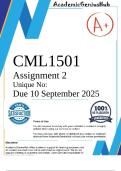
FAC1502 ASSIGNMENT 3 [QUIZ AND
ANSWERS] SEMESTER 2 2024
1. Adjusting Entries:
○ A company has earned revenue of $3,000 for services provided in December but
has not yet billed the client by the end of the year. How would you record the
adjusting entry for this revenue?
2. Depreciation Calculation:
○ A company purchased equipment for $50,000 on January 1. The equipment has
an estimated useful life of 5 years and a residual value of $5,000. Calculate the
annual depreciation expense using the straight-line method.
3. Inventory Valuation:
○ A company uses the FIFO (First-In, First-Out) method for inventory valuation. At
the beginning of the month, the company had 100 units of inventory costing $10
each. During the month, the company purchased 200 units at $12 each and sold
150 units. Calculate the cost of goods sold (COGS) and the ending inventory
value.
4. Accounts Receivable:
○ A company has accounts receivable of $20,000. After reviewing the receivables,
the company estimates that $1,500 will be uncollectible. What adjusting entry
should be made to record the estimated uncollectible amount?
5. Accrued Expenses:
○ A company has accrued salaries of $2,500 that are to be paid in the next
accounting period. What is the adjusting entry for this accrued expense?
Answers
1. Adjusting Entries:
○ Adjusting Entry:
■ Debit: Accounts Receivable $3,000
■ Credit: Service Revenue $3,000
2. Depreciation Calculation:
○ Annual Depreciation Expense (Straight-Line Method): Depreciation
Expense=Cost−Residual ValueUseful Life\text{Depreciation Expense}
= \frac{\text{Cost} - \text{Residual Value}}{\text{Useful
Life}}Depreciation Expense=Useful LifeCost−Residual Value
Depreciation Expense=50,000−5,0005=45,0005=9,000\
text{Depreciation Expense} = \frac{50,000 - 5,000}{5} = \
frac{45,000}{5} = 9,000Depreciation Expense=550,000−5,000
=545,000=9,000
■ Annual Depreciation Expense: $9,000
3. Inventory Valuation:
○ Cost of Goods Sold (FIFO Method):
■ Begin with 100 units at $10 each = $1,000
■ Add 150 units sold from the 200 units purchased at $12 each:
COGS=(100×10)+(50×12)=1,000+600=1,600\text{COGS} = (100 \times
ANSWERS] SEMESTER 2 2024
1. Adjusting Entries:
○ A company has earned revenue of $3,000 for services provided in December but
has not yet billed the client by the end of the year. How would you record the
adjusting entry for this revenue?
2. Depreciation Calculation:
○ A company purchased equipment for $50,000 on January 1. The equipment has
an estimated useful life of 5 years and a residual value of $5,000. Calculate the
annual depreciation expense using the straight-line method.
3. Inventory Valuation:
○ A company uses the FIFO (First-In, First-Out) method for inventory valuation. At
the beginning of the month, the company had 100 units of inventory costing $10
each. During the month, the company purchased 200 units at $12 each and sold
150 units. Calculate the cost of goods sold (COGS) and the ending inventory
value.
4. Accounts Receivable:
○ A company has accounts receivable of $20,000. After reviewing the receivables,
the company estimates that $1,500 will be uncollectible. What adjusting entry
should be made to record the estimated uncollectible amount?
5. Accrued Expenses:
○ A company has accrued salaries of $2,500 that are to be paid in the next
accounting period. What is the adjusting entry for this accrued expense?
Answers
1. Adjusting Entries:
○ Adjusting Entry:
■ Debit: Accounts Receivable $3,000
■ Credit: Service Revenue $3,000
2. Depreciation Calculation:
○ Annual Depreciation Expense (Straight-Line Method): Depreciation
Expense=Cost−Residual ValueUseful Life\text{Depreciation Expense}
= \frac{\text{Cost} - \text{Residual Value}}{\text{Useful
Life}}Depreciation Expense=Useful LifeCost−Residual Value
Depreciation Expense=50,000−5,0005=45,0005=9,000\
text{Depreciation Expense} = \frac{50,000 - 5,000}{5} = \
frac{45,000}{5} = 9,000Depreciation Expense=550,000−5,000
=545,000=9,000
■ Annual Depreciation Expense: $9,000
3. Inventory Valuation:
○ Cost of Goods Sold (FIFO Method):
■ Begin with 100 units at $10 each = $1,000
■ Add 150 units sold from the 200 units purchased at $12 each:
COGS=(100×10)+(50×12)=1,000+600=1,600\text{COGS} = (100 \times