Wk4: Lenses
Abbreviations:
Saturday, October 24, 2020 10:10 PM
b/w = between
w/ = with
INC = increase
• An optical lens is a transparent material such as glass that bends incoming rays of light to a common DEC = decrease
point.
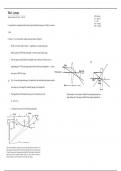
• Section 4.3.5: we will construct a simple microscope shown in figure 4.4.
○ GOAL is to test the validity of Eqn 4.3-- magnification of a simple microscope.
○ Object is placed OUTSIDE the focal length -> first lens creates a REAL image.
○ This real image is placed inside the focal length of the second lens, so this lens acts as a
magnifying glass. Will see the image projected from the first lens, and magnifies it. -> second
Principal axis-->
lens creates a VIRTUAL image.
○ Fig. 4.4: since the projected image (o1) is upside down, the second lens also projects an upside
down image (o2, even though it's technically keeping w/ the upright law).
○ The magnification of the simple microscope you will construct is given by Object distance (o): from object to middle of lens along the principal axis.
Image distance (i): from image to middle of lens along the principal axis.
𝑚 = 𝐼1*𝐿/01*𝑓2 .
○ L: distance from your eye to the object being magnified.
, • Virtual images are usually upright. Real images usually are inverted. -> Remember the VURI
acronym!
○ Is image upright? It is VIRTUAL! (o<f)
○ Is image inverted? It is REAL! (o>f)
• On a diagram, if light rays don’t meet on one side of the lens, they WILL meet on the other side. MEMORIZE CONVEX LENS scenarios,
along w/ Virtual Upright and Real Inverted
• Convex lens: all positive o,i,f. (VURI).
• Concave lens: f is always negative.
• Convex lens: cause light rays to converge/refract TOWARDS one another.
• Concave lens: cause light rays to diverge/refract AWAY from one another.
• Focal length (f): distance from the focus to the middle of the lens.
○ Convex lens: focus is along the principle axis where the rays converge.
○ Concave lens: focus is along the principle axis where the rays diverge onto the SAME side
as the rays coming in. Focal length is NEGATIVE!
• Real image: formed by CONVEX lens and CAN be projected onto a screen. It is formed by the
actual intersection of light rays that come from an object source (Fig. 4.2a).
• Virtual image: formed by a CONCAVE (always diverging) lens and CANNOT be projected onto
a screen. It is formed when rays of light diverge (Fig. 4.2b). Lengths for this image are always
Abbreviations:
Saturday, October 24, 2020 10:10 PM
b/w = between
w/ = with
INC = increase
• An optical lens is a transparent material such as glass that bends incoming rays of light to a common DEC = decrease
point.
• Section 4.3.5: we will construct a simple microscope shown in figure 4.4.
○ GOAL is to test the validity of Eqn 4.3-- magnification of a simple microscope.
○ Object is placed OUTSIDE the focal length -> first lens creates a REAL image.
○ This real image is placed inside the focal length of the second lens, so this lens acts as a
magnifying glass. Will see the image projected from the first lens, and magnifies it. -> second
Principal axis-->
lens creates a VIRTUAL image.
○ Fig. 4.4: since the projected image (o1) is upside down, the second lens also projects an upside
down image (o2, even though it's technically keeping w/ the upright law).
○ The magnification of the simple microscope you will construct is given by Object distance (o): from object to middle of lens along the principal axis.
Image distance (i): from image to middle of lens along the principal axis.
𝑚 = 𝐼1*𝐿/01*𝑓2 .
○ L: distance from your eye to the object being magnified.
, • Virtual images are usually upright. Real images usually are inverted. -> Remember the VURI
acronym!
○ Is image upright? It is VIRTUAL! (o<f)
○ Is image inverted? It is REAL! (o>f)
• On a diagram, if light rays don’t meet on one side of the lens, they WILL meet on the other side. MEMORIZE CONVEX LENS scenarios,
along w/ Virtual Upright and Real Inverted
• Convex lens: all positive o,i,f. (VURI).
• Concave lens: f is always negative.
• Convex lens: cause light rays to converge/refract TOWARDS one another.
• Concave lens: cause light rays to diverge/refract AWAY from one another.
• Focal length (f): distance from the focus to the middle of the lens.
○ Convex lens: focus is along the principle axis where the rays converge.
○ Concave lens: focus is along the principle axis where the rays diverge onto the SAME side
as the rays coming in. Focal length is NEGATIVE!
• Real image: formed by CONVEX lens and CAN be projected onto a screen. It is formed by the
actual intersection of light rays that come from an object source (Fig. 4.2a).
• Virtual image: formed by a CONCAVE (always diverging) lens and CANNOT be projected onto
a screen. It is formed when rays of light diverge (Fig. 4.2b). Lengths for this image are always