Due date Friday, 23 august 2024
ASSIGNMENT 2
FORUM
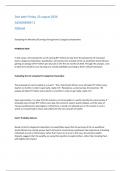
Evaluating the Morality of Earnings through Kant’s Categorical Imperative
INTRODUCTION
In this essay, I will evaluate the act of earning R77 million per day from the perspective of Immanuel
Kant’s categorical imperative. Specifically, I will examine the morality of the six wealthiest South Africans
gaining an average of R77 million per day each in the first six months of 2024. Through this analysis, I aim
to determine whether such earnings are morally justifiable according to Kant’s ethical framework.
Evaluating the Act using Kant’s Categorical Imperative
The proposed act can be stated as a maxim: “The richest South African men will take R77 million every
day for six months in order to get really, really rich.” Restated as a universal law, this becomes: “All
people will take R77 million every day for six months in order to get really, really rich.”
Upon examination, it is clear that this maxim is not conceivable in a world ruled by the universal law. If
all people were to take R77 million every day, the economic system would collapse, and the value of
money would become meaningless. Furthermore, I would not rationally act on this maxim in such a
world, as it would lead to chaos and undermine the very concept of wealth.
Kant’s Probable Opinion
Based on Kant’s categorical imperative, he would likely argue that the earnings of the six wealthiest
South Africans are morally wrong. Kant’s formula of universal law emphasizes the importance of treating
individuals as ends in themselves, rather than means to an end. In this case, the extreme wealth
disparity suggests that the wealthy are using their position to exploit others, rather than treating them
with dignity and respect.
ASSIGNMENT 2
FORUM
Evaluating the Morality of Earnings through Kant’s Categorical Imperative
INTRODUCTION
In this essay, I will evaluate the act of earning R77 million per day from the perspective of Immanuel
Kant’s categorical imperative. Specifically, I will examine the morality of the six wealthiest South Africans
gaining an average of R77 million per day each in the first six months of 2024. Through this analysis, I aim
to determine whether such earnings are morally justifiable according to Kant’s ethical framework.
Evaluating the Act using Kant’s Categorical Imperative
The proposed act can be stated as a maxim: “The richest South African men will take R77 million every
day for six months in order to get really, really rich.” Restated as a universal law, this becomes: “All
people will take R77 million every day for six months in order to get really, really rich.”
Upon examination, it is clear that this maxim is not conceivable in a world ruled by the universal law. If
all people were to take R77 million every day, the economic system would collapse, and the value of
money would become meaningless. Furthermore, I would not rationally act on this maxim in such a
world, as it would lead to chaos and undermine the very concept of wealth.
Kant’s Probable Opinion
Based on Kant’s categorical imperative, he would likely argue that the earnings of the six wealthiest
South Africans are morally wrong. Kant’s formula of universal law emphasizes the importance of treating
individuals as ends in themselves, rather than means to an end. In this case, the extreme wealth
disparity suggests that the wealthy are using their position to exploit others, rather than treating them
with dignity and respect.