
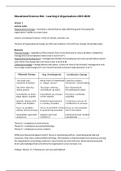
Educational Sciences MA – Learning in Organisations 2019-2020
Week 1
Lecture notes
Organisational change = moving to a desired future state with the goal of increasing the
organisation’s ability to create value.
Value is not always financial > think of schools, charities, etc.
Theories of organisational change are often prescriptive > they tell how change should take place
Boonstra
Planned change = regardless of the context, there is one best way to solve a problem, initiated by
management and employees have to act it out (A to A’).
Organisational development = management decides, but employees can come up with ideas and act
upon them; the change does not have a clear end (A to B)
Continuous change = change always takes place, it does not have to be initiated; management only
has to align small changes (it’s non-hierarchical and everyone make decisions; A to ?).
Theory E = employees as instruments.
Theory O = employees as purposeful beings.
Theory C = employees as sense-makers.
Difference/tension between E and O: focus on maximising profit vs. maximising potential and
resources. They try to achieve different things. The similarity is that they both see humans as serving
the organisation (something), whereas C sees humans as more than one -dimensional (someone).
And C acknowledges that sometimes the organisation serves humans, too.
Critique: these E, O, C theories are not very well-defined.
, 1st-order learning = improvement, acquisition of knowledge.
2nd-order learning = development of new knowledge.
3rd-order learning = reinvention/questioning.
Nielsen & Randall
Why evaluate change? To see if objectives are reached + learn from mistakes and good practices.
What to focus on? Outcomes > was the goal the right one?
How to evaluate change? Look at the theory and process.
Why process evaluation is important: “unveiling the black box”, i.e. learning from previous
interventions to show what aspects of a process yield effective results.
Aspects influencing intervention outcomes:
- Mental models and change in them
- The intervention itself (initiation, activities, implementation)
- Context: hindering and facilitating factors
Guba & Lincoln
Paradigm = a worldview that guides ontological, epistemological, and methodological choices.
Paradigms are useful to structure thoughts/discourse and to describe science. They can change over
time (e.g. geocentric to heliocentric) but also co-exist. Your paradigm of choice determines your
options.
Ontology = what is reality?
Epistemology = when can knowledge been seen as valid?
Methodology = how can one produce valid knowledge?
Positivism is seen as the most dominant approach in social science. It sees reality as existing
independently of us > one truth. That makes it possible to predict and control phenomena.
Week 1
Lecture notes
Organisational change = moving to a desired future state with the goal of increasing the
organisation’s ability to create value.
Value is not always financial > think of schools, charities, etc.
Theories of organisational change are often prescriptive > they tell how change should take place
Boonstra
Planned change = regardless of the context, there is one best way to solve a problem, initiated by
management and employees have to act it out (A to A’).
Organisational development = management decides, but employees can come up with ideas and act
upon them; the change does not have a clear end (A to B)
Continuous change = change always takes place, it does not have to be initiated; management only
has to align small changes (it’s non-hierarchical and everyone make decisions; A to ?).
Theory E = employees as instruments.
Theory O = employees as purposeful beings.
Theory C = employees as sense-makers.
Difference/tension between E and O: focus on maximising profit vs. maximising potential and
resources. They try to achieve different things. The similarity is that they both see humans as serving
the organisation (something), whereas C sees humans as more than one -dimensional (someone).
And C acknowledges that sometimes the organisation serves humans, too.
Critique: these E, O, C theories are not very well-defined.
, 1st-order learning = improvement, acquisition of knowledge.
2nd-order learning = development of new knowledge.
3rd-order learning = reinvention/questioning.
Nielsen & Randall
Why evaluate change? To see if objectives are reached + learn from mistakes and good practices.
What to focus on? Outcomes > was the goal the right one?
How to evaluate change? Look at the theory and process.
Why process evaluation is important: “unveiling the black box”, i.e. learning from previous
interventions to show what aspects of a process yield effective results.
Aspects influencing intervention outcomes:
- Mental models and change in them
- The intervention itself (initiation, activities, implementation)
- Context: hindering and facilitating factors
Guba & Lincoln
Paradigm = a worldview that guides ontological, epistemological, and methodological choices.
Paradigms are useful to structure thoughts/discourse and to describe science. They can change over
time (e.g. geocentric to heliocentric) but also co-exist. Your paradigm of choice determines your
options.
Ontology = what is reality?
Epistemology = when can knowledge been seen as valid?
Methodology = how can one produce valid knowledge?
Positivism is seen as the most dominant approach in social science. It sees reality as existing
independently of us > one truth. That makes it possible to predict and control phenomena.


