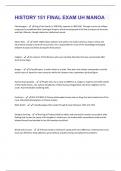
HISTORY 151 FINAL EXAM UH MANOA
Charlemagne - King of the Franks (r. 768-814); emperor (r. 800-814). Through a series of military
conquests he established the Carolingian Empire, which encompassed all of Gaul and parts of Germany
and Italy. Illiterate, though started an intellectual revival.
Marco Polo - (1254-1324) Italian explorer and author. He made numerous trips to China and
returned to Europe to write of his journeys. He is responsible for much of the knowledge exchanged
between Europe and China during this time period.
Caligula - An emperor of Pax Romana who was mentally disturbed and was assassinated after
short brutal reign.
shogun - In feudal Japan, a noble similar to a duke. They were the military commanders and the
actual rulers of Japan for many centuries while the Emperor was a powerless spiritual figure.
Austronesian peoples - People who, by as early as 2000 B.C.E., began to explore and settle islands
of the Pacific Ocean., the earliest inhabitants of New Guinea foraged food, like their neighbors to the
south. Had remarkable seafaring skills.
Confucius - (551-479 BCE) A Chinese philosopher known also as Kong Fuzi and created one of the
most influential philosophies in Chinese history.
Black Death - A deadly plague that swept through Europe between 1347 and 1351
Oedipus the King - the King of Thebes killed his father and married his mother by accident; after
finding that he was the cause of his kingdom's misfortune, his mother/wife committed suicide and he
blinded himself and decided to live life homeless and blind
Bread and Circuses - A Roman bribery method of coping with class difference. Entertainment and
food was offered to keep plebeians quiet without actually solving unemployment problems.
, Augustus - (63 BCE - 14 CE) First emperor of Rome (27 BCE - 14 CE) He restored order and
prosperity to the Empire after nearly a century of turmoil. Grandnephew to Julius Caesar.
Hajj - A pilgrimage to Mecca, performed as a duty by Muslims
Daoism - A religion in China which emphasizes the removal from society and to become one with
nature.
Battle of Tours - (732 CE) European victory over Muslims. It halted Muslim movement into
Western Europe.
Examination System - Chinese system for choosing officials for positions in the Ming imperial
bureaucracy. Candidates needed to pass one or more examinations that increased in difficulty for higher
positions.
Zheng He - (1371-1433?) Chinese naval explorer who sailed along most of the coast of Asia, Japan,
and half way down the east coast of Africa before his death.
Stigmata - Phenomenon in which a person bears all or some of the wounds of Christ in his or her
own body.
Hagia Sophia - the Cathedral of Holy Wisdom in Constantinople, built by order of the Byzantine
emperor Justinian
Grand Canal - The 1,100-mile (1,700-kilometer) waterway linking the Yellow and the Yangzi Rivers.
It was begun in the Han period and completed during the Sui Empire.
Doomsday Book - This helped keep track of people in England and helped rulers set up taxes.
Buddhism - Belief system that started in India in the 500s BC. Happiness can be achieved through
removal of one's desires. Believers seek enlightenment and the overcoming of suffering.
Charlemagne - King of the Franks (r. 768-814); emperor (r. 800-814). Through a series of military
conquests he established the Carolingian Empire, which encompassed all of Gaul and parts of Germany
and Italy. Illiterate, though started an intellectual revival.
Marco Polo - (1254-1324) Italian explorer and author. He made numerous trips to China and
returned to Europe to write of his journeys. He is responsible for much of the knowledge exchanged
between Europe and China during this time period.
Caligula - An emperor of Pax Romana who was mentally disturbed and was assassinated after
short brutal reign.
shogun - In feudal Japan, a noble similar to a duke. They were the military commanders and the
actual rulers of Japan for many centuries while the Emperor was a powerless spiritual figure.
Austronesian peoples - People who, by as early as 2000 B.C.E., began to explore and settle islands
of the Pacific Ocean., the earliest inhabitants of New Guinea foraged food, like their neighbors to the
south. Had remarkable seafaring skills.
Confucius - (551-479 BCE) A Chinese philosopher known also as Kong Fuzi and created one of the
most influential philosophies in Chinese history.
Black Death - A deadly plague that swept through Europe between 1347 and 1351
Oedipus the King - the King of Thebes killed his father and married his mother by accident; after
finding that he was the cause of his kingdom's misfortune, his mother/wife committed suicide and he
blinded himself and decided to live life homeless and blind
Bread and Circuses - A Roman bribery method of coping with class difference. Entertainment and
food was offered to keep plebeians quiet without actually solving unemployment problems.
, Augustus - (63 BCE - 14 CE) First emperor of Rome (27 BCE - 14 CE) He restored order and
prosperity to the Empire after nearly a century of turmoil. Grandnephew to Julius Caesar.
Hajj - A pilgrimage to Mecca, performed as a duty by Muslims
Daoism - A religion in China which emphasizes the removal from society and to become one with
nature.
Battle of Tours - (732 CE) European victory over Muslims. It halted Muslim movement into
Western Europe.
Examination System - Chinese system for choosing officials for positions in the Ming imperial
bureaucracy. Candidates needed to pass one or more examinations that increased in difficulty for higher
positions.
Zheng He - (1371-1433?) Chinese naval explorer who sailed along most of the coast of Asia, Japan,
and half way down the east coast of Africa before his death.
Stigmata - Phenomenon in which a person bears all or some of the wounds of Christ in his or her
own body.
Hagia Sophia - the Cathedral of Holy Wisdom in Constantinople, built by order of the Byzantine
emperor Justinian
Grand Canal - The 1,100-mile (1,700-kilometer) waterway linking the Yellow and the Yangzi Rivers.
It was begun in the Han period and completed during the Sui Empire.
Doomsday Book - This helped keep track of people in England and helped rulers set up taxes.
Buddhism - Belief system that started in India in the 500s BC. Happiness can be achieved through
removal of one's desires. Believers seek enlightenment and the overcoming of suffering.