

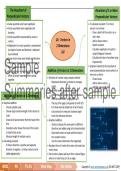
The Resultant of Resultant of 2 or More
Perpendicular Vectors: Perpendicular Vectors:
• Scalar quantities only have magnitude. • To calculate resultant if 2 or more
• Vector quantities have magnitude and vectors are co-linear:
direction. - Draw a sketch of the vectors on x-
• Vector quantities represented by arrows = and y-axes.
vectors. U1: Vectors in - Add co-linear vectors.
• Magnitude of a vector quantity is represented 2 Dimensions - Sketch resultant.
by length of vector and direction is indicated - Calculate magnitude of resultant
by arrowhead.
(A) using Pythagoras’ theorem.
• Equal vectors have same length and direction. - Calculate direction of resultant using
Sample
• Negative vectors are in opposite direction to trigonometry.
chosen positive direction. • Graphical method to find resultant of
• Resultant vector = single vector that has same Addition of Vectors in 2 Dimensions: several perpendicular vectors when 2 or
effect as several separate vectors acting more are co-linear:
• Direction of a vector using compass method: - Choose scale.
together.
- Represents direction in relation to compass - Add co-linear vectors.
Summaries after sample
points. - Add the 2 perpendicular
• Direction of vector using bearing method: components.
Addition of Vectors in 1 Dimension: - Horizontal angle always measured clockwise
from direction north –angle given as 0°.
• Graphical addition: - The top of the page corresponds to north (0°).
- Choose suitable scale. - First draw vertical dotted line at tail of vector.
- Choose origin and draw length of first vector to - Use protractor to measure clockwise angle
scale. from this reference direction.
- Draw tail of second vector from the head of the • Graphical addition:
first. - Vectors acting on the same point in different
- Resultant vector drawn from tail of first vector directions are added using tail-to-head method.
to head of last vector. - Draw both vectors to scale and then draw in
- Measure length of resultant vector. the resultant vector.
• Calculating resultant: - Use the scale to determine the magnitude.
- If chosen direction is positive and opposite • Resultant force is 0 when first vector tail meets last
direction is negative - co-linear vectors can be vector head.
added algebraically. • Force vectors always add up to form a closed figure
when 3 or more forces act at an angle.
GR11 PS T1-C1 Mind Map Via Afrika Copyright © www.summariessa.co.za (DO NOT COPY)
,Sample
Summaries after sample
,Sample
Summaries after sample
, Chemical Bonding:
Using Lewis Structures to
Represent Bonding Molecules:
• Only unpaired electrons tend to take part in bonding.
• Use dots to represent the electrons of one atom and Rules for Determining
crosses to represent the other. Shapes of Molecules:
• Double bond = each atom shares 2 unpaired
Dative Covalent Chemical Bonding: electrons. • How to determine shape of molecule:
• Triple bond = each atom shares 3 unpaired electrons. - Step 1: Draw Lewis structure of molecule.
• Dative covalent bonding = atoms with - Step 2: Identify central atom.
• Lewis structure usually contains a max of 8 dots or
incomplete numbers of valence electrons can - Step 3: Count no. of areas of negative
crosses – octet rule.
share lone pair of electrons from another charge surrounding central atom.
atoms.
Sample
• Identical to other covalent bonds.
U1: Atomic
Combination:
- Step 4: Use the table to find molecular
shape:
Molecular
Summaries after sample
Molecular Shape & VSEPR Theory:
• VSEPR theory predicts molecule shape.
• Electron pairs are arranged around each atom
to maximise the angles between electron pairs.
Structure (B)
•
•
Principles of VSEPR-Theory:
• The shape of the molecule is determined by the total no. and arrangement
of electron pairs around the central atom.
• Electron pairs around the central atom stay as far away from each other as
possible – decrease forces of repulsion.
• Lone pairs can result in distorted shape.
• Strength of repulsion between different electron pairs follow:
lone pair – lone pair > lone pair – bonded pair > bonded pair – bonded pair.
GR11 PS T1-C2 Mind Map Via Afrika Copyright © www.summariessa.co.za (DO NOT COPY)
Perpendicular Vectors: Perpendicular Vectors:
• Scalar quantities only have magnitude. • To calculate resultant if 2 or more
• Vector quantities have magnitude and vectors are co-linear:
direction. - Draw a sketch of the vectors on x-
• Vector quantities represented by arrows = and y-axes.
vectors. U1: Vectors in - Add co-linear vectors.
• Magnitude of a vector quantity is represented 2 Dimensions - Sketch resultant.
by length of vector and direction is indicated - Calculate magnitude of resultant
by arrowhead.
(A) using Pythagoras’ theorem.
• Equal vectors have same length and direction. - Calculate direction of resultant using
Sample
• Negative vectors are in opposite direction to trigonometry.
chosen positive direction. • Graphical method to find resultant of
• Resultant vector = single vector that has same Addition of Vectors in 2 Dimensions: several perpendicular vectors when 2 or
effect as several separate vectors acting more are co-linear:
• Direction of a vector using compass method: - Choose scale.
together.
- Represents direction in relation to compass - Add co-linear vectors.
Summaries after sample
points. - Add the 2 perpendicular
• Direction of vector using bearing method: components.
Addition of Vectors in 1 Dimension: - Horizontal angle always measured clockwise
from direction north –angle given as 0°.
• Graphical addition: - The top of the page corresponds to north (0°).
- Choose suitable scale. - First draw vertical dotted line at tail of vector.
- Choose origin and draw length of first vector to - Use protractor to measure clockwise angle
scale. from this reference direction.
- Draw tail of second vector from the head of the • Graphical addition:
first. - Vectors acting on the same point in different
- Resultant vector drawn from tail of first vector directions are added using tail-to-head method.
to head of last vector. - Draw both vectors to scale and then draw in
- Measure length of resultant vector. the resultant vector.
• Calculating resultant: - Use the scale to determine the magnitude.
- If chosen direction is positive and opposite • Resultant force is 0 when first vector tail meets last
direction is negative - co-linear vectors can be vector head.
added algebraically. • Force vectors always add up to form a closed figure
when 3 or more forces act at an angle.
GR11 PS T1-C1 Mind Map Via Afrika Copyright © www.summariessa.co.za (DO NOT COPY)
,Sample
Summaries after sample
,Sample
Summaries after sample
, Chemical Bonding:
Using Lewis Structures to
Represent Bonding Molecules:
• Only unpaired electrons tend to take part in bonding.
• Use dots to represent the electrons of one atom and Rules for Determining
crosses to represent the other. Shapes of Molecules:
• Double bond = each atom shares 2 unpaired
Dative Covalent Chemical Bonding: electrons. • How to determine shape of molecule:
• Triple bond = each atom shares 3 unpaired electrons. - Step 1: Draw Lewis structure of molecule.
• Dative covalent bonding = atoms with - Step 2: Identify central atom.
• Lewis structure usually contains a max of 8 dots or
incomplete numbers of valence electrons can - Step 3: Count no. of areas of negative
crosses – octet rule.
share lone pair of electrons from another charge surrounding central atom.
atoms.
Sample
• Identical to other covalent bonds.
U1: Atomic
Combination:
- Step 4: Use the table to find molecular
shape:
Molecular
Summaries after sample
Molecular Shape & VSEPR Theory:
• VSEPR theory predicts molecule shape.
• Electron pairs are arranged around each atom
to maximise the angles between electron pairs.
Structure (B)
•
•
Principles of VSEPR-Theory:
• The shape of the molecule is determined by the total no. and arrangement
of electron pairs around the central atom.
• Electron pairs around the central atom stay as far away from each other as
possible – decrease forces of repulsion.
• Lone pairs can result in distorted shape.
• Strength of repulsion between different electron pairs follow:
lone pair – lone pair > lone pair – bonded pair > bonded pair – bonded pair.
GR11 PS T1-C2 Mind Map Via Afrika Copyright © www.summariessa.co.za (DO NOT COPY)


