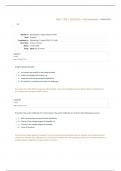
UNISA 2024 ECS1601-24-Y Online assessments Assessment 3
QUIZ
Started on Wednesday, 7 August 2024, 8:21 AM
State Finished
Completed on Wednesday, 7 August 2024, 10:31 AM
Time taken 2 hours 10 mins
Marks 16.00/18.00
Grade 88.89 out of 100.00
Question 1
Correct
Mark 1.00 out of 1.00
If GDP is greater than GDE,
a. the country has a deficit in the current account.
b. exports are greater than imports.
c. taxes are more than government expenditure.
d. the country is consuming more than it is producing.
See section 5.2 on the difference between GDP and GDE. In this case, the difference lies in the fact that the contribution of
the foreign sector is positive to GDP (i.e X>Z).
Question 2
Correct
Mark 1.00 out of 1.00
If Country X has a Gini coefficient of 0.7 and Country Y has a Gini coefficient of 0.4, which of the following is correct?
a. Both countries have an equal income distribution.
b. Country X has a higher degree of inequality.
c. Country Y has a higher degree of inequality.
d. None of the above.
Country X has a higher degree of inequality. Country X has an income distribution which is relatively more unequal than that
of Country Y. Since the Gini coefficient of 0.7 for Country X is higher than that of Country Y, which is 0.4, it means that there is
a higher degree of inequality in Country X than in Country Y.
, Question 3
Incorrect
Mark 0.00 out of 1.00
Which statement(s) regarding the national accounts is/are correct?
a) Fixed capital formation refers to the purchase of capital goods such as buildings, machinery, and equipment.
b) GDP at market prices = C + I + G + X – Z.
c) Gross domestic expenditure (GDE) does not include spending on imported goods and services.
d) GNI at market prices = GDP at market prices – net primary income payments._____.
a. a, b, c and d
b. a, b and d
c. c
d. None of the above.
Fixed capital formation refers to spending on buildings, machinery and equipment used to facilitate economic activity. Fixed
capital formation forms part of the investment expenditure in the national accounts. Refer to section 5.2 on page 93 of the
prescribed textbook. GDP at market prices is calculated by adding consumption, investment, and government expenditure (C
+ I + G) to net exports (X – Z). Refer to section 5.2 on page 94 of the prescribed textbook. Gross Domestic Expenditure (GDE)
includes import expenditure (Z). Refer to section 5.2 on pages 94 and 95 of the prescribed textbook. Primary income
payments are deducted from GDP at market prices. Refer to section 5.2 on page 92 of the prescribed textbook.
Question 4
Correct
Mark 1.00 out of 1.00
Which of the following is a macroeconomic objective?_____.
a. Increase in VAT
b. Government spending on education
c. Inflation targeting
d. Equitable income distribution
Induced An increase in VAT is a means of collecting additional tax revenue from the public to spend on areas such as health,
education, and infrastructure in the National Budget. This is a fiscal policy action taken by government to achieve
macroeconomic objectives. An increase in VAT is not a macroeconomic objective. Government spending on education is an
instrument of fiscal policy and not a macroeconomic objective.
It is used as a tool to ultimately achieve macroeconomic objectives. Inflation targeting is a strategy used by the South African
Reserve Bank to keep the inflation rate stable between 3% and 6%. The central bank adjusts monetary policy to ensure that
the inflation stays within this range. Inflation targeting is not a macroeconomic objective within itself, but rather a tool used to
achieve economic growth and price stability (which are macroeconomic objectives). The five macroeconomic objectives are
economic growth, full employment, price stability, balance of payments stability, and an equitable income distribution.
QUIZ
Started on Wednesday, 7 August 2024, 8:21 AM
State Finished
Completed on Wednesday, 7 August 2024, 10:31 AM
Time taken 2 hours 10 mins
Marks 16.00/18.00
Grade 88.89 out of 100.00
Question 1
Correct
Mark 1.00 out of 1.00
If GDP is greater than GDE,
a. the country has a deficit in the current account.
b. exports are greater than imports.
c. taxes are more than government expenditure.
d. the country is consuming more than it is producing.
See section 5.2 on the difference between GDP and GDE. In this case, the difference lies in the fact that the contribution of
the foreign sector is positive to GDP (i.e X>Z).
Question 2
Correct
Mark 1.00 out of 1.00
If Country X has a Gini coefficient of 0.7 and Country Y has a Gini coefficient of 0.4, which of the following is correct?
a. Both countries have an equal income distribution.
b. Country X has a higher degree of inequality.
c. Country Y has a higher degree of inequality.
d. None of the above.
Country X has a higher degree of inequality. Country X has an income distribution which is relatively more unequal than that
of Country Y. Since the Gini coefficient of 0.7 for Country X is higher than that of Country Y, which is 0.4, it means that there is
a higher degree of inequality in Country X than in Country Y.
, Question 3
Incorrect
Mark 0.00 out of 1.00
Which statement(s) regarding the national accounts is/are correct?
a) Fixed capital formation refers to the purchase of capital goods such as buildings, machinery, and equipment.
b) GDP at market prices = C + I + G + X – Z.
c) Gross domestic expenditure (GDE) does not include spending on imported goods and services.
d) GNI at market prices = GDP at market prices – net primary income payments._____.
a. a, b, c and d
b. a, b and d
c. c
d. None of the above.
Fixed capital formation refers to spending on buildings, machinery and equipment used to facilitate economic activity. Fixed
capital formation forms part of the investment expenditure in the national accounts. Refer to section 5.2 on page 93 of the
prescribed textbook. GDP at market prices is calculated by adding consumption, investment, and government expenditure (C
+ I + G) to net exports (X – Z). Refer to section 5.2 on page 94 of the prescribed textbook. Gross Domestic Expenditure (GDE)
includes import expenditure (Z). Refer to section 5.2 on pages 94 and 95 of the prescribed textbook. Primary income
payments are deducted from GDP at market prices. Refer to section 5.2 on page 92 of the prescribed textbook.
Question 4
Correct
Mark 1.00 out of 1.00
Which of the following is a macroeconomic objective?_____.
a. Increase in VAT
b. Government spending on education
c. Inflation targeting
d. Equitable income distribution
Induced An increase in VAT is a means of collecting additional tax revenue from the public to spend on areas such as health,
education, and infrastructure in the National Budget. This is a fiscal policy action taken by government to achieve
macroeconomic objectives. An increase in VAT is not a macroeconomic objective. Government spending on education is an
instrument of fiscal policy and not a macroeconomic objective.
It is used as a tool to ultimately achieve macroeconomic objectives. Inflation targeting is a strategy used by the South African
Reserve Bank to keep the inflation rate stable between 3% and 6%. The central bank adjusts monetary policy to ensure that
the inflation stays within this range. Inflation targeting is not a macroeconomic objective within itself, but rather a tool used to
achieve economic growth and price stability (which are macroeconomic objectives). The five macroeconomic objectives are
economic growth, full employment, price stability, balance of payments stability, and an equitable income distribution.