

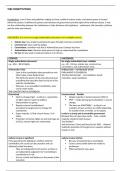
THE CONSTITUTION
Constitution: a set of laws and guidelines setting out how a political system works, and where power is located
within the system. It defines the powers and functions of government and the rights of the ordinary citizen. It sets
out the relationship between the institutions of state (between the legislature – parliament, the executive, judiciary
and the state and citizens).
UNCODIFIED: it is not in one single authoritative document, its in multiple sources.
1. Statute law: laws made by parliaments (goes through commons and lords)
2. Common law: laws made by judges
3. Conventions: unwritten rule that is followed because it always has been
4. Authoritative texts: theorists write pieces to help us understand the constitution
5. EU law: EU law used to take precedence over UK law
CODIFIED UNCODIFIED
Single authoritative document No single authoritative text: multiple
e.g., USA – Bill of Rights e.g., UK – EU law, statute law, common law,
conventions, and authoritative texts.
A hierarchy of law Ordinary law – no hierarchy of law
- Laws in the constitution take precedence over PARLIAMENT IS SOVEREIGN
other types of law (federal law) ‘Elective Dictatorship’ – Lord Hailsham (small
- This limits the power of the executive because minorities, weak mandates).
everything the executive does has to be in line
with the constitution.
- Whereas, in an uncodified constitution, laws
can be made easily.
THE CONSTITUTION IS SOVEREIGN
Entrenched Unentrenched – flexible
Hard to change/rigid – so there is a protection Simple majority in lords/commons (50%+1)
of rights and isn’t open to political FPTP -> whips (strong party discipline) = easy to
interpretation or games. change.
Requires special constitutional The laws are ADAPTABLE – so there is an
procedure/arrangements to change the evolution of laws as there are shifts depending
constitution. on societal views or trends, so its organic.
Super majority: 2/3rds of each house, ¾ of Leads to a strong and accountable government
states. Because they can pass laws easily – only a simple
Protection of human rights act and marriage act majority needed in both houses.
of 2013, human rights are entrenched. Too flexible?!
Anti-terrorism, Crime and Security Act 2001 – allowed
indefinite detention of foreign terror suspects without
charge or trial.
Judicial review is significant Judicial review limited
If law passed by the legislature conflicts with the Because of parliamentary sovereignty.
constitution, the courts can be proactive and can Courts cannot strike down law made by
ultimately strike law down. parliament.
- They are independent and neutral, so there is What parliament says, goes.
an independent judgement to if something is
constitutional or not.
- Acts as a check and balance to the power of the
executive.
Constitution: a set of laws and guidelines setting out how a political system works, and where power is located
within the system. It defines the powers and functions of government and the rights of the ordinary citizen. It sets
out the relationship between the institutions of state (between the legislature – parliament, the executive, judiciary
and the state and citizens).
UNCODIFIED: it is not in one single authoritative document, its in multiple sources.
1. Statute law: laws made by parliaments (goes through commons and lords)
2. Common law: laws made by judges
3. Conventions: unwritten rule that is followed because it always has been
4. Authoritative texts: theorists write pieces to help us understand the constitution
5. EU law: EU law used to take precedence over UK law
CODIFIED UNCODIFIED
Single authoritative document No single authoritative text: multiple
e.g., USA – Bill of Rights e.g., UK – EU law, statute law, common law,
conventions, and authoritative texts.
A hierarchy of law Ordinary law – no hierarchy of law
- Laws in the constitution take precedence over PARLIAMENT IS SOVEREIGN
other types of law (federal law) ‘Elective Dictatorship’ – Lord Hailsham (small
- This limits the power of the executive because minorities, weak mandates).
everything the executive does has to be in line
with the constitution.
- Whereas, in an uncodified constitution, laws
can be made easily.
THE CONSTITUTION IS SOVEREIGN
Entrenched Unentrenched – flexible
Hard to change/rigid – so there is a protection Simple majority in lords/commons (50%+1)
of rights and isn’t open to political FPTP -> whips (strong party discipline) = easy to
interpretation or games. change.
Requires special constitutional The laws are ADAPTABLE – so there is an
procedure/arrangements to change the evolution of laws as there are shifts depending
constitution. on societal views or trends, so its organic.
Super majority: 2/3rds of each house, ¾ of Leads to a strong and accountable government
states. Because they can pass laws easily – only a simple
Protection of human rights act and marriage act majority needed in both houses.
of 2013, human rights are entrenched. Too flexible?!
Anti-terrorism, Crime and Security Act 2001 – allowed
indefinite detention of foreign terror suspects without
charge or trial.
Judicial review is significant Judicial review limited
If law passed by the legislature conflicts with the Because of parliamentary sovereignty.
constitution, the courts can be proactive and can Courts cannot strike down law made by
ultimately strike law down. parliament.
- They are independent and neutral, so there is What parliament says, goes.
an independent judgement to if something is
constitutional or not.
- Acts as a check and balance to the power of the
executive.


