Marketing and Sales II
Learning objectives:
Lecture Week 1
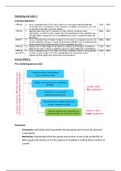
The marketing process (Q1)
Customers
- Consumers: Individuals and households who buy goods and services for personal
consumption
- Businesses: Organisations that buy goods and services to use in the production of
other goods and services or for the purpose of reselling or renting them to others at
a profit
,Customer journey
- Customer journey: The sum of experiences that customers go through when
interacting with a company or a brand.
- Customer journey map:
Illustration that details all of the touchpoints at the company or brand that
customers come into contact with as they attempt to achieve a goal, and the
emotions they experience during that journey.
Helpful to understand how customers are interacting with your company or
brand and helps to identify areas of improvement of your customers’
experience.
To understand customers and give them value
For businesses to identify points of improvement
Example
Customer journey
,Steps to create a customer journey map
From customer point of view it should be done, not the point of view of the business
1. Make sure you have done your research
2. Define behavioural stages from the customer’s perspective
3. Capture your customer’s considerations
4. Detail every touchpoint (on websites, social media, helpdesk, phone number…
interaction between customer and company)
5. Detail customer pain points (where do we lose customers? Where are customers less
satisfied? Emotions from negative to positive.)
6. Chart changing customer emotions
7. Consider what other detail can be added to the map
8. Outline opportunities for improvement
No customer journey is the same!
- Journey still differ from customer to customer
Different situations (buying situations)
Different stages
Different touchpoints
Different customers: characteristics affecting consumer behaviour
Cultural factors
, 1.1 Culture is the set of basic values, perceptions, wants and behaviors learned by a
member of society from family and other important institutions.
- Cultural factors exert a broad and deep influence on consumer behaviour. Marketers
need to understand the role played by the buyer’s culture, subculture and social
class.
- Marketers are always trying to spot cultural shifts so as to discover new products
that might be wanted. For example, switch to a healthier lifestyle, organic food…
1.2 Subculture is a group of people with shared value systems based on common life
experiences and situations (including nationalities, religions, racial groups and
geographic regions).
- Many subcultures make up important market segments and marketers often design
products and marketing programmes tailored to their needs.
- While subcultures are distinct, they are not mutually exclusive (which suggests that
somewhere there is a subculture of cybergoth, bodybuilders who ride motorbikes to
church in the nude)
- Mature consumers: The 50-plus consumer segment now accounts for nearly 50 per
cent of all consumer spending, more than any current or previous generation. For
example, they are more likely to go on longer holidays
1.3 Social classes are relatively permanent and ordered divisions in a society whose
members share similar values, interests and behaviours. Determined by income,
occupation, education, wealth and other variables (a combination)
- In some social systems, members of different classes are reared for certain roles and
cannot change their social positions.
- In Europe, however, the lines between social classes are not fixed and rigid; people
can move to a higher social class or drop into a lower one.
- Marketers are interested in social class because people within a given social class
tend to exhibit similar buying behaviour. Social classes show distinct product and
brand preferences
page 143: major social classes diagram. The key difference in these groupings is
the dependence on social and cultural capital as pivotal reflectors of class and
prospects (as well as the traditional measure of income).
Social factors
Learning objectives:
Lecture Week 1
The marketing process (Q1)
Customers
- Consumers: Individuals and households who buy goods and services for personal
consumption
- Businesses: Organisations that buy goods and services to use in the production of
other goods and services or for the purpose of reselling or renting them to others at
a profit
,Customer journey
- Customer journey: The sum of experiences that customers go through when
interacting with a company or a brand.
- Customer journey map:
Illustration that details all of the touchpoints at the company or brand that
customers come into contact with as they attempt to achieve a goal, and the
emotions they experience during that journey.
Helpful to understand how customers are interacting with your company or
brand and helps to identify areas of improvement of your customers’
experience.
To understand customers and give them value
For businesses to identify points of improvement
Example
Customer journey
,Steps to create a customer journey map
From customer point of view it should be done, not the point of view of the business
1. Make sure you have done your research
2. Define behavioural stages from the customer’s perspective
3. Capture your customer’s considerations
4. Detail every touchpoint (on websites, social media, helpdesk, phone number…
interaction between customer and company)
5. Detail customer pain points (where do we lose customers? Where are customers less
satisfied? Emotions from negative to positive.)
6. Chart changing customer emotions
7. Consider what other detail can be added to the map
8. Outline opportunities for improvement
No customer journey is the same!
- Journey still differ from customer to customer
Different situations (buying situations)
Different stages
Different touchpoints
Different customers: characteristics affecting consumer behaviour
Cultural factors
, 1.1 Culture is the set of basic values, perceptions, wants and behaviors learned by a
member of society from family and other important institutions.
- Cultural factors exert a broad and deep influence on consumer behaviour. Marketers
need to understand the role played by the buyer’s culture, subculture and social
class.
- Marketers are always trying to spot cultural shifts so as to discover new products
that might be wanted. For example, switch to a healthier lifestyle, organic food…
1.2 Subculture is a group of people with shared value systems based on common life
experiences and situations (including nationalities, religions, racial groups and
geographic regions).
- Many subcultures make up important market segments and marketers often design
products and marketing programmes tailored to their needs.
- While subcultures are distinct, they are not mutually exclusive (which suggests that
somewhere there is a subculture of cybergoth, bodybuilders who ride motorbikes to
church in the nude)
- Mature consumers: The 50-plus consumer segment now accounts for nearly 50 per
cent of all consumer spending, more than any current or previous generation. For
example, they are more likely to go on longer holidays
1.3 Social classes are relatively permanent and ordered divisions in a society whose
members share similar values, interests and behaviours. Determined by income,
occupation, education, wealth and other variables (a combination)
- In some social systems, members of different classes are reared for certain roles and
cannot change their social positions.
- In Europe, however, the lines between social classes are not fixed and rigid; people
can move to a higher social class or drop into a lower one.
- Marketers are interested in social class because people within a given social class
tend to exhibit similar buying behaviour. Social classes show distinct product and
brand preferences
page 143: major social classes diagram. The key difference in these groupings is
the dependence on social and cultural capital as pivotal reflectors of class and
prospects (as well as the traditional measure of income).
Social factors