Biology Today and Tomorrow without Physiology, 5e Cecie
Starr, Christine Evers, Lisa Starr (Instructor Manual All
Chapters, 100% Original Verified, A+ Grade)
1
____________________________________________________________________________________________
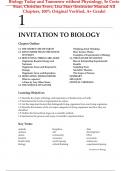
INVITATION TO BIOLOGY
Chapter Outline
1.1 THE SECRET LIFE OF EARTH Thinking about Thinking
1.2 LIFE IS MORE THAN THE SUM OF How Science Works
ITS PARTS Examples of Experiments in Biology
1.3 HOW LIVING THINGS ARE ALIKE 1.6 THE NATURE OF SCIENCE
Organisms Require Energy and Bias in Interpreting Experimental
Nutrients Results
Organisms Sense and Respond to Sampling Error
Change Scientific Theories
Organisms Grow and Reproduce The Scope of Science
1.4 HOW LIVING THINGS DIFFER SUMMARY
What is a species? SELF-QUIZ
A Rose by Any Other Name CRITICAL THINKING
1.5 THE SCIENCE OF NATURE
Learning Objectives
1.1 Describe the study of biology and importance of biodiversity on Earth.
1.2 Summarize the levels of organization in nature.
1.3 List the important factors that distinguish living organisms from non-living organisms.
1.4 Describe the features of the six major categories of living organisms and how they are
classified.
1.5 Outline the hierarchical stages of a scientific method.
1.6 Summarize the process and scope of scientific experimentation.
Key Terms
animals biosphere data
archaea cell development
atoms community DNA
bacteria consumer ecosystem
biodiversity control group eukaryotes
biology critical thinking experimental group
Invitation to Biology
,experiments nutrient reproduction
fungi organism sampling error
genus photosynthesis science
growth plants scientific method
homeostasis population scientific theory
hypothesis prediction species
inheritance probability statistically significant
law of nature producer taxon
model prokaryotes taxonomy
molecules protists variables
Lecture Outline
1.1 The Secret Life of Earth
A. There are organisms on Earth that have yet to be discovered and categorized.
B. Biology is the scientific study of life in order to make sense of the world around us.
1. It is important to understand:
a. What does it mean to be living?
b. What is scientific study and how does it work?
C. Species are going extinct at the rate of about 20 species per minute in the rain forests.
1. The rate of extinction is roughly 1,000 times faster than normal due to human activities.
1.2 Life Is More Than the Sum of Its Parts
A. Nature includes every substance and energy in the universe that has not been manufactured by
humans.
B. Natural substances can be classified based on increasing levels of complexity.
1. Atoms are the basic building blocks for all matter.
2. Molecules are unions of individual atoms.
a. There are four basic molecules associated with life: carbohydrates, lipids, nucleic acids,
and proteins.
3. Cells are the smallest unit of living things that can carry out the basic functions of life.
4. Organisms are collections of cells that work together and create complex interactions.
Organisms can exhibit several levels of interactions.
a. Tissues are groups of cells that work together to complete a process.
b. Organs are groups of tissues that work together.
c. Organ systems are groups of organs that work together to complete a complex process.
5. Populations are collections of the same type of species living in a given area.
6. Communities are all of the living populations in a given area.
7. An ecosystem includes all the living populations and the environment that the
communities interact with.
8. Finally, a biosphere encompasses all the different ecosystems on Earth.
C. Life is more than the sum of its individual parts. That is to say that there are emergent
properties or characteristics that arise out of the complexity of the interactions of a system’s
component parts.
1.3 How Living Things Are Alike
Chapter One
, A. Life is hard to define; however, there are several characteristics that all living things have in
common.
1. All living things require energy and the raw materials required to maintain energy
supplies.
a. Energy is the capacity to do work.
b. Nutrients are substances that an organism cannot make for itself but that the organism
requires for growth and survival.
c. Producers make their own food using energy and raw materials directly from the
environment. Plants are an example of a producer.
d. Consumers cannot make their own food; instead, they feed on other organisms for
food.
e. Nutrients cycle between producers and consumers, but energy does not. Energy flows
in one direction from the sun, through producers, and finally to consumers.
2. All living things have the ability to sense and respond to changes in the environment.
3. All living things have the ability to grow and reproduce.
a. Information about the variety of traits that exist between individuals is encoded for
within the DNA.
b. Inheritance is the transmission of DNA from parents to offspring through a mechanism
called reproduction.
1.4 How Living Things Differ
A. Various classification systems exist and will be covered in chapter 12. This text uses a three-
domain system: Bacteria, Archaea, and Eukarya.
1. Bacteria and Archaea are single-celled prokaryotes. Prokaryotes have no nucleus.
2. All other organisms are eukaryotes: organisms with a nucleus.
a. Protists are either single-celled or multicellular, producers or consumers.
b. Fungi are multicellular decomposers that complete digestion extracellularly.
c. Plants are multicellular producers that use photosynthesis to harvest sunlight for
conversion into chemical energy.
d. Animals are multicellular consumers that acquire nutrition by feeding on other
organisms.
B. All organisms have a two-part name.
1. First is its genus, which is a group of organisms that share a unique set of features.
2. Second is its species name, which represents a population of interbreeding organisms.
C. A Rose By Any Other Name: Individuals of a species share a unique set of inherited traits.
1.5 The Science of Nature
A. Science is the systematic study of the living world. Science is bound by the basic limitation of
observability.
B. The goal of scientific inquiry is to remove bias and subjectiveness from observation and
analysis of data.
A. Critical thinking is crucial to the scientific process.
B. Scientific study includes several common practices.
1. Observation of natural phenomena.
2. Framing questions about observations.
3. Doing background research and developing a hypothesis, or testable answer, for the
question.
Invitation to Biology
, 4. Using the hypothesis to generate an if/then process: If the hypothesis is this, then we
predict this should happen.
5. Devising a method for testing the prediction.
6. Assessing the data from the testing.
7. Reporting the findings.
C. This is not a rigid process; there are many ways of entering into scientific inquiry, and many
different starting points.
F. Experimentation is the best way to test hypotheses or falsify predictions.
G. Experiments are used to test individual variables; good experimental design seeks to reduce the
number of variables that may affect the outcome. This can be problematic because biological
systems have many interacting variables.
H. In an experiment, there are two groups: an experimental group, which receives a treatment,
and a control group, which does not receive the treatment for comparative purposes. Therefore,
changes between the two groups can be attributed to the treatment the experimental group
receives.
1.6 The Nature of Science
A. Bias in interpreting results: Researchers try to design experiments that test one variable
objectively.
B. Sampling Error: Scientists can never test every case of a phenomenon. Instead they study a
subset, or sample, of the phenomenon.
1. Sampling errors represent the difference between how the phenomenon was measured in
the sample population and how the phenomenon exists in the whole population.
2. Smaller samples have larger sampling errors.
3. Error bars on graphs represent that error.
C. A theory is a repetitively tested hypothesis that both describes a phenomena and leads to
successful future predictions about a phenomena.
1. In the sciences, theories represent the most firm understanding of nature that exists.
Theories are based in evidence and are only changed when newly acquired evidence
forces adjustment of the current model.
Suggestions for Presenting the Material
• This is the first chapter in an introductory textbook. Do not assume that students have
had previous biology classes. In fact, assume they have not. This is an important time to
lay out basic definitions: What is science? What is biology? What does it mean to be
living? How is scientific knowledge generated? Spend some time brainstorming with
your class. How do they define life, biology, and science?
• Start class by having the students decide what it means to be living. Have a large
brainstorm. After you cover what the book’s definition of life is, try to see if their
qualities fit into a more organized definition.
• Use the definition of life to frame your course on biology. Identify the qualities of living
things as themes, and relate to them over the course of the semester.
Chapter One
Starr, Christine Evers, Lisa Starr (Instructor Manual All
Chapters, 100% Original Verified, A+ Grade)
1
____________________________________________________________________________________________
INVITATION TO BIOLOGY
Chapter Outline
1.1 THE SECRET LIFE OF EARTH Thinking about Thinking
1.2 LIFE IS MORE THAN THE SUM OF How Science Works
ITS PARTS Examples of Experiments in Biology
1.3 HOW LIVING THINGS ARE ALIKE 1.6 THE NATURE OF SCIENCE
Organisms Require Energy and Bias in Interpreting Experimental
Nutrients Results
Organisms Sense and Respond to Sampling Error
Change Scientific Theories
Organisms Grow and Reproduce The Scope of Science
1.4 HOW LIVING THINGS DIFFER SUMMARY
What is a species? SELF-QUIZ
A Rose by Any Other Name CRITICAL THINKING
1.5 THE SCIENCE OF NATURE
Learning Objectives
1.1 Describe the study of biology and importance of biodiversity on Earth.
1.2 Summarize the levels of organization in nature.
1.3 List the important factors that distinguish living organisms from non-living organisms.
1.4 Describe the features of the six major categories of living organisms and how they are
classified.
1.5 Outline the hierarchical stages of a scientific method.
1.6 Summarize the process and scope of scientific experimentation.
Key Terms
animals biosphere data
archaea cell development
atoms community DNA
bacteria consumer ecosystem
biodiversity control group eukaryotes
biology critical thinking experimental group
Invitation to Biology
,experiments nutrient reproduction
fungi organism sampling error
genus photosynthesis science
growth plants scientific method
homeostasis population scientific theory
hypothesis prediction species
inheritance probability statistically significant
law of nature producer taxon
model prokaryotes taxonomy
molecules protists variables
Lecture Outline
1.1 The Secret Life of Earth
A. There are organisms on Earth that have yet to be discovered and categorized.
B. Biology is the scientific study of life in order to make sense of the world around us.
1. It is important to understand:
a. What does it mean to be living?
b. What is scientific study and how does it work?
C. Species are going extinct at the rate of about 20 species per minute in the rain forests.
1. The rate of extinction is roughly 1,000 times faster than normal due to human activities.
1.2 Life Is More Than the Sum of Its Parts
A. Nature includes every substance and energy in the universe that has not been manufactured by
humans.
B. Natural substances can be classified based on increasing levels of complexity.
1. Atoms are the basic building blocks for all matter.
2. Molecules are unions of individual atoms.
a. There are four basic molecules associated with life: carbohydrates, lipids, nucleic acids,
and proteins.
3. Cells are the smallest unit of living things that can carry out the basic functions of life.
4. Organisms are collections of cells that work together and create complex interactions.
Organisms can exhibit several levels of interactions.
a. Tissues are groups of cells that work together to complete a process.
b. Organs are groups of tissues that work together.
c. Organ systems are groups of organs that work together to complete a complex process.
5. Populations are collections of the same type of species living in a given area.
6. Communities are all of the living populations in a given area.
7. An ecosystem includes all the living populations and the environment that the
communities interact with.
8. Finally, a biosphere encompasses all the different ecosystems on Earth.
C. Life is more than the sum of its individual parts. That is to say that there are emergent
properties or characteristics that arise out of the complexity of the interactions of a system’s
component parts.
1.3 How Living Things Are Alike
Chapter One
, A. Life is hard to define; however, there are several characteristics that all living things have in
common.
1. All living things require energy and the raw materials required to maintain energy
supplies.
a. Energy is the capacity to do work.
b. Nutrients are substances that an organism cannot make for itself but that the organism
requires for growth and survival.
c. Producers make their own food using energy and raw materials directly from the
environment. Plants are an example of a producer.
d. Consumers cannot make their own food; instead, they feed on other organisms for
food.
e. Nutrients cycle between producers and consumers, but energy does not. Energy flows
in one direction from the sun, through producers, and finally to consumers.
2. All living things have the ability to sense and respond to changes in the environment.
3. All living things have the ability to grow and reproduce.
a. Information about the variety of traits that exist between individuals is encoded for
within the DNA.
b. Inheritance is the transmission of DNA from parents to offspring through a mechanism
called reproduction.
1.4 How Living Things Differ
A. Various classification systems exist and will be covered in chapter 12. This text uses a three-
domain system: Bacteria, Archaea, and Eukarya.
1. Bacteria and Archaea are single-celled prokaryotes. Prokaryotes have no nucleus.
2. All other organisms are eukaryotes: organisms with a nucleus.
a. Protists are either single-celled or multicellular, producers or consumers.
b. Fungi are multicellular decomposers that complete digestion extracellularly.
c. Plants are multicellular producers that use photosynthesis to harvest sunlight for
conversion into chemical energy.
d. Animals are multicellular consumers that acquire nutrition by feeding on other
organisms.
B. All organisms have a two-part name.
1. First is its genus, which is a group of organisms that share a unique set of features.
2. Second is its species name, which represents a population of interbreeding organisms.
C. A Rose By Any Other Name: Individuals of a species share a unique set of inherited traits.
1.5 The Science of Nature
A. Science is the systematic study of the living world. Science is bound by the basic limitation of
observability.
B. The goal of scientific inquiry is to remove bias and subjectiveness from observation and
analysis of data.
A. Critical thinking is crucial to the scientific process.
B. Scientific study includes several common practices.
1. Observation of natural phenomena.
2. Framing questions about observations.
3. Doing background research and developing a hypothesis, or testable answer, for the
question.
Invitation to Biology
, 4. Using the hypothesis to generate an if/then process: If the hypothesis is this, then we
predict this should happen.
5. Devising a method for testing the prediction.
6. Assessing the data from the testing.
7. Reporting the findings.
C. This is not a rigid process; there are many ways of entering into scientific inquiry, and many
different starting points.
F. Experimentation is the best way to test hypotheses or falsify predictions.
G. Experiments are used to test individual variables; good experimental design seeks to reduce the
number of variables that may affect the outcome. This can be problematic because biological
systems have many interacting variables.
H. In an experiment, there are two groups: an experimental group, which receives a treatment,
and a control group, which does not receive the treatment for comparative purposes. Therefore,
changes between the two groups can be attributed to the treatment the experimental group
receives.
1.6 The Nature of Science
A. Bias in interpreting results: Researchers try to design experiments that test one variable
objectively.
B. Sampling Error: Scientists can never test every case of a phenomenon. Instead they study a
subset, or sample, of the phenomenon.
1. Sampling errors represent the difference between how the phenomenon was measured in
the sample population and how the phenomenon exists in the whole population.
2. Smaller samples have larger sampling errors.
3. Error bars on graphs represent that error.
C. A theory is a repetitively tested hypothesis that both describes a phenomena and leads to
successful future predictions about a phenomena.
1. In the sciences, theories represent the most firm understanding of nature that exists.
Theories are based in evidence and are only changed when newly acquired evidence
forces adjustment of the current model.
Suggestions for Presenting the Material
• This is the first chapter in an introductory textbook. Do not assume that students have
had previous biology classes. In fact, assume they have not. This is an important time to
lay out basic definitions: What is science? What is biology? What does it mean to be
living? How is scientific knowledge generated? Spend some time brainstorming with
your class. How do they define life, biology, and science?
• Start class by having the students decide what it means to be living. Have a large
brainstorm. After you cover what the book’s definition of life is, try to see if their
qualities fit into a more organized definition.
• Use the definition of life to frame your course on biology. Identify the qualities of living
things as themes, and relate to them over the course of the semester.
Chapter One