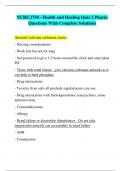
NURS 2750 - Health and Healing Quiz 2 Pharm
Questions With Complete Solutions
Antacids (calcium carbonate, tums)
- Nursing considerations:
- Work fast but not for long
- Not practical to give 1-2 hours around the clock and only taken
PO
- Those with renal failure - give calcium carbonate antacids as it
can help to bind phosphate
- Drug interactions:
- Toxicity from salts all preclude regular/acute care use
- Drug interactions with fluoroquinolones, tetracyclines, some
antiretrovirals
- Contraindications:
- Allergy
- Renal failure or electrolyte disturbances - Do not take
magnesium antacids can accumulate in renal failure
- ADR
- Constipation
,calcium carbonate
What type of antacid do we give those with renal failure because
it binds to phosphae
Magnesium antacids
What type of antacid do we AVOID giving to those with renal
failure ot electrolyte disturbances because it accumulates in the
kidneys and causes worsening renal failure?
Antacids: Drug Interactions
- Toxicity from salts all preclude regular/acute care use
- Drug interactions with fluoroquinolones, tetracyclines, some
antiretrovirals
constipation
What is the one ADR of antacids?
H2 blockers ("tidine"- ranitidine, famotidine)
- MOA: reduce acid secretion through histamine2 blockade
- ADRs:
- Overall very few
- Can increase anticholinergic burden (CNS ADRs in elderly
patients include confusion/disorientation)
- Increased risk of pneumonia
- Increased risk of C. difficile
,- B12 deficiency anemia with long term use
H2 blockers MOA
- reduce acid secretion through histamine2 blockade
H2 blocker ADR
- Can increase anticholinergic burden (CNS ADRs in elderly
patients include confusion/disorientation)
- Increased risk of pneumonia
- Increased risk of C. difficile
- B12 deficiency anemia with long term use
Proton pump inhibitors - ("prazole"- rabeprazole, omeprazole,
pantoprazole sodium)
- MOA: irreversibly bind to H+/K+ adenosine triphosphatase
(ATPase) enzyme
- IV, PO, long acting = most effective acid suppressive therapy
- Nursing considerations:
- All PPIs begin to lose effectiveness if exposed to gastric acid
directly
- All oral PPI dosage forms even the “dissolving beads” retain
an enteric coating that are meant to remain intact until the small
intestine (site of most drug absorption)
- Always ensure that no dosage form of a PPI is crushed!
- ADRs:
, - Very similar to H2 blockers (but this is like due to a greater
efficacy seen - somewhat higher risk of acid suppression related
ADRs)
- Pneumonia, C. difficile, B12, calcium deficiency
- Osteoporosis: risk of wrist/hip/spine fractures in long-term use
of HIV control
- Interactions:
- Raise stomach pH → may reduce absorption of medications
that need acidic environments to absorbed
- Rilpivirine = antiretroviral drug that can have its effects
diminished when administered with PPIs → leads to loss
- PPIs known to inhibit “OAT3”
- Organic ion transporter (needed to excrete various drugs via
renal route)
- This can result in methotrexate toxicity (esp. In higher doses
used in oncology)
prazole
What is the ending for PPIs
tidine
what is the ending fr H2 blockers
Proton pump inhibitors MOA
Questions With Complete Solutions
Antacids (calcium carbonate, tums)
- Nursing considerations:
- Work fast but not for long
- Not practical to give 1-2 hours around the clock and only taken
PO
- Those with renal failure - give calcium carbonate antacids as it
can help to bind phosphate
- Drug interactions:
- Toxicity from salts all preclude regular/acute care use
- Drug interactions with fluoroquinolones, tetracyclines, some
antiretrovirals
- Contraindications:
- Allergy
- Renal failure or electrolyte disturbances - Do not take
magnesium antacids can accumulate in renal failure
- ADR
- Constipation
,calcium carbonate
What type of antacid do we give those with renal failure because
it binds to phosphae
Magnesium antacids
What type of antacid do we AVOID giving to those with renal
failure ot electrolyte disturbances because it accumulates in the
kidneys and causes worsening renal failure?
Antacids: Drug Interactions
- Toxicity from salts all preclude regular/acute care use
- Drug interactions with fluoroquinolones, tetracyclines, some
antiretrovirals
constipation
What is the one ADR of antacids?
H2 blockers ("tidine"- ranitidine, famotidine)
- MOA: reduce acid secretion through histamine2 blockade
- ADRs:
- Overall very few
- Can increase anticholinergic burden (CNS ADRs in elderly
patients include confusion/disorientation)
- Increased risk of pneumonia
- Increased risk of C. difficile
,- B12 deficiency anemia with long term use
H2 blockers MOA
- reduce acid secretion through histamine2 blockade
H2 blocker ADR
- Can increase anticholinergic burden (CNS ADRs in elderly
patients include confusion/disorientation)
- Increased risk of pneumonia
- Increased risk of C. difficile
- B12 deficiency anemia with long term use
Proton pump inhibitors - ("prazole"- rabeprazole, omeprazole,
pantoprazole sodium)
- MOA: irreversibly bind to H+/K+ adenosine triphosphatase
(ATPase) enzyme
- IV, PO, long acting = most effective acid suppressive therapy
- Nursing considerations:
- All PPIs begin to lose effectiveness if exposed to gastric acid
directly
- All oral PPI dosage forms even the “dissolving beads” retain
an enteric coating that are meant to remain intact until the small
intestine (site of most drug absorption)
- Always ensure that no dosage form of a PPI is crushed!
- ADRs:
, - Very similar to H2 blockers (but this is like due to a greater
efficacy seen - somewhat higher risk of acid suppression related
ADRs)
- Pneumonia, C. difficile, B12, calcium deficiency
- Osteoporosis: risk of wrist/hip/spine fractures in long-term use
of HIV control
- Interactions:
- Raise stomach pH → may reduce absorption of medications
that need acidic environments to absorbed
- Rilpivirine = antiretroviral drug that can have its effects
diminished when administered with PPIs → leads to loss
- PPIs known to inhibit “OAT3”
- Organic ion transporter (needed to excrete various drugs via
renal route)
- This can result in methotrexate toxicity (esp. In higher doses
used in oncology)
prazole
What is the ending for PPIs
tidine
what is the ending fr H2 blockers
Proton pump inhibitors MOA