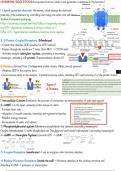
HORMONE RECEPTORS:(recognizes hormone, binds it and generates a response to the hormone)
1. Ligand-gated ion channels: Hormones, which change the electrical
potential of the membrane by controlling how many ions enter/exit cell. (Membrane)
Sodium Potassium pump eg:
Influx of positively charged ions (Na)/Efflux of negatively charged
ions (Cl) = depolarizes membrane & brings it closer to 0.
Efflux of K = hyperpolarizes membrane, becomes more negative.
2. G Protein-Coupled Receptors. (Membrane)
= Protein that attaches GDP (inactive) or GTP (active).)
- Passes through the membrane 7 times (from NH2 -> COOH side)
- Activates enzyme adenylate-cyclase, generating a secondary First messenger = hormone
messenger, activating a G-protein. (Transmembrane domain 6)
Coupling system = G protein
Effector system = Enzyme
G Proteins: (Formed from 3 Independent protein chains. (Alpha, beta & gamma).)
- Attaches GDP in the inactive form.
-Once hormone binds to the receptor, G proteins become active, attaching GTP and removing 2 of the protein chains.
Types of
G Proteins
----->
Secondary Messengers:
1. Intracellular Calcium (Involved in the process of contraction via interconnection of actin and myosin)
2. cAMP = In the heart, activates protein kinase A which:
- Increase heart rate
- relaxation of smooth vascular, bronchial and myometrial muscles
- Mobilize energy reserves
- Homeostasis of water and calcium.
3. Phosphatidylinositol system (Membrane phospholipids that generate secondary messengers)
Enzyme (phospholipase C) splits phospholipid into Diacylglycerol and Inositol triphosphate ( secondary messengers).
4. cGMP and Guanylate Cyclase (converts GTP -> cGMP
3. Enzyme Receptors: (membrane) -> act as enzymes when hormone attaches.
4. Nuclear Hormone Receptors: (inside the cell) -> Hormone attaches at the carboxy terminus end.
Attaching to DNA -> activation of transcription
1. Ligand-gated ion channels: Hormones, which change the electrical
potential of the membrane by controlling how many ions enter/exit cell. (Membrane)
Sodium Potassium pump eg:
Influx of positively charged ions (Na)/Efflux of negatively charged
ions (Cl) = depolarizes membrane & brings it closer to 0.
Efflux of K = hyperpolarizes membrane, becomes more negative.
2. G Protein-Coupled Receptors. (Membrane)
= Protein that attaches GDP (inactive) or GTP (active).)
- Passes through the membrane 7 times (from NH2 -> COOH side)
- Activates enzyme adenylate-cyclase, generating a secondary First messenger = hormone
messenger, activating a G-protein. (Transmembrane domain 6)
Coupling system = G protein
Effector system = Enzyme
G Proteins: (Formed from 3 Independent protein chains. (Alpha, beta & gamma).)
- Attaches GDP in the inactive form.
-Once hormone binds to the receptor, G proteins become active, attaching GTP and removing 2 of the protein chains.
Types of
G Proteins
----->
Secondary Messengers:
1. Intracellular Calcium (Involved in the process of contraction via interconnection of actin and myosin)
2. cAMP = In the heart, activates protein kinase A which:
- Increase heart rate
- relaxation of smooth vascular, bronchial and myometrial muscles
- Mobilize energy reserves
- Homeostasis of water and calcium.
3. Phosphatidylinositol system (Membrane phospholipids that generate secondary messengers)
Enzyme (phospholipase C) splits phospholipid into Diacylglycerol and Inositol triphosphate ( secondary messengers).
4. cGMP and Guanylate Cyclase (converts GTP -> cGMP
3. Enzyme Receptors: (membrane) -> act as enzymes when hormone attaches.
4. Nuclear Hormone Receptors: (inside the cell) -> Hormone attaches at the carboxy terminus end.
Attaching to DNA -> activation of transcription