

GLOBAL CHANGE
Climate Change: the physical science basis
Philippe Huybrechts (Geografie)
1. Some basics of the climate system
Weather vs Climate
Weather: atmospheric condition at a given time and place
lots of variables, difficult to predict
- air temp, precipitation, clouds, air pressure, wind speeds, atmospheric humidity,...
- Chaotic component (“Lorenz butterfly): lots of feedback, can not be predicted more
than 14 days ahead.
Climate: mean and extreme conditions of the atmosphere, ocean,
sea ice, … l
- long period of time (30 yrs bv)
- climate is the statistic of the weather
Differents spheres interact: crucial to understand climate system
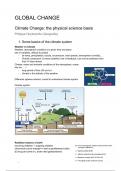
Climate system:
Radiation balance of earth
Incoming radiation = outgoing radiation
inkomende zonne energie=> deel w gereflecteerd (alfa)
(E terug de ruimte in), ander deel geabsorbeerd.
-
,Calculation of the global mean temperature
mean annual temp. of earth
only 3 variables
helderheid vd zon, reflectiviteit aarde, effectieve
emissive aarde.
Greenhouse effect (GE)
=process through which heat is trapped near Earth's
surface by substances known as 'greenhouse gases.
The greenhouse effect is a natural phenomenon, but
the extra gasses produced by human activity are
making it stronger. We are now adding to these
gasses faster than oceans and plants can absorb
them — the greenhouse effect is being 'enhanced' by
humans.
- radiatie absorberen en terug uitstralen
- Nodig voor leven op aarde: zorgt voor hogere T +15°C, zonder GE -19°C
- Water vapor as + feedback => even higher T
- CO2 heel belangrijk onderdeel
- aarde radieert long wave
absorption spectra of greenhouse gasses in the near infrared
smooth lines: Plank curves (radiation
from earth surface for specific T)
Kronkellijn: actual emitted radiation
by earth
diff between both= absorption in
atmosphere
Greenhouse gasses in atmosphere
-
, - Natural GE
- water vapor most important (feedback) but is internal to climate system
- climate warming => more water vapor in atmosphere => more greenhouse trapping
of radiation => more warming of climate
- if we warm climate door c GH gassen te verhogen gaat c waterdamp ook verhogen in
dit leidt tot meer radiatie
effect of doubling CO2 c (dit is wat er
gebeurd is sinds 1958 !!)
- eerst verwarming en dan
komen feedback responses
- balans snel hersteld
1) CO2 x 2 => less outgoing
longwave radiation
2) Mean annual surface T +1,2°
C en emission is terug
normaal
3) feedbacks => Ts (15°C) +
2,5° C (met de 1,2 erin!!)
2. Changes in human and natural drivers of climate
- Before and after the effects
caused by humans
- industrialisation big part
- deforestation: burning of the
threes
Detailed measurements on hawaii
since 1958
- CO2 c x2 since pre-industrial times
- Now: first time since 2 million years that there was this c of CO2
-
Climate Change: the physical science basis
Philippe Huybrechts (Geografie)
1. Some basics of the climate system
Weather vs Climate
Weather: atmospheric condition at a given time and place
lots of variables, difficult to predict
- air temp, precipitation, clouds, air pressure, wind speeds, atmospheric humidity,...
- Chaotic component (“Lorenz butterfly): lots of feedback, can not be predicted more
than 14 days ahead.
Climate: mean and extreme conditions of the atmosphere, ocean,
sea ice, … l
- long period of time (30 yrs bv)
- climate is the statistic of the weather
Differents spheres interact: crucial to understand climate system
Climate system:
Radiation balance of earth
Incoming radiation = outgoing radiation
inkomende zonne energie=> deel w gereflecteerd (alfa)
(E terug de ruimte in), ander deel geabsorbeerd.
-
,Calculation of the global mean temperature
mean annual temp. of earth
only 3 variables
helderheid vd zon, reflectiviteit aarde, effectieve
emissive aarde.
Greenhouse effect (GE)
=process through which heat is trapped near Earth's
surface by substances known as 'greenhouse gases.
The greenhouse effect is a natural phenomenon, but
the extra gasses produced by human activity are
making it stronger. We are now adding to these
gasses faster than oceans and plants can absorb
them — the greenhouse effect is being 'enhanced' by
humans.
- radiatie absorberen en terug uitstralen
- Nodig voor leven op aarde: zorgt voor hogere T +15°C, zonder GE -19°C
- Water vapor as + feedback => even higher T
- CO2 heel belangrijk onderdeel
- aarde radieert long wave
absorption spectra of greenhouse gasses in the near infrared
smooth lines: Plank curves (radiation
from earth surface for specific T)
Kronkellijn: actual emitted radiation
by earth
diff between both= absorption in
atmosphere
Greenhouse gasses in atmosphere
-
, - Natural GE
- water vapor most important (feedback) but is internal to climate system
- climate warming => more water vapor in atmosphere => more greenhouse trapping
of radiation => more warming of climate
- if we warm climate door c GH gassen te verhogen gaat c waterdamp ook verhogen in
dit leidt tot meer radiatie
effect of doubling CO2 c (dit is wat er
gebeurd is sinds 1958 !!)
- eerst verwarming en dan
komen feedback responses
- balans snel hersteld
1) CO2 x 2 => less outgoing
longwave radiation
2) Mean annual surface T +1,2°
C en emission is terug
normaal
3) feedbacks => Ts (15°C) +
2,5° C (met de 1,2 erin!!)
2. Changes in human and natural drivers of climate
- Before and after the effects
caused by humans
- industrialisation big part
- deforestation: burning of the
threes
Detailed measurements on hawaii
since 1958
- CO2 c x2 since pre-industrial times
- Now: first time since 2 million years that there was this c of CO2
-

