WEEK 7- BRAIN AND COGNITION- expertise
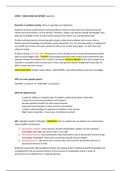
Expertise vs problem solving- these 2 capacities are related but…
Expertise involves people being at solving problems similar to those they have experienced and
solved many times before, such as driving. Therefore, experts use domain-specific knowledge. They
build up knowledge of how to solve similar issues for the future. E.g. checking blind spot.
Problem solving however involved people trying to solve novel problems and so must rely on
domain-general knowledge using flexible, general heuristics. E.g. not reversing actions- if getting lost
we wouldn’t go all the way home and back to the house to then leave again- we take short cuts
using sub stages.
Problem solving- the Hanoi task. Final goal is to move all disks to the far peg whilst keeping smaller
disks on top of bigger disks. THOMAS found people generally make several quick movements then
paused to divide the problem into a series of sub-goals. EGAN & GREENO found when people were
trained on 3 problems then transferred to 4 they used general domain independent heuristics (ie
didn’t reverse previous moves).
NEWELL&SIMONS problem space theory- LIMITATIONS- real world problems use prior knowledge
Why are some people expert?
NATURE- is it talent? Or NURTURE- is it practice?
What do experts have?
- A superior ability to recognise type of problem and knowing what is important
- A large store of previous problems and solutions
- Domain-specific heuristics for their expert domain
- Improved representation of deep structure of problems
- A better understanding of categories of problems in the domain.
- High levels of expertise = many years of intensive practise!!
ACT- Adaptive Control of Thought- ANDERSON- tries to explain how we adapt to our environment
using cognitive mechanisms-
1. Declarative memory- stores general, domain-independent, explicit (can be reported)
knowledge used when we start to learn a new skill
2. Procedural memory- stores production rules that build on info in declarative memory using
knowledge compilation- these rules are domain-specific and are implicit.
3. Working memory- this stores the currently active info from the declarative memory or
procedural memory or both.
Anderson argues that skill acquisition involves fine tuning chunks of domain-specific knowledge and
compiling them into procedural memory by the process of composition where a series of
productions are combined into a single production.
Expertise vs problem solving- these 2 capacities are related but…
Expertise involves people being at solving problems similar to those they have experienced and
solved many times before, such as driving. Therefore, experts use domain-specific knowledge. They
build up knowledge of how to solve similar issues for the future. E.g. checking blind spot.
Problem solving however involved people trying to solve novel problems and so must rely on
domain-general knowledge using flexible, general heuristics. E.g. not reversing actions- if getting lost
we wouldn’t go all the way home and back to the house to then leave again- we take short cuts
using sub stages.
Problem solving- the Hanoi task. Final goal is to move all disks to the far peg whilst keeping smaller
disks on top of bigger disks. THOMAS found people generally make several quick movements then
paused to divide the problem into a series of sub-goals. EGAN & GREENO found when people were
trained on 3 problems then transferred to 4 they used general domain independent heuristics (ie
didn’t reverse previous moves).
NEWELL&SIMONS problem space theory- LIMITATIONS- real world problems use prior knowledge
Why are some people expert?
NATURE- is it talent? Or NURTURE- is it practice?
What do experts have?
- A superior ability to recognise type of problem and knowing what is important
- A large store of previous problems and solutions
- Domain-specific heuristics for their expert domain
- Improved representation of deep structure of problems
- A better understanding of categories of problems in the domain.
- High levels of expertise = many years of intensive practise!!
ACT- Adaptive Control of Thought- ANDERSON- tries to explain how we adapt to our environment
using cognitive mechanisms-
1. Declarative memory- stores general, domain-independent, explicit (can be reported)
knowledge used when we start to learn a new skill
2. Procedural memory- stores production rules that build on info in declarative memory using
knowledge compilation- these rules are domain-specific and are implicit.
3. Working memory- this stores the currently active info from the declarative memory or
procedural memory or both.
Anderson argues that skill acquisition involves fine tuning chunks of domain-specific knowledge and
compiling them into procedural memory by the process of composition where a series of
productions are combined into a single production.