BRAIN AND COGNITION WEEK 10- reasoning and decision making
Multiple forms of thinking:
- Reasoning research= do humans follow laws of logic? Inductive and deductive reasoning
- Decision making= do they think using laws of probability
- Problem solving research= research into reasoning/decision making, ptps come up with the
solutions themselves
- Creativity research= how are novel products and ideas created?
- Analogy making= to what extent can knowledge acquired in a domain be transferred in a
different domain?
The approaches differ in tasks studied and the theoretical assumptions made… BUT they all study
the same question: thinking! They key conclusions are also the same:
- Long-term memory knowledge is essential to thinking
- Limits in attention and short-term memory make even simple problems hard to solve
- Whether attention is directed to the key aspects of the problem predicts whether people
will find a good solution
REASONING
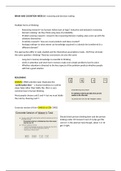
WASON (1968) selection task- illustrates the
‘confirmation bias’ – a human tendency to confirm
views help rather than falsify the, this is a very
common bias in human thinking.
Most people choose card E and 4- but we must falsify
the rule by choosing card 7.
Concrete version of this= GRIGGS & COX (1982)
Should check person drinking beer and the person
looking under 18! Around 3 out of 4 ptps get this
correct- in the abstract task though, about 1 in 10
get it right.
Multiple forms of thinking:
- Reasoning research= do humans follow laws of logic? Inductive and deductive reasoning
- Decision making= do they think using laws of probability
- Problem solving research= research into reasoning/decision making, ptps come up with the
solutions themselves
- Creativity research= how are novel products and ideas created?
- Analogy making= to what extent can knowledge acquired in a domain be transferred in a
different domain?
The approaches differ in tasks studied and the theoretical assumptions made… BUT they all study
the same question: thinking! They key conclusions are also the same:
- Long-term memory knowledge is essential to thinking
- Limits in attention and short-term memory make even simple problems hard to solve
- Whether attention is directed to the key aspects of the problem predicts whether people
will find a good solution
REASONING
WASON (1968) selection task- illustrates the
‘confirmation bias’ – a human tendency to confirm
views help rather than falsify the, this is a very
common bias in human thinking.
Most people choose card E and 4- but we must falsify
the rule by choosing card 7.
Concrete version of this= GRIGGS & COX (1982)
Should check person drinking beer and the person
looking under 18! Around 3 out of 4 ptps get this
correct- in the abstract task though, about 1 in 10
get it right.