

Topic 8: The periodic table
8.1 ARRANGEMENT OF ELEMENTS--------------------
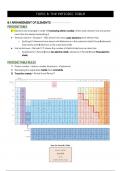
PERIODIC TABLE
● Elements are arranged in order of increasing atomic number, where each element has one proton
more than the element preceding it
● Vertical columns = Groups (I - VIII), shows how many outer electrons each element has
○ Eg Group IV elements have atoms with 4 electrons in the outermost shell, Group 6 elements
have atoms with 6 electrons in the outermost shells
● Horizontal rows = Periods (1-7), shows the number of shells of electrons an atom has
○ Eg elements in Period 2 have two electron shells, elements in Period 3 have three electron
shells
PERIODIC TABLE RULES
1) Proton number = atomic number (# protons = # electrons)
2) Red zigzag line separates metals from nonmetals
3) Transition metals = Period 6 and Period 7
, PATTERNS AND TRENDS
1) Main-group elements tend to form cations with a charge equal to the group number
● Group 1 and 1+ ions, Group 2 and 2+ ions
2) When atoms collide and react, it is the outer electrons that meet and interact. So, elements in the
same group have similar chemical properties because they have the same number of electrons in
their outer shell
3) The Periodic Table can also be used to predict boiling point, melting point, density and many more
properties by comparing to nearby elements
4) Most reactive elements are near the left and right-hand sides
5) Least reactive elements are in the centre
6) Poor metals - below the steps separating metals from non-metals are fairly unreactive and have
some properties like non-metals
8.2 GROUP I PROPERTIES - ALKALI METALS (1 valence electron)---------------------
● Relatively soft metals with general trends going down the group
PROPERTY CHARACTER
Appearance Shiny but quickly form a dull layer of oxide/tarnish.
Strength Soft metals - easily cut with a knife
● Become even softer and denser as you move down the group
M.p and b.p
Low compared with other metals due to its weak metallic bonds. M.p and b.p
decrease as you move down
8.1 ARRANGEMENT OF ELEMENTS--------------------
PERIODIC TABLE
● Elements are arranged in order of increasing atomic number, where each element has one proton
more than the element preceding it
● Vertical columns = Groups (I - VIII), shows how many outer electrons each element has
○ Eg Group IV elements have atoms with 4 electrons in the outermost shell, Group 6 elements
have atoms with 6 electrons in the outermost shells
● Horizontal rows = Periods (1-7), shows the number of shells of electrons an atom has
○ Eg elements in Period 2 have two electron shells, elements in Period 3 have three electron
shells
PERIODIC TABLE RULES
1) Proton number = atomic number (# protons = # electrons)
2) Red zigzag line separates metals from nonmetals
3) Transition metals = Period 6 and Period 7
, PATTERNS AND TRENDS
1) Main-group elements tend to form cations with a charge equal to the group number
● Group 1 and 1+ ions, Group 2 and 2+ ions
2) When atoms collide and react, it is the outer electrons that meet and interact. So, elements in the
same group have similar chemical properties because they have the same number of electrons in
their outer shell
3) The Periodic Table can also be used to predict boiling point, melting point, density and many more
properties by comparing to nearby elements
4) Most reactive elements are near the left and right-hand sides
5) Least reactive elements are in the centre
6) Poor metals - below the steps separating metals from non-metals are fairly unreactive and have
some properties like non-metals
8.2 GROUP I PROPERTIES - ALKALI METALS (1 valence electron)---------------------
● Relatively soft metals with general trends going down the group
PROPERTY CHARACTER
Appearance Shiny but quickly form a dull layer of oxide/tarnish.
Strength Soft metals - easily cut with a knife
● Become even softer and denser as you move down the group
M.p and b.p
Low compared with other metals due to its weak metallic bonds. M.p and b.p
decrease as you move down


