Complete Blood Count Questions And Answers With Verified Solutions Graded A+
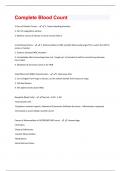
3 Uses of Platelet Counts - 1. Assess bleeding disorders 2. Part of coagulation workup 3. Monitor course of disease or bone marrow failure 4 Interfering Factors - 1. Abonormalities in RBC size (EX) Abnormally large (This is when the CBC M comes in handy) 2. Extreme elevated WBC elevation 3. Immediately after hemorrhage have not "caught up" so hematocrit will be normal (may decrease hours later) 4. Elevations & decreases same as for HGB 4 Red Blood Cell (RBC) characteristics - 1. Biconcave Disk 2. Carry Oxygen from lungs to tissues; carries carbon dioxide from tissues to lungs 3. 120 day lifespan 4. The Spleen breaks down RBCs Basophils (Mast Cells) - Normal = 0.5% - 1.0% -Granulocytic cells -Cytoplasm contains Heparin, Histamine & Serotonin (Infiltrate the tissue - Inflammatory response) -Decreased as acute allergic reaction occurs Causes of Abnormalities in DECREASED RBC count - -Hemorrhage -Hemolysis -Dietary Deficiencies -Genetic Abnormalities -Medications -Bone Marrow Failure-Chronic illness -Renal Failure Causes of Abnormalities in INCREASED RBC count - -Physiologic adaptation -COPD -Polycythemia vera (make more RBCs then normal) -Dehydration -Hemoglobinopathy Components of a Complete Blood Count (CBCG) - 1. White Blood Cell Count -If subtypes of WBCs are included, this is called a Differential (CBC D) or (CBC M) 2. Red Blood Cell Count 3. Hemoglobin (HGB) 4. Hematocrit (HCT) 5. Mean Corpuscular Volume (MCV) 6. Mean Corpuscular Hemoglobin (MCH) 7. MCHC (Mean Corpuscular Hemoglobin Concentration) -Platelet Count -RDW (Red cell Distribution Width)
Written for
- Institution
- Complete Blood Count
- Course
- Complete Blood Count
Document information
- Uploaded on
- July 28, 2024
- Number of pages
- 7
- Written in
- 2023/2024
- Type
- Exam (elaborations)
- Contains
- Questions & answers
Subjects

Also available in package deal