The DSM QUESTIONS & ANSWERS RATED 100% CORRECT!!
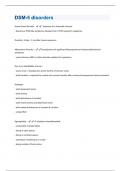
Describe Axis five - Answer-Gives a global assessment of functioning. A score of 1 to 100 is used to classify the patient based on an evaluation of how well they function socially, occupationally and psychologically 1 = being in severe danger of harm to self or other 100 = showing the individual has superior functioning in a wide range of activities Describe Axis four - Answer-Measures psychological and environmental problems that may affect diagnosis Includes: - problems with family - educational problems - housing problems - economic problems Describe Axis one - Answer-Any clinical disorder or conditions already present other than personality disorders and mental retardation Includes: - substance related disorders - schizophrenic / psychotic disorders - mood disorders - anxiety disorders - eating disorders Describe Axis three - Answer-Assesses general medical conditions that may affect diagnosis - physical problems that are of relevance to the condition or treatment-e.g. if the patient had diabetes, this could affect the use of certain drugs Describe Axis two - Answer-Personality disorders and mental retardation. Helps us understand Axis 1 Describe Brown's 2001 study evaluating reliability of the DSM - Answer-- Anxiety and mood disorder in 362 outpatients in Boston, USA - Two independent interviews using anxiety disorders interview schedule for DSM IV - much agreement - Disagreement focused on whether the person had enough symptoms, whether they were severe enough or had lasted long enough to gain a diagnosis - Difficult to classify people on the boundary particularly with regard to depression and generalised anxiety disorder Describe concurrent validity - Answer-- When the results of a study matched the result of another study done at the same time - If a diagnosis made using the DSM arrives at the same mental disorder that another diagnosis has, it has concurrent validity Describe construct validity - Answer-- Whether or not a classified disorder is a good indicator of what you're trying to measure - E.g. operationalizing a disorder like depression by drawing a list of symptoms and features, you begin to lose some understanding of the real nature of the disorder Describe descriptive validity - Answer-- symptoms of one disorder should be different from those of other categories - individuals with different diagnoses may show similar symptoms e.g. depression may be seen in some anxiety disorders and manic depression - most patients show co morbidity - meaning that they have several disorders at once - this raises questions about whether they are in fact different disorders - Eysneck 1997 = up to 2/3rds of patients with an anxiety disorder have been diagnosed with one or more additional anxiety disordersDescribe etiological validity - Answer-- Requires all patients who have the same diagnosis should have developed the disorder for the same reason - Not the case as causes vary considerably from person to person and very few underlying causes are known - there is a wide range of treatment for the same disorder - this kind of validity may be unattainable because there are generally multiple cases for disorders
Written for
- Institution
- The DSM
- Course
- The DSM
Document information
- Uploaded on
- July 27, 2024
- Number of pages
- 8
- Written in
- 2023/2024
- Type
- Exam (elaborations)
- Contains
- Questions & answers
Subjects

Also available in package deal