100% satisfaction guarantee Immediately available after payment Both online and in PDF No strings attached 4.2 TrustPilot
logo-home
Exam (elaborations)

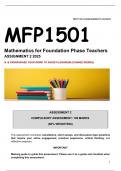
MNB3701 Assignment 2 (COMPLETE ANSWERS) Semester 2 2024 (195080) - DUE 5 August 2024

Rating
4.0
(4)
Sold
25
Pages
25
Grade
A+
Uploaded on
27-07-2024
Written in
2023/2024

MNB3701 Assignment 2 (COMPLETE ANSWERS) Semester 2 2024 (195080) - DUE 5 August 2024 ; 100% TRUSTED Complete, trusted solutions and explanations. For assistance, Whats-App 0.6.7-1.7.1-1.7.3.9. Ensure your success with us . . Executive summary Important: • Your report should start with an executive summary. • An executive summary should summarise the key points of the report (maximum 300 words). • The key elements of the executive summary must include the following elements (1) the purpose of the report, (2) objectives that you aim to accomplish in your report, (3) key findings, (4) conclusions drawn, and (5) recommendations. • Note you will only indicate the conclusions drawn from your evaluation in reports 1, 2, and 3, and NOT make any recommendations for future management action in the first report. MNB3701/PORTFOLIO OF WORK/SEMESTER 2/2024 10 • Note recommendations, covering the entire report are only to be made in the final report. • Write the executive summary only once you have completed all the other required sections of the first report. (5 marks) 6.3.3 Literature search • Write a brief and concise description of the literature search you have undertaken (maximum 200 words). • It must be a brief description of how you went about doing the literature search. It is not merely a list of the elements of your literature search undertaken. • Note your literature search should focus on scholarly literature related to the topics of your assignment. • In terms of the key elements that must be included in the description of your literature search: (1) You must indicate the period considered in your literature search (for example the period from 2010 to 2022), (2) search terms used, which may indicate inclusion or exclusion criteria used (3) the databases and search engines used, (4) the results of your search, (5) number of articles that you read (for example abstracts that you have read) and (6) how many of these sources did you consider and useful in completing the first report. • This literature description should be presented as a paragraph and not as a bullet point statement. • Then indicate the sources you have decided to use in writing up your report. Reference these sources in-text and the bibliography at the end of your report. • Note that in-text references and the bibliography should align. • You may add a table at the end of your report as an annexure to give an overview of the articles considered in writing your report. This will help to meet the word limit for the literature section. Do not include a list of sources in the literature section. The list of sources used must be included in the literature section. • You must reference at least 10 sources that you have used that are reputable and/or scholarly in writing your first report. • Note sources or articles already cited in the online learning units should not form part of the 10 references/sources you have decided to use. These sources must be added if used in addition to the required ten sources. MNB3701/PORTFOLIO OF WORK/SEMESTER 2/2024 11 • It is advised to read the required article readings, in each of the learning units, before starting your literature search, as these articles are a useful starting point to do your literature search. • Websites constructed by anonymous authors and “wiki-like” pages are not considered reputable scholarly sources. These sources have not been peer-reviewed. Hence, careful discernment is required in the sources used to write up your report. (5 Marks) 6.3.4 Background • In this section of your report write a brief and concise description that will give the reader sufficient background to the MNE’s path to internationalisation (maximum 500 words). • Include in the background section aspects such as the: (1) historical path the organisation has taken to become an MNE and (2) key decisions or the role of decision makers/leaders played in becoming an MNE. (3) It is also important to indicate the motivation for expanding operations into Africa and the product markets served by the MNE. • Conclude the background section by stating the objectives set by the MNE’s management (review section 2.2) that you will address in the first report. (10 Marks) 6.3.5 Formal institutional frameworks Important: • The first objective that you must accomplish in writing all three of the reports is to identify and evaluate the determinants of the success or failure of operating the MNE in the African context. • The second objective to accomplish is to draw conclusions from your evaluation. In other words, what implications for management action are drawn from your evaluation of the determinants of the success or failure of operating the MNE that you picked? • Note the institutions-based perspective is a useful theoretical perspective to identify, evaluate, and explain what determines the success or failure of an MNE operating in different locations internationally. • Required article readings are as follows: MNB3701/PORTFOLIO OF WORK/SEMESTER 2/2024 12 • Peng, MW, Wang, DY & Jiang, Y. 2008. An institution-based view of international business strategy: a focus on emerging economies. Journal of International Business Studies 39(5):920–936. • Brandenburger, AM & Nalebuff, BJ. 1995. The right game: use game theory to shape strategy (volume 76). Chicago: Harvard Business Review:57–71. • It is important to understand the two propositions made in the institutions-based view and then make a judgment based on facts found which one of these two propositions applies to the MNE you are reporting on. • DO NOT merely describe institutional workings, considerations, or theory. You must use the theory to evaluate which one of the propositions applies to the MNE you have picked. Guidelines for preparing and writing up the section on formal institutional frameworks (maximum 1000 words): • In preparing to write your report, you should have done the required readings and your homework first on the formal institutional frameworks in the host country. This will be crucial to develop a thorough understanding of how the workings of formal institutions govern the behavior of the MNE. • Only then evaluate which aspects of the workings of formal institutions are key to the success or failure of the MNE’s operations. This may include current issues or debates on the workings of institutions that are affecting the current operations or future direct investments by the MNE in the host country. • Finally, given your evaluation of formal institutions: what key implications did you draw from your evaluation for management action? (20 Marks) 6.3.6 Informal Institutional Frameworks Important: • The second proposition in the institutions-based view is that formal and informal institutions combine to govern MNEs behavior, but in contexts where formal institutions’ constraints are not clear or inadequate (meaning the rules of the game), then informal constraints will play a much larger role in reducing uncertainty and provide constancy operating the MNE. (20 Marks) MNB3701/PORTFOLIO OF WORK/SEMESTER 2/2024 13 Guidelines for preparing and writing up the section on formal institutional frameworks (maximum 1000 words): • In preparing to write this section of your report, you should have done your homework on the informal institutional frameworks of the host country. This will be crucial to developing a thorough understanding of how the workings of informal institutions govern the behavior of MNEs and will include reading up on the concept of contextual intelligence. • Required article reading: Khanna, T. 2014. Contextual intelligence. Harvard Business Review 92(9):58–68. • Then evaluate which aspects of the workings of informal institutions are key to the success or failure of the MNE. • Your evaluation should also focus on whether the MNE is acting culturally intelligent or needs to develop cultural intelligence. • You should also consider in your evaluation issues and debates provoked by informal institutions such as culture, ethics, and norms in the host country. • Finally, given your evaluation of informal institutions: what key implications did you draw from your evaluation of informal institutional workings for management action? 6.3.7 Conclusions • In writing the conclusions section (maximum 500 words), you must show how the management problem identified in section 2.1 connects to the conclusions drawn from your evaluation and derived from your evidence presented in the report (as opposed to personal interpretations, is required). In other words, you must connect what you investigated with the facts found (and not your personal interpretations) about the management problem identified. • The conclusions should close the “circle” of your report by connecting to the management problem you were initially presented with.

Show more Read less
Institution
Course


Whoops! We can’t load your doc right now. Try again or contact support.

Connected book

Written for

Institution
Course

Document information

Uploaded on
July 27, 2024
Number of pages
25
Written in
2023/2024
Type
Exam (elaborations)
Contains
Questions & answers

Subjects

Content preview

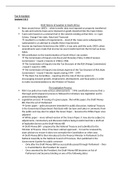
MNB3701
Assignment 2 Semester 2 2024
Detailed Solutions, References & Explanations

Unique number: 195080

Due Date: 5 August 2024
SASOL'S OPERATIONS AND INSTITUTIONAL FRAMEWORKS IN MOZAMBIQUE: AN
ANALYTICAL REPORT

TABLE OF CONTENTS
1. EXECUTIVE SUMMARY ......................................................................................4
2. LITERATURE SEARCH ......................................................................................5
3. BACKGROUND ......................................................................................................6
3.1. Historical Path to Becoming an MNE ................................................................6
3.2. Key Decisions and Role of Decision Makers ....................................................6
3.3. Motivation for Expanding into Africa .................................................................7
3.4. Product Markets Served ...................................................................................7
3.5. Objectives Set by Management ........................................................................7
4. FORMAL INSTITUTIONAL FRAMEWORKS ..........................................................8
4.1 Overview............................................................................................................8
4.2. Political System ................................................................................................9
4.2.1. Determinants of Success and Failure .........................................................9
4.2.2. Implications for Management .....................................................................9 Terms of use
By making use of this document you agree to:
• Use this document as a guide for learning, comparison and reference purpose,
4.3. Economic System .............................................................................................9
• Not to duplicate,
4.3.1. Determinants reproduce
of Success andand/or misrepresent
Failure the contents of this document as your own work,
.........................................................9
• Fully accept the consequences should you plagiarise or misuse this document.
4.3.2. Implications for Management ...................................................................10
4.4. Legal System ..................................................................................................10 Disclaimer
Extreme care has been used to create this document, however the contents are provided “as is” without
4.4.1. Determinants of Success
any representations and Failure
or warranties, .......................................................
express or implied. The author assumes no liability 10 as a result of
reliance and use
4.4.2. Implications for of the contents of...................................................................
Management this document. This document is to be used for comparison, 10 research
and reference purposes ONLY. No part of this document may be reproduced, resold or transmitted in any
4.5. Evaluation of Propositions from the Institutions-Based View .......................... form or 11by any means.
4.5.1. Political System Evaluation ......................................................................11

$3.04
Get access to the full document:
Purchased by 25 students

100% satisfaction guarantee
Immediately available after payment
Both online and in PDF
No strings attached

Reviews from verified buyers

Showing all 4 reviews
6 months ago

1 year ago

1 year ago

1 year ago

4.0

4 reviews

5
2
4
1
3
0
2
1
1
0
Trustworthy reviews on Stuvia

All reviews are made by real Stuvia users after verified purchases.

Get to know the seller

Seller avatar
Reputation scores are based on the amount of documents a seller has sold for a fee and the reviews they have received for those documents. There are three levels: Bronze, Silver and Gold. The better the reputation, the more your can rely on the quality of the sellers work.
EduPal University of South Africa (Unisa)
Follow You need to be logged in order to follow users or courses
Sold
149163
Member since
7 year
Number of followers
35995
Documents
4310
Last sold
1 day ago

4.2

13555 reviews

5
7803
4
2688
3
1790
2
455
1
819

Recently viewed by you

Why students choose Stuvia

Created by fellow students, verified by reviews

Quality you can trust: written by students who passed their exams and reviewed by others who've used these notes.

Didn't get what you expected? Choose another document

No worries! You can immediately select a different document that better matches what you need.

Pay how you prefer, start learning right away

No subscription, no commitments. Pay the way you're used to via credit card or EFT and download your PDF document instantly.

Student with book image

“Bought, downloaded, and aced it. It really can be that simple.”

Alisha Student

Frequently asked questions