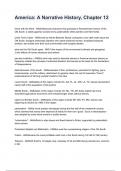
America: A Narrative History, Chapter 12
Gone with the Wind - ANSHollywood production that portrayed a Romanticized version of the
Old South: a stable agrarian society led by paternalistic white planters and their family
Uncle Tom's Cabin - ANSnovel by Harriet Beecher Stowe; portrayed a very dark myth about the
Old South: arrogant aristocratic planters who raped enslaved women, brutalized enslaved
workers, adn lorded over their local communities with haughty disdain.
what set the Old South apart - ANS1) the impact of the environment (climate and geogrphy)
2) the effects of human decisions and actions
peculiar institution - ANSthis term was used to describe slavery in America because slavery so
fragrantly violated the principle of individual freedom that served as the basis for the Declaration
of Independence
distinctiveness of the South - ANSexamples of this: architecture; penchant for fighting, guns,
horsemanship, and the military; attachment to agrarian ideal; the cult of masculine "honor";
preponderance of farming; people's belief in this idea
Lower South - ANSstates of this region include SC, GA, FL, AL, MS, LA, TX; slaves represented
nearly half of the population of this portion
Middle South - ANSstates of this region include VA, NC, TN, AR; these states had more
diversified agricultural economics and included larger areas without slavery.
Upper (or Border) South - ANSstates of this region include DE, MD, KY, MO; slavery was
beginning to decline by 1860 in this region
paternalism - ANSa moral position developed during the first half of the nineteenth century
which claimed that slaves were deprived of liberty for their own "good." Such a rationalization
was adopted by some slave owners to justify slavery
"colonization" - ANSefforts to ship slaves and freed blacks to Africa; supported by paternalistic
slave owners
Protestant (Baptist and Methodist) - ANSthis was the overwhelming religion of the Old South
Cotton - ANSbecame the most profitable cash crop in the South during 1st half of 19th century
Tobacco - ANSOld South's 1st staple crop; mainstay of VA and MD during colonial era; common
in NC
Gone with the Wind - ANSHollywood production that portrayed a Romanticized version of the
Old South: a stable agrarian society led by paternalistic white planters and their family
Uncle Tom's Cabin - ANSnovel by Harriet Beecher Stowe; portrayed a very dark myth about the
Old South: arrogant aristocratic planters who raped enslaved women, brutalized enslaved
workers, adn lorded over their local communities with haughty disdain.
what set the Old South apart - ANS1) the impact of the environment (climate and geogrphy)
2) the effects of human decisions and actions
peculiar institution - ANSthis term was used to describe slavery in America because slavery so
fragrantly violated the principle of individual freedom that served as the basis for the Declaration
of Independence
distinctiveness of the South - ANSexamples of this: architecture; penchant for fighting, guns,
horsemanship, and the military; attachment to agrarian ideal; the cult of masculine "honor";
preponderance of farming; people's belief in this idea
Lower South - ANSstates of this region include SC, GA, FL, AL, MS, LA, TX; slaves represented
nearly half of the population of this portion
Middle South - ANSstates of this region include VA, NC, TN, AR; these states had more
diversified agricultural economics and included larger areas without slavery.
Upper (or Border) South - ANSstates of this region include DE, MD, KY, MO; slavery was
beginning to decline by 1860 in this region
paternalism - ANSa moral position developed during the first half of the nineteenth century
which claimed that slaves were deprived of liberty for their own "good." Such a rationalization
was adopted by some slave owners to justify slavery
"colonization" - ANSefforts to ship slaves and freed blacks to Africa; supported by paternalistic
slave owners
Protestant (Baptist and Methodist) - ANSthis was the overwhelming religion of the Old South
Cotton - ANSbecame the most profitable cash crop in the South during 1st half of 19th century
Tobacco - ANSOld South's 1st staple crop; mainstay of VA and MD during colonial era; common
in NC