
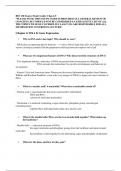
BIO 110 Exam 2 Study Guide: Chps 6-9*PLEASE NOTE: THIS STUDY GUIDE IS PROVIDED AS A GENERAL REVIEW OF CONCEPTS, BUT SHOULD NOT BE CONSIDERED AN EXHAUSTIVE LIST OF ALL THE TOPICS WE HA VE COVERED IN CLASS! YOU ARE RESPONSIBLE FOR ALL INFORMATION COVERED IN LECTURE!Chapter 6: DNA & Gene Expression• Why is DNA such a hot topic? Why should we care?- DNA plays an important part in forensics —> saliva, blood, dead skin cells, etc found at crime scenes can help accurately find the perpetrator and keep innocent suspects out of jail• What are two important features of DNA? Who discovered the structure of DNA?- Two important features: molecules of DNA are passed down from parent to offspringDNA encodes the instructions for growth, development, and behavior in an organism- Francis Crick and American James Watson put discovered information together (from Maurice Wilkins and Rosalind Franklin’s work with x-ray images of DNA) to figure out exact structure of DNA• What is a nucleic acid? A nucleotide? What does a nucleotide consist of?- Nucleic acid = macromolecule that stores and transfers information DNA and RNA consists of individual nucleotides - Nucleotide = a molecule containing a sugar molecule, phosphate group, and nitrogen containing basestogether these individual units make up a nucleic acid • What is the double helix? How are the two strands held together? What makes up the backbone?- Double helix —> physical structure of DNA the sugar molecules and phosphate groups form the backbone and spiral around each other the backbone is held together by the alternating sugar and phosphate components • What are the bases and how do they pair? - The bases make up the rungs of the ladder and are held together by hydrogen bonds- Adenine — Thymine- Cystine — Guanine • What is a genome? A chromosome? A gene? An allele? A trait? Can you provide examples?- Genome = full set of DNA present in the individual organism (consists of 23 unique pairs of chromosomes — one from mom, one from dad —> total of 46 chromosomes)- Chromosome = linear/circular strand of DNA with specific sequences of base pairs - Gene = sequence of base pairs in DNA that carries the information necessary for producing a functional end product (ie a gene in humans codes for an enzyme that breaks down dietary fat called triglyceride lipase) - Trait = any single characteristic or feature of an organism (ie color of a flower’s pedals)
Preview 3 out of 24 pages
Class notes
Exam 2 Study Guide
Preview 3 out of 24 pages
Provides an overview of chapters 6, 7, 8, and 9 for Exam 2 on DNA and genetic expression, biotechnology, chromosomes and cell division, and Mandelian Genetics.
Content preview
Connected book
Document information
- Uploaded on
- July 25, 2024
- Number of pages
- 24
- Written in
- 2023/2024
- Type
- Class notes
- Professor(s)
- Dr. brandie littlefield
- Contains
- All classes
$7.99
Wrong document? Swap it for free
Within 14 days of purchase and before downloading, you can choose a different document. You can simply spend the amount again.
Written by students who passed
Immediately available after payment
Read online or as PDF

Available in package deal
Package deal
Cumulative Final Exam

