Core Practical 16- 13/01/23
Core practical 16 - Respiration
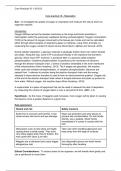
Aim : to investigate the uptake of oxygen in respiration and measure the rate at which an
organism respires
Introduction
Oxygen diffuses across the alveolar membrane in the lungs and binds reversibly to
haemoglobin within the pulmonary capillaries forming oxyhaemoglobin. Oxygen consumption
(VO2) is the amount of oxygen consumed by the tissues per minute and can be calculated
either through direct analysis of respiratory gases or indirectly, using Fick's principle, by
measuring the oxygen content of mixed venous blood (Dunn, Mythen and Grocott, 2016).
During cellular respiration, a glucose molecule is gradually broken down into carbon dioxide
and water. Along the way, some ATP is produced directly in the reactions that transform
glucose. Much more ATP, however, is produced later in a process called oxidative
phosphorylation. Oxidative phosphorylation is powered by the movement of electrons
through the electron transport chain, a series of proteins embedded in the inner membrane
of the mitochondrion (Khan Academy, 2015). The 4 stages are glycolysis, link reaction,
krebs cycle and oxidative phosphorylation. In oxidative phosphorylation, electrons are
passed from 1 molecule to another along the electron transport chain and the energy
released in these electron transfers is used to form an electrochemical gradient. Oxygen sits
at the end of the electron transport chain where it accepts electrons and picks up protons to
form water. Without oxygen, the reaction stops (Khan Academy, 2016).
A respirometer is a piece of equipment that can be used to measure the rate of respiration
by measuring the volume of oxygen taken in over a set period of time. (BBC, n.d).
Hypothesis : As the mass of maggots used increases, more oxygen will be taken in causing
the liquid to move a greater distance in a given time
Risk assessment
Hazard and risk Safety measure
Soda lime is corrosive and harmful. It can Wear eye protection and wear gloves to
cause severe skin burns and eye damage prevent skin contamination. Do not handle
directly, use a spatula. Wash hands
immediately if it comes in contact with the
skin
Glasswares such as test tubes are fragile Take care when handling glassware and
causing them to break easily. They have keep away from the edge of surfaces.
very sharp edges when they’re broken, this
may cause skin injury (Low risk)
Maggots are a biohazard and cause trigger Use disposable gloves and wash hands
allergies(low risk) thoroughly after handling
Ethical Considerations : To reduce stress to the organism, we will handle them gently and
use a paintbrush to move them
, Core Practical 16- 13/01/23
Variables
Independent variable : the mass of maggots used
Dependent variable : the rate of oxygen uptake
Control variables :
- Time - recordings of volume will be done every 10 seconds
- Temperature – could be controlled via a water bath or monitored to check for any
change as changing temperature would affect oxygen consumption
- The mass of soda lime - using a balance, weigh out 2g of soda lime
- Activity and age of organism - use maggots of the same age and length
- Use the same species of maggots as there may be variations in the metabolic rates
in organisms of different species
- Acclimatise the maggots to their new environment, wait 1 minute after moving them
into the respirometer
Control : Experiments can be carried out with plastic beads in the tube as a negative control
(as plastic beads shouldn’t respire).
Equipment
● Respirometer -
● 5g of actively respiring organism (maggots) - take up oxygen in respiration
● Soda lime - absorbs CO2 released in respiration from the living organisms being
studied
● Coloured liquid - allows changes in volume to be seen
● Dropping pipette - to place the coloured liquid into the capillary tube
● Fine permanent marker pen - to mark the changes in volume
● Solvent - to remove the marker
● Wire mesh - prevent organisms being studied coming into contact with soda lime
which is harmful
● Stopwatch - to record the time for the oxygen to be produced to be able to calculate
rate
Method
Core practical 16 - Respiration
Aim : to investigate the uptake of oxygen in respiration and measure the rate at which an
organism respires
Introduction
Oxygen diffuses across the alveolar membrane in the lungs and binds reversibly to
haemoglobin within the pulmonary capillaries forming oxyhaemoglobin. Oxygen consumption
(VO2) is the amount of oxygen consumed by the tissues per minute and can be calculated
either through direct analysis of respiratory gases or indirectly, using Fick's principle, by
measuring the oxygen content of mixed venous blood (Dunn, Mythen and Grocott, 2016).
During cellular respiration, a glucose molecule is gradually broken down into carbon dioxide
and water. Along the way, some ATP is produced directly in the reactions that transform
glucose. Much more ATP, however, is produced later in a process called oxidative
phosphorylation. Oxidative phosphorylation is powered by the movement of electrons
through the electron transport chain, a series of proteins embedded in the inner membrane
of the mitochondrion (Khan Academy, 2015). The 4 stages are glycolysis, link reaction,
krebs cycle and oxidative phosphorylation. In oxidative phosphorylation, electrons are
passed from 1 molecule to another along the electron transport chain and the energy
released in these electron transfers is used to form an electrochemical gradient. Oxygen sits
at the end of the electron transport chain where it accepts electrons and picks up protons to
form water. Without oxygen, the reaction stops (Khan Academy, 2016).
A respirometer is a piece of equipment that can be used to measure the rate of respiration
by measuring the volume of oxygen taken in over a set period of time. (BBC, n.d).
Hypothesis : As the mass of maggots used increases, more oxygen will be taken in causing
the liquid to move a greater distance in a given time
Risk assessment
Hazard and risk Safety measure
Soda lime is corrosive and harmful. It can Wear eye protection and wear gloves to
cause severe skin burns and eye damage prevent skin contamination. Do not handle
directly, use a spatula. Wash hands
immediately if it comes in contact with the
skin
Glasswares such as test tubes are fragile Take care when handling glassware and
causing them to break easily. They have keep away from the edge of surfaces.
very sharp edges when they’re broken, this
may cause skin injury (Low risk)
Maggots are a biohazard and cause trigger Use disposable gloves and wash hands
allergies(low risk) thoroughly after handling
Ethical Considerations : To reduce stress to the organism, we will handle them gently and
use a paintbrush to move them
, Core Practical 16- 13/01/23
Variables
Independent variable : the mass of maggots used
Dependent variable : the rate of oxygen uptake
Control variables :
- Time - recordings of volume will be done every 10 seconds
- Temperature – could be controlled via a water bath or monitored to check for any
change as changing temperature would affect oxygen consumption
- The mass of soda lime - using a balance, weigh out 2g of soda lime
- Activity and age of organism - use maggots of the same age and length
- Use the same species of maggots as there may be variations in the metabolic rates
in organisms of different species
- Acclimatise the maggots to their new environment, wait 1 minute after moving them
into the respirometer
Control : Experiments can be carried out with plastic beads in the tube as a negative control
(as plastic beads shouldn’t respire).
Equipment
● Respirometer -
● 5g of actively respiring organism (maggots) - take up oxygen in respiration
● Soda lime - absorbs CO2 released in respiration from the living organisms being
studied
● Coloured liquid - allows changes in volume to be seen
● Dropping pipette - to place the coloured liquid into the capillary tube
● Fine permanent marker pen - to mark the changes in volume
● Solvent - to remove the marker
● Wire mesh - prevent organisms being studied coming into contact with soda lime
which is harmful
● Stopwatch - to record the time for the oxygen to be produced to be able to calculate
rate
Method