100% satisfaction guarantee Immediately available after payment Both online and in PDF No strings attached 4.2 TrustPilot
logo-home
Exam (elaborations)

MAP Knowledge Test Guaranteed Success

Rating
-
Sold
-
Pages
15
Grade
A+
Uploaded on
20-07-2024
Written in
2023/2024

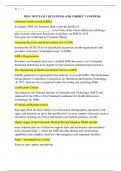
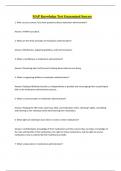
MAP Knowledge Test Guaranteed Success 1. Who can you contact if you have questions about medication administration? Answer: A MAP Consultant. 2. What are the three principles of medication administration? Answer: Mindfulness, Supporting Abilities, and Communication. 3. What is mindfulness in medication administration? Answer: Remaining alert and focused, thinking about what you are doing. 4. What is supporting abilities in medication administration? Answer: Helping individuals function as independently as possible and encouraging them to participate fully in the medication administration process. 5. What is communication in medication administration? Answer: Reading the HCP order, pharmacy label, and medication sheet, checking 5 rights, and talking and listening to the individual while administering their medication. 6. What rights do individuals have when it comes to their medications? Answer: Confidentiality, knowledge of their medications and the reasons they are taken, knowledge of the risks and benefits of the medications, the right to refuse medications, and the right to receive medications only as ordered by their healthcare provider. 7. What is observation in medication administration? Answer: The process of watching someone carefully to obtain information. 8. What is objective observation? Answer: Factual information that can be seen, heard, felt, smelled, or measured. 9. What is subjective observation? Answer: Observations that come from working with an individual who communicates how they are feeling. 10. What is reporting in medication administration? Answer: Giving spoken or written information about something observed or told. 11. When should you report a change in an individual's condition? Answer: Immediately after observing the change, without delay. 12. Who should you call in case of an emergency? Answer: 911 or Poison Control. 13. Who should you contact if an occurrence (error) happens when administering medication? Answer: A MAP Consultant. 14. Who should you contact if you have questions about a medication or need clarification on a HCP order? Answer: A Prescribing Healthcare Provider. 15. Who should you contact if there is a problem with a medication or you need assistance with administration? Answer: Your Supervisor. 16. What is a medication progress note? Answer: A note that includes date, time, medication, dose, given/not given/refused, reason (for giving/not giving), results and/or response, and staff signature. 17. How should you document errors in medication administration? Answer: Draw a single line through the mistake, write "error," write initials, and write what you meant to write. 18. What is brand name medication? Answer: Medication created and made by a specific pharmaceutical company that they named. 19. What is generic medication? Answer: Medication known by its chemical name and manufactured by many different pharmaceutical companies (less expensive). 20. What does IC stand for? Answer: Interchange, which means the generic name medication was supplied in place of the brand name medication. Dietary Supplements ️Products that contain dietary ingredients such as vitamins, minerals, herbs, or other substances. May be purchased from a pharmacy without a prescription from HCP; however, MAP requires that all these meds be labeled by the pharmacy, which means that HCP must write a prescription. Requirements include: HCP order, packaged by pharm, labeled by pharm, secured in locked area, tracked using Med Ordering/Receiving log, Med Sheet, Transfer Document). E.g. multivitamins, fish oil. Nutritional Supplements ️'Conventional' food items such as Ensure, gastric tube feedings, or instant breakfast.; not medications and do not fall under MAP. Desired Effect ️When a medication does exactly what it was intended to do. No Effect Noted ️When a medication is taken for a specific reason and the symptoms continue. Can occur for two reasons: 1) body will not respond to med and a different med will need to be ordered; 2) the med has not had enough time to work. Side Effects ️Results from a med that were not wanted or intended even if the desired effect is achieved. Adverse Responses (Severe Side Effects) ️Severe undesired results from a medication; things to observe for include: allergic reaction, anaphylactic reaction, paradoxical reaction (when the response the pt experiences is the opposite of what the med was intended to produce), toxicity (when med builds up in the body to the point where the body cannot handle it any more). Medication Interaction ️A mixing of medications in the body, which will either increase or decrease the effects and/or side effects of one or both of the meds; the more meds a person takes the greater the possibility (can also occur with dietary supplements). Note: substances such as alcohol, nicotine, and caffeine have the ability to interact/interfere with absorption in the body. I must inform HCP if any of the pts I support use these substances. Sensitivity to Medication ️The phenomenon in which each person responds differently to the same medication. Factors include: age, weight, general health, medical history, use of other meds/dietary supplements. Preparing Pt for an HCP Appointment ️1. Tell pt date and time 2. Discuss what will happen 3. Follow any instructions ordered to prep for visit 4. Think about: items to keep pt occupied, encouraging pt to wear comfortable clothes Be sure to have: 1. Pt insurance card 2. Copy of current medication sheets or list of medications 3. HCP Encounter/Consult/Order Form 4. Driving directions 5. Money for parking, gas, food/drink 6. Provider on-call info 7. Family/Guardian info 8. Name of pharmacy/phone # 9. Charged phone Pt Appointment with HCP ️1. Assist pt if needed 2. Advocate, encourage participation and support abilities 3. Obtain the written results and recommendations from the apt including HCP Encounter/Consult/Order form After Appointment with HCP ️1. Ensure pharmacy received prescription 2. Pick up new meds or check on delivery 3. Bring back all forms, any prescriptions, HCP orders, and the next apt card to give to appropriate person 4. Transcribe all medication orders onto the med admin sheet (Post and Verify all orders) 5. Secure the medication 6. Document the visit 7. Communicate changes to all staff Medication Reconciliation ️The process of comparing an individual's new medication orders to all of the medication orders that were in place prior to the new orders (must be done during every transition of care). HCP Order by Telephone ️1. Record the order word-for-word on HCP Telephone Order form 2. Read back the info given to me to confirm 3. Ask for spelling 4. Draw lines through any blank spaces 5. Make sure HCP signs original order within 72 hours (I can administer medication while waiting for the signature in the first 72 hours) 6. Provide pharm contact info to the HCP

Show more Read less
Institution
Course


Whoops! We can’t load your doc right now. Try again or contact support.

Written for

Institution
Study
Course

Document information

Uploaded on
July 20, 2024
Number of pages
15
Written in
2023/2024
Type
Exam (elaborations)
Contains
Questions & answers

Subjects

Content preview

MAP Knowledge Test Guaranteed Success
1. Who can you contact if you have questions about medication administration?


Answer: A MAP Consultant.


2. What are the three principles of medication administration?


Answer: Mindfulness, Supporting Abilities, and Communication.


3. What is mindfulness in medication administration?


Answer: Remaining alert and focused, thinking about what you are doing.


4. What is supporting abilities in medication administration?


Answer: Helping individuals function as independently as possible and encouraging them to participate
fully in the medication administration process.


5. What is communication in medication administration?


Answer: Reading the HCP order, pharmacy label, and medication sheet, checking 5 rights, and talking
and listening to the individual while administering their medication.


6. What rights do individuals have when it comes to their medications?


Answer: Confidentiality, knowledge of their medications and the reasons they are taken, knowledge of
the risks and benefits of the medications, the right to refuse medications, and the right to receive
medications only as ordered by their healthcare provider.


7. What is observation in medication administration?

, Answer: The process of watching someone carefully to obtain information.


8. What is objective observation?


Answer: Factual information that can be seen, heard, felt, smelled, or measured.


9. What is subjective observation?


Answer: Observations that come from working with an individual who communicates how they are
feeling.


10. What is reporting in medication administration?


Answer: Giving spoken or written information about something observed or told.


11. When should you report a change in an individual's condition?


Answer: Immediately after observing the change, without delay.


12. Who should you call in case of an emergency?


Answer: 911 or Poison Control.


13. Who should you contact if an occurrence (error) happens when administering medication?


Answer: A MAP Consultant.
$9.96
Get access to the full document:

100% satisfaction guarantee
Immediately available after payment
Both online and in PDF
No strings attached


Also available in package deal

Get to know the seller

Seller avatar
Reputation scores are based on the amount of documents a seller has sold for a fee and the reviews they have received for those documents. There are three levels: Bronze, Silver and Gold. The better the reputation, the more your can rely on the quality of the sellers work.
bestscores1 Kent State University
Follow You need to be logged in order to follow users or courses
Sold
12
Member since
1 year
Number of followers
0
Documents
1369
Last sold
5 days ago
ReadEase

Welcome to ReadEase, your ultimate resource for exam preparation. At ReadEase, we specialize in providing comprehensive study materials and resources to help you excel in your exams. Whether you're preparing for standardized tests, professional certifications, or academic assessments, our finely curated collection covers a wide range of subjects and levels. From practice tests and study guides to expert tips and strategies, we're here to support your journey to success. ReadEase is committed to availing high-quality educational content, helping you thrive and achieve your academic and professional goals. Have any questions? We're just a message away.

Read more Read less
4.3

4 reviews

5
2
4
1
3
1
2
0
1
0

Recently viewed by you

Why students choose Stuvia

Created by fellow students, verified by reviews

Quality you can trust: written by students who passed their tests and reviewed by others who've used these notes.

Didn't get what you expected? Choose another document

No worries! You can instantly pick a different document that better fits what you're looking for.

Pay as you like, start learning right away

No subscription, no commitments. Pay the way you're used to via credit card and download your PDF document instantly.

Student with book image

“Bought, downloaded, and aced it. It really can be that simple.”

Alisha Student

Frequently asked questions