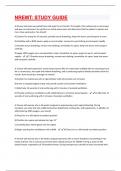
NREMT: STUDY GUIDE LATEST QUESTIONS WITH 100% SOLVED SOLUTIONS!!
A 20-year-old male was pulled from cold water by his friends. The length of his submersion is not known and was not witnessed. You perform an initial assessment and determine that the patient is apneic and has a slow, weak pulse. You should: A) Suction his airway for 30 seconds, provide rescue breathing, keep him warm, and transport at once B) Ventilate with a BVM device, apply a cervical collar, remove his wet clothing and transport rapidly C) Provide rescue breathing, remove wet clothing, immobilize his spine, keep him warm and transport carefully D) apply 100% oxygen via a nonrebreather mask, immobilize his spine, keep him warm, and transport rapidly - C) Provide rescue breathing, remove wet clothing, immobilize his spine, keep him warm and transport carefully A 23-year-old male experience severe head trauma after his motorcycle collided with an oncoming truck. He is unconscious, has rapid and shallow breathing, and is producing copious bloody secretions from his mouth. How should you manage his airway? A) Suction his oropharynx with a rigid catheter until all secretion are removed B) Insert a nasopharyngeal airway and provide suction and assisted ventilations C) Altertnate 15 seconds of oral suctioning with 2 minutes of assisted ventilation D) Provide continuous ventilations with a BVM device to minimize tissue hypoxia - C) Alternate 15 seconds of oral suctioning with 2 minutes of assisted ventilation A 33-year-old woman who is 36 weeks' pregnant is experiencing scant vaginal bleeding. During transport, you note that she suddenly becomes diaphoretic, tachycardic, and hypotensive. In addition to administering 100% oxygen, you should: A) Place her in a left lateral recumbent position B) Position her supine and elevate her legs 12" C) Carefully place sterile gauze into her vagina D) Begin assisting her ventilations with a BVM - A) Place her in a left lateral recumbent position A 35-year-old woman who is 30 weeks' pregnant presents with a severe headache and swelling in her hands and feet. She is conscious and alert with a blood pressure of 148/94 mm Hg, a pulse of 100 beats/minute, respirations of 24 breaths/minute. During transport you should be most concerned with:A) Her prematurely delivering the baby B) The possibility that she may experience a seizure C) Using your lights and siren to clear the traffic D) Her hypertension causing a hemorrhagic stroke - B) The possibility that she may experience a seizure A 37-year-old female with a history of diabetes presents with excessive urination and weakness of 2 days' duration. You apply 100% oxygen and assess her blood glucose level, which reads 320 mg/dL. If the patient's condition is not promptly treated, she will MOST likely develop A) Severe insulin shock B) Acidosis and dehydration C) Complete renal failure D) hypoxia and overhydration - B) Acidosis and dehydration
Written for
- Institution
- NREMT
- Course
- NREMT
Document information
- Uploaded on
- July 19, 2024
- Number of pages
- 20
- Written in
- 2023/2024
- Type
- Exam (elaborations)
- Contains
- Questions & answers
Subjects

Also available in package deal